188 books match the query 'Middle Eastern' and 3 start with n
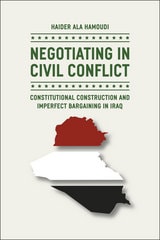
cover of Negotiating in Civil Conflict: Constitutional Construction and Imperfect Bargaining in Iraq

Negotiating in Civil Conflict

Constitutional Construction and Imperfect Bargaining in Iraq

Haider Ala Hamoudi

University of Chicago Press, 2013
In 2005, Iraq drafted its first constitution and held the country’s first democratic election in more than fifty years. Even under ideal conditions, drafting a constitution can be a prolonged process marked by contentious debate, and conditions in Iraq are far from ideal: Iraq has long been racked by ethnic and sectarian conflict, which intensified following the American invasion and continues today. This severe division, which often erupted into violence, would not seem to bode well for the fate of democracy. So how is it that Iraq was able to surmount its sectarianism to draft a constitution that speaks to the conflicting and largely incompatible ideological view of the Sunnis, Shi’ah, and Kurds?
 
Haider Ala Hamoudi served in 2009 as an adviser to Iraq’s Constitutional Review Committee, and he argues here that the terms of the Iraqi Constitution are sufficiently capacious to be interpreted in a variety of ways, allowing it to appeal to the country’s three main sects despite their deep disagreements. While some say that this ambiguity avoids the challenging compromises that ultimately must be made if the state is to survive, Hamoudi maintains that to force these compromises on issues of central importance to ethnic and sectarian identity would almost certainly result in the imposition of one group’s views on the others. Drawing on the original negotiating documents, he shows that this feature of the Constitution was not an act of evasion, as is sometimes thought, but a mark of its drafters’ awareness in recognizing the need to permit the groups the time necessary to develop their own methods of working with one another over time.

[more]
cover of No Rattling of Sabers: An Anthology of Israeli War Poetry

No Rattling of Sabers

An Anthology of Israeli War Poetry

Translation and introduction by Esther Raizen

University of Texas Press, 1995

<p>In this collection, Esther Raizen explores the significance and value of Hebrew poetry written in response to the wars in which Israel was involved during the last fifty years. The anthology includes the works of many poets, some as well known as Nathan Altherman and Yehudah Amichai and others less known. The poems, presented in both English and Hebrew, depict war as viewed by the soldier, as reflected upon by civilians, and as a force giving rise to the creation of poetry.</p>
<p>Raizen explores in an introductory essay the issue of whether poetry written with a defined political message and in the context of certain historical events can function adequately on the aesthetic level. She also tracks the changes in the characteristics of Israeli war poetry from 1948 to 1991, beginning with the glorified patriotism expected in the 1930s-1940s and progressing to the critical ideas in the later years, during which poetry is characterized by understatement and cynicism.</p>
[more]
cover of Nonsovereign Styles: Rhythms of Relation in Persian Modernism

Nonsovereign Styles

Rhythms of Relation in Persian Modernism

Maziyar Faridi

Northwestern University Press, 2027

Exploring motifs in modern Persian literature and Iranian film that demand new forms of relationality from politics

Assembling an understudied corpus of literary and filmic texts at the intersection of Persian and global modernism, Maziyar Faridi traces a constellation of aesthetic motifs that resist colonially imported constructs of political relationality in order to argue for an intermedial poetics of nonsovereignty. Moving from the poetry of Nima Yushij and Ahmad Shamlou to the ciné-poems of Férydoun Rahnéma and Forugh Farrokhzad, Nonsovereign Styles charts the transformation of poetic language through its exposure to minor ethnic languages and the rhetorics of English, French, and Spanish modernist poetry and alternative film. Faridi centers two key motifs: ezterāb, a trembling rhythm in which the self encounters itself as difference, and mehr, an aporetic mode of relation beyond identity, community, and sovereignty. Against the state’s project of ethnonationalism, these motifs form a poetics that is both transhistorical and transnational, producing a translational link between Iranian and internationalist poets, such as Langston Hughes and Paul Éluard. By situating Persian modernism within the broader map of global modernism, this book invites us to consider what reading these texts can teach us today about styles of relating to the world and the very sense of the political.

[more]