Results by title
618 books match the query 'Motion pictures' and 15 start with n
National Identities and Post-Americanist Narratives
Donald E. Pease
Duke University Press, 1994
This volume, originally published as a special issue of bounrary 2, focuses on the process of assembling and dismantling the American national narrative(s), sketching its inception and demolition. The contributors examine various cultural, political, and historical sources--colonial literature, mass movements, epidemics of disease, mass spectacle, transnational corporations, super-weapons, popular magazines, literary texts--out of which this narrative was constructed, and propose different understandings of nationality and identity following in its wake.
Contributors. Jonathan Arac, Lauren Berlant, Robert J. Corber, Elizabeth Freeman, Kathryn V. Lingberg, Jack Matthews, Alan Nadel, Patrick O'Donnell, Daniel O'Hara, Donald E. Pease, Ross Posnock, John Carlos Rowe, Rob Wilson
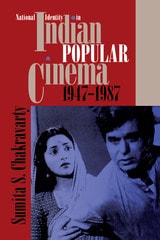
National Identity in Indian Popular Cinema, 1947-1987
By Sumita S. Chakravarty
University of Texas Press, 1993
Although Indian popular cinema has a long history and is familiar to audiences around the world, it has rarely been systematically studied. This book offers the first detailed account of the popular film as it has grown and changed during the tumultuous decades of Indian nationhood. The study focuses on the cinema’s characteristic forms, its range of meanings and pleasures, and, above all, its ideological construction of Indian national identity.
Informed by theoretical developments in film theory, cultural studies, postcolonial discourse, and “Third World” cinema, the book identifies the major genres and movements within Bombay cinema since Independence and uses them to enter larger cultural debates about questions of identity, authenticity, citizenship, and collectivity. Chakravarty examines numerous films of the period, including Guide (Vijay Anand, 1965), Shri 420 [The gentleman cheat] (Raj Kapoor, 1955), and Bhumika [The role] (Shyam Benegal, 1977). She shows how “imperso-nation,” played out in masquerade and disguise, has characterized the representation of national identity in popular films, so that concerns and conflicts over class, communal, and regional differences are obsessively evoked, explored, and neutralized.
These findings will be of interest to film and area specialists, as well as general readers in film studies.

Nazi Film Melodrama
Laura Heins
University of Illinois Press, 2013
Near Black
White-to-Black Passing in American CultureBaz Dreisinger
University of Massachusetts Press, 2008
In the United States, the notion of racial “passing” is usually associated with blacks and other minorities who seek to present themselves as part of the white majority. Yet as Baz Dreisinger demonstrates in this fascinating study, another form of this phenomenon also occurs, if less frequently, in American culture: cases in which legally white individuals are imagined, by themselves or by others, as passing for black.
In Near Black, Dreisinger explores the oft-ignored history of what she calls “reverse racial passing” by looking at a broad spectrum of short stories, novels, films, autobiographies, and pop-culture discourse that depict whites passing for black. The protagonists of these narratives, she shows, span centuries and cross contexts, from slavery to civil rights, jazz to rock to hip-hop. Tracing their role from the 1830s to the present day, Dreisinger argues that central to the enterprise of reverse passing are ideas about proximity. Because “blackness,” so to speak, is imagined as transmittable, proximity to blackness is invested with the power to turn whites black: those who are literally “near black” become metaphorically “near black.”
While this concept first arose during Reconstruction in the context of white anxieties about miscegenation, it was revised by later white passers for whom proximity to blackness became an authenticating badge. As Dreisinger shows, some white-to-black passers pass via self-identification. Jazz musician Mezz Mezzrow, for example, claimed that living among blacks and playing jazz had literally darkened his skin. Others are taken for black by a given community for a period of time. This was the experience of Jewish critic Waldo Frank during his travels with Jean Toomer, as well as that of disc jockey Hoss Allen, master of R&B slang at Nashville's famed WLAC radio. For journalists John Howard Griffin and Grace Halsell, passing was a deliberate and fleeting experiment, while for Mark Twain's fictional white slave in Pudd'nhead Wilson, it is a near-permanent and accidental occurrence.
Whether understood as a function of proximity or behavior, skin color or cultural heritage, self-definition or the perception of others, what all these variants of “reverse passing” demonstrate, according to Dreisinger, is that the lines defining racial identity in American culture are not only blurred but subject to change.
Negative Life
The Cinema of ExtinctionSteven Swarbrick and Jean-Thomas Tremblay
Northwestern University Press, 2024
How films help us understand the inevitable death of Earth and humanity
Negative Life: The Cinema of Extinction brings cinema studies, queer theory, and psychoanalysis into novel configuration around the concept of negative life, a sundering of human and nonhuman relations. Engaging a philosophical and cinematic corpus that rejects the pastoralism of “entanglement” or “enmeshment,” Steven Swarbrick and Jean-Thomas Tremblay counter ecocritical pieties and cut a new path for theory. They examine films by Julian Pölsler, Kelly Reichardt, Lee Isaac Chung, Mahesh Mathai, Paul Schrader, and others that exemplify the existential contradictions currently intensifying amid the sixth mass extinction. Each case study testifies formally and thematically to negative life as a structural condition of thought and film. Together, the cases reveal the unlivable dimension of life and art, where form, desire, and nonbelonging tarry with the future-oriented promise of ecostudies—where all that lives connects. Negative Life militates against this promise, showing that faith in connection is a dead end.
New African Cinema
Orlando, Valérie K
Rutgers University Press, 2017
Orlando illuminates the diverse themes evident in the works of filmmakers such as Ousmane Sembène’s Ceddo (Senegal, 1977), Sarah Maldoror’s Sambizanga (Angola, 1972), Assia Djebar’s La Nouba des femmes de Mont Chenoua (The Circle of women of Mount Chenoua, Algeria, 1978), Zézé Gamboa’s The Hero (Angola, 2004) and Abderrahmane Sissako’s Timbuktu (Mauritania, 2014), among others. Orlando also considers the influence of major African film schools and their traditions, as well as European and American influences on the marketing and distribution of African film. For those familiar with the polemics of African film, or new to them, Orlando offers a cogent analytical approach that is engaging.

New Directions in Israeli Media
Film, Television, and Digital ContentEdited by Yaron Peleg, Eran Kaplan, and Ido Rosen
University of Texas Press, 2025
A comprehensive analysis of the major trends and developments in contemporary Israeli media.
In the twenty-first century, Israeli filmmaking has transformed from a localized industry into a globally recognized and diverse national cinema, its filmmakers gaining prominence internationally and introducing new themes, aesthetics, and voices to the scene. At the same time, Israeli television shows have emerged as a dominant force, propelled by the spread of streaming. Through the rise of online content creation and consumption, especially in the 2010s, new voices have revolutionized the creative landscape.
With Israel’s position at the cutting edge of technology and virtual platforms, Israeli media has seen a boom, winning prizes at international film festivals and adapting shows like Euphoria, Homeland, and Fauda for wider audiences. In New Directions in Israeli Media, thirteen contributors detail the shifting dynamics of Israeli cinema, television, and online content in the digital age, exploring how globalization, technological advances, and changing audience preferences are reshaping creative industries. Editors Yaron Peleg, Eran Kaplan, and Ido Rosen have assembled a volume that prompts critical reflection on the intersection of art, technology, and culture in a rapidly changing media landscape.
New Israeli Horror
Local Cinema, Global GenreOlga Gershenson
Rutgers University Press, 2024
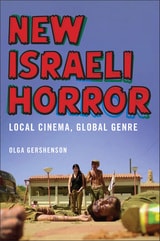
Before 2010, there were no Israeli horror films. Then distinctly Israeli serial killers, zombies, vampires, and ghosts invaded local screens. The next decade saw a blossoming of the genre by young Israeli filmmakers. New Israeli Horror is the first book to tell their story. Through in-depth analysis, engaging storytelling, and interviews with the filmmakers, Olga Gershenson explores their films from inception to reception. She shows how these films challenge traditional representations of Israel and its people, while also appealing to audiences around the world.
Gershenson introduces an innovative conceptual framework of adaptation, which explains how filmmakers adapt global genre tropes to local reality. It illuminates the ways in which Israeli horror borrows and diverges from its international models. New Israeli Horror offers an exciting and original contribution to our understanding of both Israeli cinema and the horror genre.
A companion website to this book is available at https://websites.umass.edu/newisraelihorror/
Book trailer: https://youtu.be/oVJsD0QCORw (https://youtu.be/oVJsD0QCORw)
New Maricón Cinema
Outing Latin American FilmBy Vinodh Venkatesh
University of Texas Press, 2016
Recent critically and commercially acclaimed Latin American films such as XXY, Contracorriente, and Plan B create an affective and bodily connection with viewers that elicits in them an emotive and empathic relationship with queer identities. Referring to these films as New Maricón Cinema, Vinodh Venkatesh argues that they represent a distinct break from what he terms Maricón Cinema, or a cinema that deals with sex and gender difference through an ethically and visually disaffected position, exemplified in films such as Fresa y chocolate, No se lo digas a nadie, and El lugar sin límites.
Covering feature films from Argentina, Chile, Cuba, Ecuador, Mexico, Peru, the United States, and Venezuela, New Maricón Cinema is the first study to contextualize and analyze recent homo-/trans-/intersexed-themed cinema in Latin America within a broader historical and aesthetic genealogy. Working with theories of affect, circulation, and orientations, Venkatesh examines key scenes in the work of auteurs such as Marco Berger, Javier Fuentes-León, and Julia Solomonoff and in films including Antes que anochezca and Y tu mamá también to show how their use of an affective poetics situates and regenerates viewers in an ethically productive cinematic space. He further demonstrates that New Maricón Cinema has encouraged the production of “gay friendly” commercial films for popular audiences, which reflects wider sociocultural changes regarding gender difference and civil rights that are occurring in Latin America.

New Zealand Cinema
Interpreting the PastEdited by Alistair Fox, Barry Keith Grant, and Hilary Radner
Intellect Books, 2011
New Zealand has produced one of the world’s most vibrant film cultures, a reflection of the country’s evolving history and the energy and resourcefulness of its people. From early silent features like The Te Kooti Trail to recent films such as River Queen, this book examines the role of the cinema of New Zealand in building a shared sense of national identity. The works of key directors, including Peter Jackson, Jane Campion, and Vincent Ward, are here introduced in a new light, and select films are given in-depth coverage. Among the most informative accounts of New Zealand’s fascinating national cinema, this will be a must for film scholars around the globe.
Nicaragua and the Politics of Utopia
Development and Culture in the Modern StateDaniel Chavez
Vanderbilt University Press, 2015
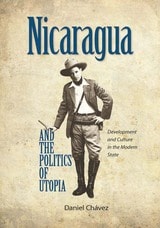
For each era, Chavez reveals the ways Nicaraguan popular culture adapted and interpreted the new political order, shaping, critiquing, or amplifying the regime's message of stability and prosperity for the people. These tactics of interpretation, otherwise known as meaning-making, became all-important for the Nicaraguan people, as they opposed the autocracy of Somocismo, or complemented the Sandinistas, or struggled to find their place in the Neoliberal era. In every case, Chavez shows the reflective nature of cultural production and its pursuit of utopian idealism.
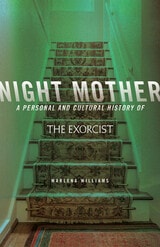
Night Mother
A Personal and Cultural History of The ExorcistMarlena Williams
The Ohio State University Press, 2023
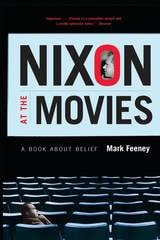
Nixon at the Movies
A Book about BeliefMark Feeney
University of Chicago Press, 2004
Nixon at the Movies takes a new and often revelatory approach to looking at Nixon's career—and Hollywood's. From the obvious (All the President's Men) to the less so (Elvis Presley movies and Nixon's relationship to '60s youth culture) to several onscreen "alternate" Nixons (Fred MacMurray in Double Indemnity, Tony Curtis in The Sweet Smell of Success, Gene Hackman in The Conversation), Feeney sees aspects of Nixon's character, and the nation's, refracted and reimagined in film. Conversely, Feeney argues that Nixon can help us see the movies in a new light, making a strong case for Nixon as the movies' tutelary deity during the early '70s, playing a role in Hollywood's Silver Age comparable to FDR's during its Golden Age.
Stylishly written and bracingly eclectic, Nixon at the Movies draws on biography, politics, cultural history, and film criticism to show just how deeply in the twentieth-century American grain lies the pair of seemingly incongruous nouns in its title. As Nixon once remarked to Garry Wills: "Isn't that a hell of a thing, that the fate of a great country can depend on camera angles?"
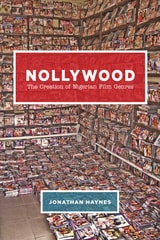
Nollywood
The Creation of Nigerian Film GenresJonathan Haynes
University of Chicago Press, 2016
Haynes describes the major Nigerian film genres and how they relate to Nigerian society—its values, desires, anxieties, and social tensions—as the country and its movies have developed together over the turbulent past two decades. As he shows, Nollywood is a form of popular culture; it produces a flood of stories, repeating the ones that mean the most to its broad audience. He interprets these generic stories and the cast of mythic figures within them: the long-suffering wives, the business tricksters, the Bible-wielding pastors, the kings in their traditional regalia, the glamorous young professionals, the emigrants stranded in New York or London, and all the rest. Based on more than twenty years of research, Haynes’s survey of Nollywood’s history and genres is unprecedented in scope, while his book also vividly describes landmark films, leading directors, and the complex character of this major branch of world cinema.
Novel and Film
Essays in Two GenresBruce Morrissette
University of Chicago Press, 1985
The influential essays collected in Novel and Film display a wide range of critical and analytic approaches to the narrative aspects of the two genres. For all the variety of their subjects, from constructional forms such as interior duplication and game play to intertextual parallels with mathematics and topology, these essays together define a unified critical perspective, one that has brought fresh precision to the analysis of narrative techniques and that continues to raise questions of prime importance to contemporary fiction. Included is a complete bibliography of Morrissette's scholarly works.