Results by title
58 books match the query 'Navajo Indians' and 10 start with n
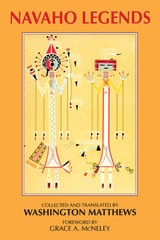
Navaho Legends
Washington Matthews
University of Utah Press, 1994
Navaho Legends is one of the earliest collections of Navajo oral traditions in English, and still the best. Originally published in 1897, Washington Matthews’s sensitive translation contains extensive versions of the Original Legend and two other tales. These richly detailed legends remain among the most complete sources of Navajo cultural, ritual, and ceremonial information.
This edition is fully faithful to the original, containing Matthews’s introduction, extensive notes, interlinear prayer translations, musical notations, and index, plus a new note on orthography by Robert Young.
Navajo Courts and Navajo Common Law
A Tradition of Tribal Self-GovernanceRaymond D. Austin
University of Minnesota Press, 2009
The Navajo Nation court system is the largest and most established tribal legal system in the world. Since the landmark 1959 U.S. Supreme Court decision in Williams v. Lee that affirmed tribal court authority over reservation-based claims, the Navajo Nation has been at the vanguard of a far-reaching, transformative jurisprudential movement among Indian tribes in North America and indigenous peoples around the world to retrieve and use traditional values to address contemporary legal issues.
A justice on the Navajo Nation Supreme Court for sixteen years, Justice Raymond D. Austin has been deeply involved in the movement to develop tribal courts and tribal law as effective means of modern self-government. He has written foundational opinions that have established Navajo common law and, throughout his legal career, has recognized the benefit of tribal customs and traditions as tools of restorative justice.
In Navajo Courts and Navajo Common Law, Justice Austin considers the history and implications of how the Navajo Nation courts apply foundational Navajo doctrines to modern legal issues. He explains key Navajo foundational concepts like Hózhó (harmony), K'é (peacefulness and solidarity), and K'éí (kinship) both within the Navajo cultural context and, using the case method of legal analysis, as they are adapted and applied by Navajo judges in virtually every important area of legal life in the tribe.
In addition to detailed case studies, Justice Austin provides a broad view of tribal law, documenting the development of tribal courts as important institutions of indigenous self-governance and outlining how other indigenous peoples, both in North America and elsewhere around the world, can draw on traditional precepts to achieve self-determination and self-government, solve community problems, and control their own futures.

Navajo Kinship and Marriage
Gary Witherspoon
University of Chicago Press, 1996
"Witherspoon . . . clarifies problems pertaining to Navajo kinship and marriage through his skillful use of the concepts of cultural and social systems. He adds to the body of knowledge on the Navajo by his own fieldwork and unique life experiences." —R. S. Freed, Sociology
"Not only can Witherspoon's book on Navajo kinship help unravel the web for the Anglo willing to concentrate, it can also bring to Navajo readers an understanding of why Anglos don't understand Navajo family relationships." —Joanne Reuter, Navajo Times
"This is an important work on Navajo kinship and marriage." —David F. Aberle, American Anthropology
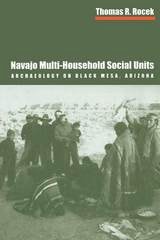
Navajo Multi-Household Social Units
Archaeology on Black Mesa, ArizonaThomas R. Rocek
University of Arizona Press, 1995
Rocek explores a neglected but major source of social flexibility in these societies. While many studies have focused on household and community-level organization, few have examined the flexible, intermediate-sized, "middle-level" cooperative units that bind small groups of households together. Middle-level units, says the author, must be recognized as important sources of social flexibility in many such cultural contexts. Futhermore, attention to middle-level units is critical for understanding household or community-level organization, because the flexibility they offer can fundamentally alter the behavior of social units of a larger or smaller scale.
In examining the archaeological record of Navajo settlement, Rocek develops archaeological methods for examing multiple-household social units (variously called "outfits or "cooperating groups") through spatial analysis, investigates evidence of change in middle-level units over time, relates these changes to economic and demographic flux, and compares the Navajo case study to the broader ethnographic literature of middle-level units. Rocek finds similarities with social organization in non-unilineally organized societies, in groups that have been traditionally described as characterized by network organization, and particularly in pastoral societies. The results of Rocek's study offer a new perspective on variability in Navajo social organization while suggesting general patterns of the response of social groups to change.
Rocek's work will be of significant interest not only to those with a professional interest in Navajo history and culture, but also, for its methodological insights, to a far broader range of archaeologists, social anthropologists, ethnohistorians, ethnoarchaeologists, historians, cultural geographers, and political scientists.
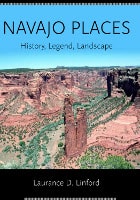
Navajo Places
Laurance D. Linford
University of Utah Press, 2000
Navajoland is the heart and soul of the American Southwest. While the Navajo Reservation incorporates portions of Arizona, New Mexico, and Utah, this is only about half the traditional homeland of 220,000 Diné, the People. In one way or another, nearly all of it, including the original homeland, is sacred to them. Before Spaniards and Americans affixed their own names to the land, every topographic feature had at least one Navajo name. Many of these made their way onto maps—in various forms—or are still in use among Navajo speakers.
Navajo Places is the most ambitious attempt yet to preserve this rich legacy. Through years of research, interviews, and consultation with Navajo authorities, Laurance Linford has compiled a place-name guide that goes beyond reservation boundaries to include the entirety of the traditional Navajo homeland. The volume contains over 1,200 entries, plus a pronunciation guide and sections on Navajo history and the relation of ritual and sacred legend to landscape.
An invaluable resource for anyone interested in the Four Corners region.
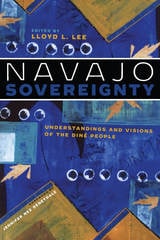
Navajo Sovereignty
Understandings and Visions of the Diné PeopleEdited by Lloyd L. Lee; Foreword by Jennifer Nez Denetdale
University of Arizona Press, 2017
The last few decades have given rise to an electrifying movement of Native American activism, scholarship, and creative work challenging five hundred years of U.S. colonization of Native lands. Indigenous communities are envisioning and building their nations and are making decolonial strides toward regaining power from colonial forces.
The Navajo Nation is among the many Native nations in the United States pushing back. In this new book, Diné author Lloyd L. Lee asks fellow Navajo scholars, writers, and community members to envision sovereignty for the Navajo Nation. He asks, (1) what is Navajo sovereignty, (2) how do various Navajo institutions exercise sovereignty, (3) what challenges does Navajo sovereignty face in the coming generations, and (4) how did individual Diné envision sovereignty?
Contributors expand from the questions Lee lays before them to touch on how Navajo sovereignty is understood in Western law, how various institutions of the Navajo Nation exercise sovereignty, what challenges it faces in coming generations, and how individual Diné envision power, authority, and autonomy for the people.
A companion to Diné Perspectives: Revitalizing and Reclaiming Navajo Thought, each chapter offers the contributors’ individual perspectives. The book, which is organized into four parts, discusses Western law’s view of Diné sovereignty, research, activism, creativity, and community, and Navajo sovereignty in traditional education. Above all, Lee and the contributing scholars and community members call for the rethinking of Navajo sovereignty in a way more rooted in Navajo beliefs, culture, and values.
Contributors:
Raymond D. Austin
Bidtah N. Becker
Manley A. Begay, Jr.
Avery Denny
Larry W. Emerson
Colleen Gorman
Michelle L. Hale
Michael Lerma
Leola Tsinnajinnie
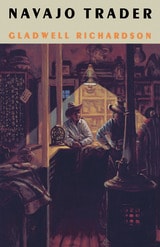
Navajo Trader
Gladwell Richardson
University of Arizona Press, 1986
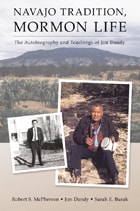
Navajo Tradition, Mormon Life
The Autobiography and Teachings of Jim DandyRobert S. McPherson
University of Utah Press, 2012
Born in the early 1940s in northern Arizona’s high country desert, Jim Dandy began life imbued with the traditions of the Navajo people. Raised by his father and grandfather—both medicine men—and a grandmother steeped in Navajo practices, he embraced their teachings and followed in their footsteps. But attending the LDS Placement program in northern Utah changed his life’s course when he became a member of the Mormon Church. Following graduation from high school, Jim served an LDS mission among his people, obtained a bachelor’s degree, and entered the work force in southeastern Utah as a career counselor, teacher, and community advocate who improved educational opportunities on the Navajo Reservation.
Jim has led a life of service and teaching. He maintains the traditional philosophy with which he was raised and the Mormon beliefs that he learned and continues to follow; his life reflects the values inherent in these two different worlds. Readers interested in Navajo philosophy will find his blend of these two distinct views fascinating, while others will better understand the effects of the controversial placement program on the life of one individual. However, this is primarily the warm story of a man’s life among his people and his love for them and their culture.
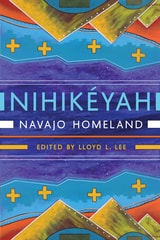
Nihikéyah
Navajo HomelandEdited by Lloyd L. Lee
University of Arizona Press, 2023
While various books have investigated Native American reservations and homelands, this book is from Diné individuals’ experiences, observations, and examinations. Poets, writers, and scholars frame their thoughts on four key questions: What are the thoughts/perspectives on nihikéyah/Navajo homeland? What challenges does nihikéyah face in the coming generations, and what should all peoples know about nihikéyah? And how can nihikéyah build a strong and positive Navajo Nation for the rest of this century and beyond?
The authors come from a variety of backgrounds and use multiple approaches to discuss Diné history in the U.S. Southwest, as well as forward-looking examinations of the Navajo Nation.
Together, the essays shed new light on Diné homeland and the challenges to the Navajo homeland and its peoples.
Contributors
Mario Atencio
Shawn Attakai
Wendy Shelly Greyeyes
Rex Lee Jim
Manny Loley
Jonathan Perry
Jake Skeets
Jennifer Jackson Wheeler
Northern Navajo Frontier 1860 1900
Robert S. McPherson
Utah State University Press, 2001
The Navajo nation is one of the most frequently researched groups of Indians in North America. Anthropologists, sociologists, historians, and others have taken turns explaining their views of Navajo history and culture. A recurrent theme throughout is that the U.S. government defeated the Navajos so soundly during the early 1860s that after their return from incarceration at Bosque Redondo, they were a badly shattered and submissive people.
The next thirty years saw a marked demographic boom during which the Navajo population doubled. Historians disagree as to the extent of this growth, but the position taken by many historians is that because of this growth and the rapidly expanding herds of sheep, cattle, and horses, the government beneficently gave more territory to its suffering wards.
While this interpretation is partly accurate, it centers on the role of the government, the legislation that was passed, and the frustrations of the Indian agents who rotated frequently through the Navajo Agency in Fort Defiance, New Mexico, and ignores or severely limits one of the most important actors in this process of land acquisition-the Navajos themselves. Instead of being a downtrodden group of prisoners, defeated militarily in the 1860s and dependent on the U.S. government for protection and guidance in the 1870s and 80s, they were vigorously involved in defending and expanding the borders of their homelands. This was accomplished not through war and as a concerted effort, but by an aggressive defensive policy built on individual action that varied with changing circumstances. Many Navajos never made the Long Walk to Bosque Redondo. Instead they eluded capture in northern and western hinterlands and thereby pushed out their frontier. This book focuses on the events and activities in one part of the Navajo borderlands-the northern frontier-where between 1860 and 1900 the Navajos were able to secure a large portion of land that is still part of the reservation. This expansion was achieved during a period when most Native Americans were losing their lands.