Results by title
121 books match the query 'Neoliberalism' and 12 start with n

Nature Inc.
Environmental Conservation in the Neoliberal AgeEdited by Bram Büscher, Wolfram Dressler, and Robert Fletcher
University of Arizona Press, 2014
As public funding for conservation efforts grows ever scarcer and the private sector is brimming with ideas about how its role—along with its profits— can grow, market forces have found their way into environmental management to a degree unimaginable only a few years ago. Ecotourism, payment for environmental services (PES), and new conservation finance instruments such as species banking, carbon trading, and biodiversity derivatives are only some of the market mechanisms that have sprung into being. This is “Nature™ Inc.”: a fast-growing frontier of networks, activities, knowledge, and regulations that are rapidly changing the relations between people and nature on both global and local scales.
Nature™ Inc. brings together cutting-edge research by respected scholars from around the world to analyze how “neoliberal conservation” is reshaping human–nature relations that have been fashioned over two centuries of capitalist development. Contributors synthesize and add to a growing body of academic literature that cuts across the disciplinary boundaries of geography, sociology, anthropology, political science, and development studies to critically interrogate the increasing emphasis on neoliberal market-based mechanisms in environmental conservation. They all grapple with one overriding question: can capitalist market mechanisms resolve the environmental problems they have helped create?
Neobugarrón
Heteroflexibility, Neoliberalism, and Latin/o American Sexual PracticeRamón E. Soto-Crespo
The Ohio State University Press, 2023
How should we understand the bugarrón, a man who has sex with other men while regarding himself as heterosexual? Reaching beyond queer and gay studies, Ramón E. Soto-Crespo’s research suggests that this paradoxical figure mutated into what he calls the “neobugarrón,” a neoliberal market-oriented actor who used the traditional sexual practice as an optimizing strategy for manipulating the forces of globalization during the 1990s. In Neobugarrón: Heteroflexibility, Neoliberalism, and Latin/o American Sexual Practice, Soto-Crespo chronicles the cultural modifications of bugarrón, a distinct male-male sexual practice in Latin/o America and the Caribbean, during the twentieth and twenty-first centuries. Working with and against Foucault and Kinsey to examine diverse works from anthropology, literature, cinema, and social media, he investigates a wide array of bugarrón sources, ranging from previously underexamined multimedia to ethnographies, fiction, films, and beyond. These works constitute a neobugarrón archive and attest to a sexual practice currently metamorphosing on the cusp of extinction. Soto-Crespo’s analysis challenges conventional understandings of “heteroflexible” sex between men and reveals a hitherto unnoticed transformation in neoliberal ecologies of bugarrón sexual practice.
Neoliberal Apartheid
Palestine/Israel and South Africa after 1994Andy Clarno
University of Chicago Press, 2017
After a decade of research in the Johannesburg and Jerusalem regions, Andy Clarno presents here a detailed ethnographic study of the precariousness of the poor in Alexandra township, the dynamics of colonization and enclosure in Bethlehem, the growth of fortress suburbs and private security in Johannesburg, and the regime of security coordination between the Israeli military and the Palestinian Authority in the West Bank. The first comparative study of the changes in these two areas since the early 1990s, the book addresses the limitations of liberation in South Africa, highlights the impact of neoliberal restructuring in Palestine, and argues that a new form of neoliberal apartheid has emerged in both contexts.

Neoliberal Bonds
Undoing Memory in Chilean Art and LiteratureFernando A. Blanco
The Ohio State University Press, 2015
Neoliberal Bonds vehemently criticizes how Chile’s transition governments, through a series of political and legal maneuvers, created the state’s official memory narratives. Blanco argues that the state, the media, academia, and the neoliberal market colluded to colonize and mediatize the “memory scene.” In contrast to these official narratives, Neoliberal Bonds analyzes alternative memory accounts within the visual arts and literature that push back against the state, its institutions, and its economic allies. These alternative memory narratives highlight the ontological fracture of the new neoliberal subjects; they also bring into sharp relief the urgent need for democratization that still poses a challenge to Chile a quarter century after its “transition to democracy” began.
Neoliberal Chicago
Edited by Larry Bennett, Roberta Garner, and Euan Hague
University of Illinois Press, 2017
Neoliberal Frontiers
An Ethnography of Sovereignty in West AfricaBrenda Chalfin
University of Chicago Press, 2010
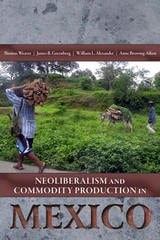
Neoliberalism and Commodity Production in Mexico
Thomas Weaver
University Press of Colorado, 2012
Detailed ethnographic fieldwork shows how foreign investment, privatization, deregulation, and elimination of welfare benefits have devastated national industries and natural resources and threatened agriculture, driving the campesinos and working class deeper into poverty. Focusing on specific commodity chains and the changes to production and marketing under neoliberalism, the contributors highlight the detrimental impacts of policies by telling the stories of those most affected by these changes. They detail the complex interplay of local and global forces, from the politically mediated systems of demand found at the local level to the increasingly powerful municipal and state governments and the global trade and banking institutions.
Sharing a common theoretical perspective and method throughout the chapters, Neoliberalism and Commodity Production in Mexico is a multi-sited ethnography that makes a significant contribution to studies of neoliberal ideology in practice.

Neoliberalism and Contemporary American Literature
Edited by Liam Kennedy and Stephen Shapiro
Dartmouth College Press, 2019

Neoliberalism and Unlawful Governance
The Crisis of Democratic RightsGuillermina Seri
University of Michigan Press, 2026
In looking at the ways in which people resist, the book honors the perspective of the excluded and the voices of those most immediately affected by neoliberal austerity—from activists defending land and rights to communities subjected to various forms of exploitation, extractivism, and displacement. Bringing in these voices and theoretical perspectives, including from beyond the English-speaking world, this book highlights alternative ways of thinking about democracy and rights, drawing from the tradition of the commons. Through its deep analysis of history, theory, and world events, Neoliberalism and Unlawful Governance offers fresh insights into how various forms of emergency measures, policing, and security are used to privilege markets over people and the planet, while also emphasizing the crucial role of popular movements in defending and expanding democratic rights and to rebuilding commons.
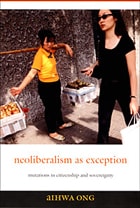
Neoliberalism as Exception
Mutations in Citizenship and SovereigntyAihwa Ong
Duke University Press, 2006
Ong traces how these and other neoliberal exceptions to business as usual are reconfiguring relationships between governing and the governed, power and knowledge, and sovereignty and territoriality. She argues that an interactive mode of citizenship is emerging, one that organizes people—and distributes rights and benefits to them—according to their marketable skills rather than according to their membership within nation-states. Those whose knowledge and skills are not assigned significant market value—such as migrant women working as domestic maids in many Asian cities—are denied citizenship. Nevertheless, Ong suggests that as the seam between sovereignty and citizenship is pried apart, a new space is emerging for NGOs to advocate for the human rights of those excluded by neoliberal measures of human worthiness.
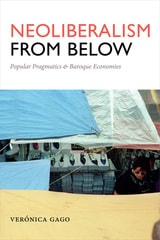
Neoliberalism from Below
Popular Pragmatics and Baroque EconomiesVerónica Gago
Duke University Press, 2017

Neoliberalism in Vietnam, Volume 20
Ann M. Leshkowich and Christina Schwenkel
Duke University Press, 0
Contributors draw their conclusions from ethnographic fieldwork in contemporary urban spaces. They link neoliberalism in Vietnam to a set of globally diverse technical practices, institutions, modes of power, and governing strategies; for example, in its shifting currency regimes and its anticorruption campaigns. Contributors also explore the growing emphasis on self-improvement and modernization through studies of architecture, changing beauty standards, and the impact of in vitro fertilization. Biopolitical logics and the self-regulation of moral personhood are also addressed in essays on HIV/AIDS and transnational adoption. The issue highlights the ways in which the socialist past is integral to the present in Vietnam, even as it is remade and newly configured.
Contributors: Erik Harms, Nina Hien, Ann Marie Leshkowich, Li Zhang, Ken MacLean, Alfred John Montoya, Melissa J. Pashigian, Christina Schwenkel, Allison Truitt
Guest editors: Christina Schwenkel (Associate Professor, Department of Anthropology, University of California at Riverside) and Ann Marie Leshkowich (Associate Professor and Chair, Department of Sociology and Anthropology, College of the Holy Cross).