Results by title
126 books match the query 'New England' and 4 start with n
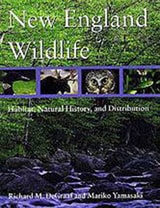
New England Wildlife
Habitat, Natural History, and DistributionRichard M. DeGraaf and Mariko Yamasaki
University Press of New England, 2000
New England Wildlife presents the natural histories and distributions of 338 inland wildlife species in New England. It also details the habitat relationships of all New England terrestrial and aquatic species, presented in sections on amphibians and reptiles, birds, and mammals. Each species account includes an illustration and range map, along with information on distribution in the region, status, habitat, special habitat requirements, details of breeding biology, home range and movements, and food habits, each fully documented from the pertinent literature. The introduction includes a brief land-use history of the region, descriptions of forest types and nonforest habitats, and wildlife responses to landscape change. A necessity for all land managers and naturalists as well as birders, walkers, nature lovers, residents, and visitors to New England, the book includes the most recent information on natural history and distribution, and matrices relating all species to standard classifications of forest cover - types and nonforest habitats.
[more]
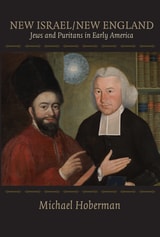
New Israel / New England
Jews and Puritans in Early AmericaMichael Hoberman
University of Massachusetts Press, 2011
The New England Puritans' fascination with the legacy of the Jewish religion has been well documented, but their interactions with actual Jews have escaped sustained historical attention. New Israel/New England tells the story of the Sephardic merchants who traded and sojourned in Boston and Newport between the mid-seventeenth century and the era of the American Revolution. It also explores the complex and often contradictory meanings that the Puritans attached to Judaism and the fraught attitudes that they bore toward the Jews as a people.
More often than not, Michael Hoberman shows, Puritans thought and wrote about Jews in order to resolve their own theological and cultural dilemmas. A number of prominent New Englanders, including Roger Williams, Increase Mather, Samuel Sewall, Benjamin Colman, Cotton Mather, Jonathan Edwards, and Ezra Stiles, wrote extensively about post-biblical Jews, in some cases drawing on their own personal acquaintance with Jewish contemporaries.
Among the intriguing episodes that Hoberman investigates is the recruitment and conversion of Harvard's first permanent instructor of Hebrew, the Jewish-born Judah Monis. Later chapters describe the ecumenical friendship between Newport minister Ezra Stiles and Haim Carigal, an itinerant rabbi from Palestine, as well as the life and career of Moses Michael Hays, the prominent freemason who was Boston's first permanently established Jewish businessman, a founder of its insurance industry, an early sponsor of the Bank of Massachusetts, and a personal friend of Paul Revere.
[more]
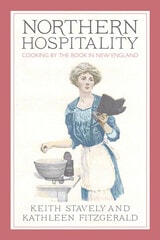
Northern Hospitality
Cooking by the Book in New EnglandKeith Stavely
University of Massachusetts Press, 2011
If you think traditional New England cooking is little more than baked beans and clam chowder, think again. In this enticing anthology of almost 400 historic New England recipes from the seventeenth to the early twentieth century, you will be treated to such dishes as wine-soaked bass served with oysters and cranberries, roast shoulder of lamb seasoned with sweet herbs, almond cheesecake infused with rosewater, robust Connecticut brown bread, zesty ginger nuts, and high-peaked White Mountain cake.
Beginning with four chapters placing the region's best-known cookbook authors and their works in nuanced historical context, Keith Stavely and Kathleen Fitzgerald then proceed to offer a ten-chapter cornucopia of culinary temptation. Readers can sample regional offerings grouped into the categories of the liquid one-pot meal, fish, fowl, meat and game, pie, pudding, bread, and cake. Recipes are presented in their original textual forms and are accompanied by commentaries designed to make them more accessible to the modern reader. Each chapter, and each section within each chapter, is also prefaced by a brief introductory essay. From pottage to pie crust, from caudle to calf's head, historic methods and obscure meanings are thoroughly—sometimes humorously—explained.
Going beyond reprints of single cookbooks and bland adaptations of historic recipes, this richly contextualized critical anthology puts the New England cooking tradition on display in all its unexpected--and delicious--complexity. Northern Hospitality will equip readers with all the tools they need for both historical understanding and kitchen adventure.
[more]
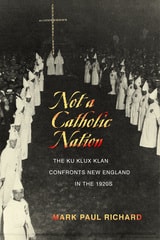
Not a Catholic Nation
The Ku Klux Klan Confronts New England in the 1920sMark Paul Richard
University of Massachusetts Press, 2015
During the 1920s the Ku Klux Klan experienced a remarkable resurgence, drawing millions of American men and women into its ranks. In Not a Catholic Nation, Mark Paul Richard examines the KKK's largely ignored growth in the six states of New England—Connecticut, Maine, Massachusetts, New Hampshire, Rhode Island, and Vermont—and details the reactions of the region's Catholic population, the Klan's primary targets.
Drawing on a wide range of previously untapped sources—French-language newspapers in the New England–Canadian borderlands; KKK documents scattered in local, university, and Catholic repositories; and previously undiscovered copies of the Maine Klansmen—Richard demonstrates that the Klan was far more active in the Northeast than previously thought. He also challenges the increasingly prevalent view that the Ku Klux Klan became a mass movement during this period largely because it functioned as a social, fraternal, or civic organization for many Protestants. While Richard concedes that some Protestants in New England may have joined the KKK for those reasons, he shows that the politics of ethnicity and labor played a more significant role in the Klan's growth in the region.
The most comprehensive analysis of the Ku Klux Klan's antagonism toward Catholics in the 1920s, this book is also distinctive in its consideration of the history of the Canada–U.S. borderlands, particularly the role of Canadian immigrants as both proponents and victims of the Klan movement in the United States.
[more]