Results by title
226 books match the query 'New Jersey' and 27 start with n
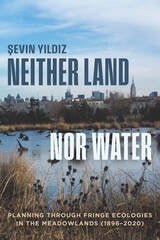
Neither Land nor Water
Planning Through Fringe Ecologies in the Meadowlands (1896–2020)Sevin Yildiz
University of Chicago Press, 2026
An urban and environmental history of the New Jersey Meadowlands, where marsh meets megamall.
The New Jersey Meadowlands, the vast marshes across the Hudson River from New York City, are a mysterious and complex wetland. Both strange and well-known to the millions of people who traverse the northeast corridor every year, this landscape is not well understood despite its familiarity. Seemingly natural and unnatural, human and nonhuman, the Meadowlands has long been shaped by urban development, industry, infrastructure, and countless dreams.
In Neither Land nor Water, Şevin Yıldız offers a close look at the planners, scientists, developers, politicians, industrialists, and others who have engaged with, dreamed about, or damaged this transitional ecology in different ways over the decades. She traces key periods in the area’s rich histories of urban planning and ecological thought, from the dispossession of the Lenape natives, through the dawn of ecological science, and onto both intensive industrial developments and environmental resistance to them. She examines as well how the Meadowlands exposes the inadequacies of today’s approaches to planning in the face of climate change and how they perhaps offer clues to a better future.
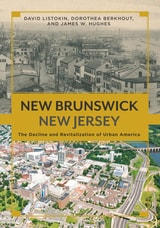
New Brunswick, New Jersey
The Decline and Revitalization of Urban AmericaListokin, David
Rutgers University Press, 2016
New Jersey
Betsy Andrews
University of Wisconsin Press, 2007
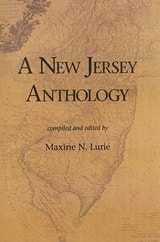
New Jersey Anthology
Lurie, Maxine N
Rutgers University Press, 2002
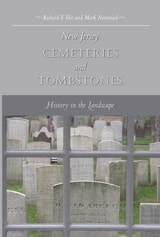
New Jersey Cemeteries and Tombstones
History in the LandscapeVeit, Richard F
Rutgers University Press, 2008
From the earliest memorials used by Native Americans to the elaborate structures of the present day, Richard Veit and Mark Nonestied use grave markers to take an off-beat look at New Jersey’s history that is both fascinating and unique.
New Jersey Cemeteries and Tombstones presents a culturally diverse account of New Jersey’s historic burial places from High Point to Cape May and from the banks of the Delaware to the ocean-washed Shore, to explain what cemeteries tell us about people and the communities in which they lived. The evidence ranges from somber seventeenth-century decorations such as hourglasses and skulls that denoted the brevity of colonial life, to modern times where memorials, such as a life-size granite Mercedes Benz, reflect the materialism of the new millennium. Also considered are contemporary novelties such as pet cemeteries and what they reveal about today’s culture. To tell their story the authors visited more than 1,000 burial grounds and interviewed numerous monument dealers and cemetarians.
This richly illustrated book is essential reading for history buffs and indeed anyone who has ever wandered inquisitively through their local cemeteries.
New Jersey Dreaming
Capital, Culture, and the Class of '58Sherry B. Ortner
Duke University Press, 2005
Ortner tracked down nearly all 304 of her classmates. She interviewedabout 100 in person and spoke with most of the rest by phone, recording her classmates’ vivid memories of time, place, and identity. Ortner shows how social class affected people’s livesin many hidden and unexamined ways. She also demonstrates that the Class of ‘58’s extreme upward mobility must be understood in relation to the major identity movements of the twentieth century—the campaign against anti-Semitism, the Civil Rights movement, and feminism.
A multisited study combining field research with an interdisciplinary analytical framework, New Jersey Dreaming is a masterly integration of developments at the vanguard of contemporary anthropology. Engaging excerpts from Ortner's field notes are interspersed throughout the book. Whether recording the difficulties and pleasures of studying one's own peer group, the cultures of driving in different parts of the country, or the contrasting experiences of appointment-making in Los Angeles and New York, they provide a rare glimpse into the actual doing of ethnographic research.
New Jersey Fan Club
Artists and Writers Celebrate the Garden StateKerri Sullivan
Rutgers University Press, 2022
Despite the many jokes and stereotypes about New Jersey and its residents, in reality the state is a wildly diverse place, home to a vast variety of landscapes, cultures, and people. There is no singular New Jersey experience, and the stories that its residents have to share about the state will surprise you.
New Jersey Fan Club: Artists and Writers Celebrate the Garden State is an eclectic anthology featuring personal essays, interviews, and comics from a broad group of established and emerging writers and artists who have something to say about New Jersey. It offers a multifaceted look at the state’s history and significance, told through narrative nonfiction, photographs, and illustrations.
New Jersey Fan Club is edited by Kerri Sullivan, founder of the popular Instagram account Jersey Collective (@jerseycollective), which features weekly takeovers by different New Jerseyans. This book functions the same way: it gives dozens of different contributors the chance to share what New Jersey looks like to them. The book is an exploration of how the same locale can shape people in different ways, and it will inspire readers to look at the Garden State with fresh eyes and appreciate its bounty of beautiful places and vibrant spaces.

New Jersey Ferns and Fern Allies
Montgomery, James D.
Rutgers University Press, 1993
New Jersey is exceptionally rich in ferns, as three centuries of naturalists have recognized. Both amateur and professional botanists will welcome this new, complete, fully illustrated guide to the state's ferns and fern allies (the lycopods and horsetails). After an introduction to fern classification and nomenclature, the history of fern collecting, and the ecology and distribution of ferns within New Jersey, the authors describe eighty-three species, in thirty genera, and thiry-two hybrid forms (more than any other state). They include a fascinating account of the rare curly-grass fern, Schizaea pusilla, "New Jersy's most famous plant."
For each species, the authors provide a detailed drawing and comments on taxonomy, habitat, chromosome counts, habits of growth, and status as endangered species. Distribution maps show not only where plants have been collected, but also the time period for the most recent date of collectionÐÐa convenient way of showing the plant's spread or depletion. Throughout, the book reflects the latest research by fern experts.
An essential field guide and reference for naturalists, botanists, hikers, gardeners, and conservationists in New Jersey and the mid-Atlantic states.
New Jersey Politics and Government, 4th edition
The Suburbs Come of AgeSalmore, Barbara G
Rutgers University Press, 2013
Offering a comprehensive overview of New Jersey politics and government, chapters cover the state’s political history; campaigns and elections; interest groups; the constitution; the development of government institutions; relationships with neighboring states, the federal government, and its own municipalities and counties; tax and spending policies; education; and quality of life issues.
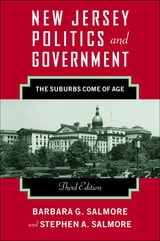
New Jersey Politics and Government
The Suburbs Come of AgeSalmore, Barbara G
Rutgers University Press, 2008
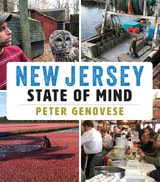
New Jersey State of Mind
Peter Genovese
Rutgers University Press, 2020
For this new book, Genovese spent months scouring the state for rich stories and fascinating locations. New Jersey State of Mind takes us on a journey to over twenty-five of these places and introduces us to the colorful characters who live and work there, from a demolition derby driver to a female craft brewer, and from a Cuban celebrity chef to a Portuguese pig breeder. He also reveals the many natural wonders that have earned New Jersey its “Garden State” nickname, from cranberry bogs to river tours to wild bird sanctuaries.
Collectively, these pieces paint a picture of a diverse state full of hard-working individuals who care for their communities. This book cuts through the myths and stereotypes surrounding the state and reveals the proud beating heart of the real New Jersey.
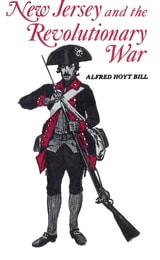
New Jersey and The Revolutionary War
Bill, Alfred
Rutgers University Press, 1970
Bill introduces us to the people who were responsible for winning the war and shaping the future of our country, people such as George Washington, General Hugh Mercer, Thomas Paine, Alexander Hamilton, James Monroe, and Thomas Marshall. He also portrays other colorful figures, such as Benedict Arnold, and British officers, including Howe, Cornwallis, and RaIl. Alfred Bill has produced that rare species of history book that reads like an exciting adventure story. He not only presents the facts, but clearly illuminates them with pertinent background information. Clearly written and highly readable, this book will be enjoyed by everyone from students 10 serious historians.
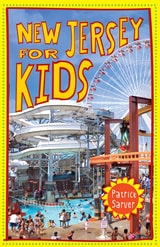
New Jersey for Kids
Sarver, Patrick
Rutgers University Press, 2012
Many parents in the Garden State are familiar with Great Adventure in Jackson, the boardwalk at Point Pleasant, and the Adventure Aquarium in Camden, but do they know about Kindermusik in Teaneck, the Young Chef’s Academy in Hillsborough, or the Buehler Challenger and Science Center in Paramus?
In New Jersey for Kids, Patrick Sarver provides parents with a handy reference guide offering hundreds of educational and entertaining ideas for children and their parents to explore and enjoy. Activities are designed specifically for kids ages 12 and under and cover a wide array of fun ways to enrich their intellectual lives, build their athletic skills, express themselves creatively, or just have room to play. The activities covered include:
- Robotics workshops
- Themed tea parties
- Plays and performances for children
- Museum tours, special exhibits, and programs for kids
- Pony rides and horseback riding lessons
- Specialized summer camps
- Arts and crafts classes
- Gymnastics classes
- Zoos and nature activities
- Hockey, soccer, and baseball clinics
- Acting and dancing lessons
- Play centers with slides, ball pits, and bounce castles
Busy parents no longer need to spend hours surfing the Web and scouting out resources to find nearby activities their kids might enjoy. New Jersey for Kids puts this information right in the palms of their hands. Chapters are organized by category so it is easy to locate just the right activities to suit an individual child’s interests, whether it’s a fun way to spend an afternoon or a class that might inspire a lifelong passion. Along with descriptions and commentary, listings include recommended age ranges, handicap accessibility, and estimated durations of activities as well as practical information on hours, price ranges, Web sites, and phone numbers.
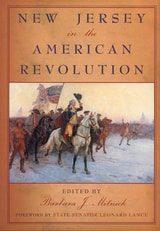
New Jersey in the American Revolution
Mitnick, Barbara J
Rutgers University Press, 2005
Barbara J. Mitnick has edited a remarkably comprehensive anthology, bringing new life to the rich and turbulent late eighteenth-century period in New Jersey. Originally conceived as a legacy of the state's 225th Anniversary of the Revolution Celebration Commission and sponsored by the Washington Association of New Jersey, the volume brings together contributions by twelve outstanding and recognized experts on New Jersey history.
Chapters explore topics including New Jersey as the "Crossroads of the Revolution," important military campaigns, the 1776 Constitution, and the significant contribution of blacks, Native Americans, and women. Reflecting the contemporary view that the war's impact extended beyond military engagements, original essays also discuss the fine and decorative arts, literature, architecture, archaeology, and social and economic conditions. The reader is presented with a picture of life in New Jersey both separate from as well as connected to the fight for American independence and the establishment of the nation.
Fresh and significant observations, including the fact that soldiers fought 238 battles on New Jersey soil (more than any other state) and that the social and political changes resulting from the war were more revolutionary than evolutionary make this accessibly written, beautifully illustrated volume appeal to the lay reader as well as scholars of New Jersey and Revolutionary War history.
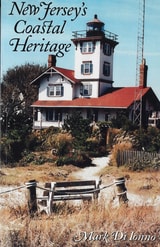
New Jersey's Coastal Heritage
A GuideDi Ionno, Mark
Rutgers University Press, 1997
Most people see the Jersey Shore as sun, sand, and surf . . . and hours in bumper-to-bumper traffic on the Garden State Parkway. But theres much more to the Shore!Long before the first hotel, miniature golf range, and amusement pier were built, explorers, sailors, and settlers were drawn to New Jerseys coast and left their mark upon it.
In this book, Mark Di Ionno invites you to join him in discovering New Jerseys rich and varied coastal heritage. Hell take you on a personal tour to explore the Sandy Hook Lighthouse and Spermaceti Cove Station, admire offbeat collections of saltwater taffy boxes and sand art in Atlantic City, spend an afternoon at Brigantine and unravel the legend of Captain Kidd, marvel at the skills of Tuckertons boatbuilders, discover New Jerseys own version of the Boston Tea Party in Greenwich, and find inspiration at Ocean Grove, a Methodist meeting place.
Organized by county and amply illustrated with photographs and maps, the guides entries give directions and information about hours, programs, and accessibility, and, above all, lively descriptions of the local history and cultural traditions that make each place special. Di Ionno includes many sites on the National Park Services Coastal Heritage Trail, but roves beyond the Trail to highlight a host of other wonderful museums, buildings, byways, and landmarks that could not be incorporated into the official trail.
New Jersey's Environments
Past, Present, and FutureMaher, Neil M
Rutgers University Press, 2006
Americans often think of New Jersey as an environmental nightmare. As seen from its infamous turnpike, which is how many travelers experience the Garden State, it is difficult not to be troubled by the wealth of industrial plants, belching smokestacks, and hills upon hills of landfills. Yet those living and working in New Jersey often experience a very different environment. Despite its dense population and urban growth, two-thirds of the state remains covered in farmland and forest, and New Jersey has a larger percentage of land dedicated to state parks and forestland than the average for all states. It is this ecological paradox that makes New Jersey important for understanding the relationship between Americans and their natural world.
In New Jersey’s Environments,historians, policy-makers, and earth scientists use a case study approach to uncover the causes and consequences of decisions regarding land use, resources, and conservation. Nine essays consider topics ranging from solid waste and wildlife management to the effects of sprawl on natural disaster preparedness. The state is astonishingly diverse and faces more than the usual competing interests from environmentalists, citizens, and businesses.
This book documents the innovations and compromises created on behalf of and in response to growing environmental concerns in New Jersey, all of which set examples on the local level for nationwide and worldwide efforts that share the goal of protecting the natural world.
New Jersey's Multiple Municipal Madness
Karcher, Alan
Rutgers University Press, 1998
Alan Karcher looks at the history and high cost of New Jersey's multiple municipalities. He investigates the economic considerations, political pressures, and personal agendas that created the bizarre configurations dividing the Garden State, while analyzing the public policies that allowed and even encouraged the formation of new municipalities. Karcher also examines the political dynamics that thwarted every effort of New Jersey metropolises to join the front ranks of major American cities.
Karcher identifies the major motivations behind the unparalleled experience of New Jersey's municipal multiplication. He delves deeply into the primary causes of new lines being drawn, such as road appropriations, the location of a railroad station, control of a local school district, the regulation of alcohol sales, and the preservation of exclusivity prior to the acceptance of zoning. He also assesses the present situation and what has happened in the past 60 years since the municipal multiplication madness ceased, calling on elected officials to confront reality and correct yesterday's excesses.
The genesis of the present political map of the state is a story that while interesting is not always charming, while fascinating is far from edifying. Little in the history can be called quaint. Rather it is a story of separation and exclusion, of division and greed, of preservation of prerogatives and prejudices. It is a story that supports the conclusion that these lines are rarely the product of chance, rather they were drawn by politicians with very human foibles and frailties, and with very narrow agendas-agendas that have proven to be egregiously expensive for today's taxpayers.
Alan Karcher, the former Speaker of the New Jersey Assembly during the activist 1980s, currently practices municipal law in Middlesex County. He represents the third generation of his family to serve as a member of the New Jersey State Legislature.
New Jersey's Natures
Environmental Histories of the Garden StateRaechel Lutz
Rutgers University Press, 2026
New Jersey’s Natures takes up the challenge of expanding academic and popular conceptions of New Jersey and its landscapes through the lens of environmental history. Scholars’ essays showcase the ways in which nature is integral to understandings of the state and its past as well as its future. These essays show that New Jersey should no longer solely be known as a place where pollution and suburbanization run amok but rather a place where history happens.
The contributors investigate how nature and history are intertwined within this small but mighty state, covering topics from the colonial period to the present across North, South, and Central Jersey. They investigate natural features like the Delaware River and Bay, the Pinelands, and the unforgettable Jersey Shore. In this book, you will find Indigenous Americans making meaning as settlers threaten their ways of life, Governor William Livingston considering Central Jersey’s features as he fights in the American Revolution, farmers building the state’s industrial agriculture, a foreign diplomat planting an arboretum, squatters in the swampy Meadowlands subverting social and economic norms, activists fighting for parks, forests, and beaches across two centuries, and much more.
New Jersey's Postsuburban Economy
James W. Hughes and Joseph J. Seneca
Rutgers University Press, 2015
From the rural agricultural and natural resource based economy and lifestyle of the seventeenth century to today’s postindustrial, suburban-dominated, automobile-dependent economy, the economic drivers which were considered to be an asset are now viewed by many to be the state’s greatest disadvantage. On the brink of yet another transformation, this one driven by a new technology and an internet based global economy, New Jersey will have to adapt itself yet again—this time to a postsuburban digital economy.
Hughes and Seneca describe the forces that are now propelling the state into yet another economic era. They do this in the context of historical economic transformations of New Jersey, setting out the technological, demographic, and transportation shifts that defined and drove them.
New Jersey
A Guide to the StateWestergaard, Barbara
Rutgers University Press, 2006
In the third edition of this classic guide, Barbara Westergaard surveys the state’s rich diversity while providing the most up-to-date information on several hundred of New Jersey’s towns, cities, and parks. Entries are arranged alphabetically with concise yet thorough descriptions detailing what there is to see and do in each community and its surrounding area and how each place is connected to its past. The book lists museums, parks, historical points of interest, natural and recreational areas, and many other attractions. There is even a guided tour of the New Jersey Turnpike—the most heavily traveled toll road in the country. Updated for this edition, the book includes new points of interest and population figures.
Whether you are a longtime resident or newcomer to New Jersey, a commuter, a visitor, or a neighbor from a nearby state, this easy-to-use, town-by-town guide will lead you to new discoveries.
Includes information on:
· towns and cities
· museums
· arts centers
· historic sites
· lighthouses
· nature centers
· animal refuges and zoos
· amusement parks
· wineries
· sports facilities
· planetariums
· parks and gardens
New Jersey
A History of the Garden StateLurie, Maxine N
Rutgers University Press, 2012
New Jersey: A History of the Garden State presents a fresh, comprehensive overview of New Jersey’s history from the prehistoric era to the present. The findings of archaeologists, political, social, and economic historians provide a new look at how the Garden State has evolved.
The state has a rich Native American heritage and complex colonial history. It played a pivotal role in the American Revolution, early industrialization, and technological developments in transportation, including turnpikes, canals, and railroads. The nineteenth century saw major debates over slavery. While no Civil War battles were fought in New Jersey, most residents supported it while questioning the policies of the federal government.
Next, the contributors turn to industry, urbanization, and the growth of shore communities. A destination for immigrants, New Jersey continued to be one of the most diverse states in the nation. Many of these changes created a host of social problems that reformers tried to minimize during the Progressive Era. Settlement houses were established, educational institutions grew, and utopian communities were founded. Most notably, women gained the right to vote in 1920. In the decades leading up to World War II, New Jersey benefited from back-to-work projects, but the rise of the local Ku Klux Klan and the German American Bund were sad episodes during this period.
The story then moves to the rise of suburbs, the concomitant decline of the state’s cities, growing population density, and changing patterns of wealth. Deep-seated racial inequities led to urban unrest as well as political change, including such landmark legislation as the Mount Laurel decision. Today, immigration continues to shape the state, as does the tension between the needs of the suburbs, cities, and modest amounts of remaining farmland.
Well-known personalities, such as Jonathan Edwards, George Washington, Woodrow Wilson, Dorothea Dix, Thomas Edison, Frank Hague, and Albert Einstein appear in the narrative. Contributors also mine new and existing sources to incorporate fully scholarship on women, minorities, and immigrants. All chapters are set in the context of the history of the United States as a whole, illustrating how New Jersey is often a bellwether for the nation..
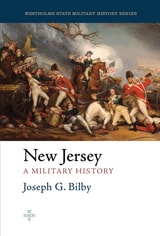
New Jersey
A Military HistoryJoseph G. Bilby
Westholme Publishing, 2017
New Jersey: A Military History by military historian Joseph G. Bilby tells the long, diverse, and sometimes complicated story of New Jersey’s citizens and their significant and continuing role in America’s defense. Over more than 350 years as a colony and state, hundreds of thousands of New Jersey residents have served in regular armed forces, militia, and National Guard units or in direct support of those organizations. New Jerseyans in the military include General “Scotch Willie” Maxwell of Sussex County, an unappreciated Revolutionary War master tactician; First Sergeant George Ashby of Allentown, of Company H, 45th United States Colored Infantry, the state’s last surviving Civil War veteran; Clara Maas of Newark, a nurse who sacrificed her life in the effort to eradicate Yellow Fever; Captain William J. Reddan, who led his company into hell during the Meuse-Argonne offensive in 1918; and Medal of Honor winner John Basilone, whose sense of duty and honor led him to return to combat and death in World War II.
Complete with maps, an annotated list of historical sites in the state, and further reading, New Jersey: A Military History is an important reference for those interested in the role of the Garden State in our nation’s wars.
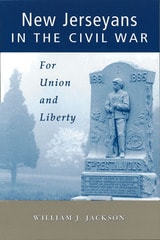
New Jerseyans in the Civil War
For Union and LibertyJackson, William J
Rutgers University Press, 2006
The Civil War divided New Jersey just as it did the nation. As a small state sandwiched between two large and powerful neighbors, New Jersey had always enthusiastically supported the creation of a strong central government. On the other hand, many New Jersey citizens did not share the anti-slavery sentiments of the North; they supported property rights of slave owners and believed in the natural inferiority of blacks. Subsequently, when southern states began to secede from the Union to form the Confederacy, New Jerseyans were left divided and confused.
William J. Jackson examines the ironies, paradoxes, and contradictions that characterized New Jersey's unique historical role in the war. This is the only book to incorporate social and political history with that of military history and strategy. Civil War aficionados and historians will also welcome Jackson's analysis of the participation of New Jersey African Americans on the home front and in the military.
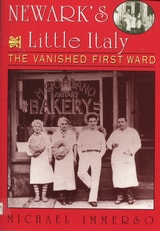
Newark's Little Italy
The Vanished First WardImmerso, Michael
Rutgers University Press, 1997

No Easy Walk
Newark, 1980-1993Helen M. Stummer
Temple University Press, 1994
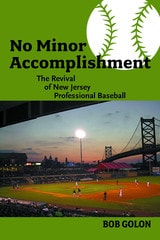
No Minor Accomplishment
The Revival of New Jersey Professional BaseballGolon, Bob
Rutgers University Press, 2008
In No Minor Accomplishment, sports historian and New Jersey native Bob Golon tells the story of the state's baseball scene since the Trenton Thunder arrived in 1994. Drawing on interviews with team owners and employees, industry executives and fans, Golon goes behind the scenes to show how maintaining a minor league ball club can be a risky business venture. Stadiums cost millions to build, and a team full of talented players does not immediately guarantee success. Instead, each of the eight minor league and independent professional teams in the state must tailor themselves to the communities in which they are situated. Shrewd marketing is necessary to attract fans, but Golon also explains how, unlike Major League Baseball, the business aspect of the minor and independent leagues is not something the average spectator notices. For the fans, baseball in New Jersey is wholesome, exciting family entertainment.
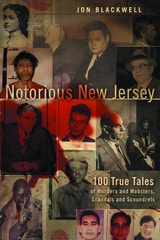
Notorious New Jersey
100 True Tales of Murders and Mobsters, Scandals and ScoundrelsJon Blackwell
Rutgers University Press, 2007
Notorious New Jersey is the definitive guide to murder, mayhem, the mob, and corruption in the Garden State. With tabloid punch, Jon Blackwell tells riveting accounts of Alexander Hamilton falling mortally wounded on the dueling grounds of Weehawken; Dutch Schultz getting pumped full of lead in the men’s room of the Palace Chop House in Newark; and a gang of Islamic terrorists in Jersey City mixing the witch’s brew of explosives that became the first bomb to rock the World Trade Center. Along with these dramatic stories are tales of lesser-known oddities, such as the nineteenth-century murderer whose skin was turned into leather souvenirs, and the state senator from Jersey City who faked his death in a scuba accident in the 1970s in an effort to avoid prison.
Blackwell also sheds light on some historical whodunits—was Bruno Hauptmann really guilty of kidnapping the Lindbergh baby? Who was behind the anthrax attacks of 2001? Not forgotten either are notorious characters who may actually be innocent, including Rubin “Hurricane” Carter, and those who have never been convicted of wrongdoing although they left office in scandal, including Robert Torricelli and James McGreevey.
Through 100 historic true-crime tales that span over 300 years of history, Blackwell shows readers a side of New Jersey that would make even the Sopranos shudder.