Results by title
173 books match the query 'Origins' and 4 start with n

NATIONALIST FERMENT
ORIGINS OF U.S. FOREIGN POLICY, 1789-1812MARIE-JEANNE ROSSIGNOL
The Ohio State University Press, 2003
This book was published in June 1994 by a French publisher and became the winner of the Organization of American Historians foreign language book prize.
The Nationalist Ferment contributes significantly to the renewal of early U.S. diplomatic history. Since the 1980s, a number of diplomatic historians have turned aside from traditional diplomatic issues and sources. They have instead focused on gender, ethnic relationships, culture, and the connections between foreign and domestic policy.
Rossignol argues that in the years 1789–1812 the new nation needed to assert its independence and autonomous character in the face of an unconvinced world. After overcoming initial divisions caused by foreign policy, Americans met this challenge by defining common foreign policy objectives and attitudes, which both legitimized the United States abroad and reinforced national unity at home. This book establishes the constant connections between domestic and international issues during the early national period.

Nagara and Commandery
Origins of the Southeast Asian Urban TraditionsPaul Wheatley
University of Chicago Press, 1983
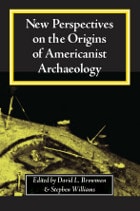
New Perspectives on the Origins of Americanist Archaeology
Edited by David L. Browman and Stephen Williams
University of Alabama Press, 2002
In this landmark book, experienced scholars take a retrospective look at the developing routes that have brought American archaeologists into the 21st century.
In 1996, the Society for American Archaeology's Committee on the History of Archaeology established a biennial symposium
named after Gordon R. Willey, one of the fathers of American archaeology, to focus on the history of the discipline. This volume grew out of the
second symposium, presented at the 1998 meeting of the Society for American Archaeology.
Interest in the intellectual history of the field is certainly nothing new—the first such volume appeared in 1856—but previously, focus has been on individuals and their theories and methods, or on various government agencies that supported, developed, or mandated
excavations in North America. This volume, however, focuses on the roots of Americanist archaeology, including its pre-1915 European connections, and on some of the earliest work by women archaeologists, which has been largely overlooked.
Full of valuable insights for archaeologists and anthropologists—both professional and amateur—into the history and
development of Americanist archaeology, New Perspectives will also inspire and serve as a model for future research.
David Browman is Professor of Anthropology and Chair of the Interdisciplinary Program in Archaeology at Washington University. Stephen Williams is Professor Emeritus of Anthropology at Harvard University.
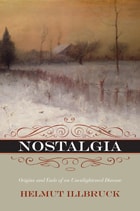
Nostalgia
Origins and Ends of an Unenlightened DiseaseHelmut Illbruck
Northwestern University Press, 2012