Results by title
55 books match the query 'Pease, Donald E.' and 4 start with n
National Identities and Post-Americanist Narratives
Donald E. Pease
Duke University Press, 1994
National narratives create imaginary relations within imagined communities called national peoples. But in the American narrative, alongside the nexus of belonging established for the national community, the national narrative has represented other peoples (women, blacks, "foreigners", the homeless) from whom the property of nationness has been removed altogether and upon whose differences from them the national people depended for the construction of their norms. Dismantling this opposition has become the task of post-national (Post-Americanist) narratives, bent on changing the assumptions that found the "national identity."
This volume, originally published as a special issue of bounrary 2, focuses on the process of assembling and dismantling the American national narrative(s), sketching its inception and demolition. The contributors examine various cultural, political, and historical sources--colonial literature, mass movements, epidemics of disease, mass spectacle, transnational corporations, super-weapons, popular magazines, literary texts--out of which this narrative was constructed, and propose different understandings of nationality and identity following in its wake.
This volume, originally published as a special issue of bounrary 2, focuses on the process of assembling and dismantling the American national narrative(s), sketching its inception and demolition. The contributors examine various cultural, political, and historical sources--colonial literature, mass movements, epidemics of disease, mass spectacle, transnational corporations, super-weapons, popular magazines, literary texts--out of which this narrative was constructed, and propose different understandings of nationality and identity following in its wake.
Contributors. Jonathan Arac, Lauren Berlant, Robert J. Corber, Elizabeth Freeman, Kathryn V. Lingberg, Jack Matthews, Alan Nadel, Patrick O'Donnell, Daniel O'Hara, Donald E. Pease, Ross Posnock, John Carlos Rowe, Rob Wilson
[more]
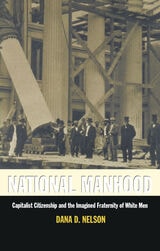
National Manhood
Capitalist Citizenship and the Imagined Fraternity of White MenDana D. Nelson
Duke University Press, 1998
National Manhood explores the relationship between gender, race, and nation by tracing developing ideals of citizenship in the United States from the Revolutionary War through the 1850s. Through an extensive reading of literary and historical documents, Dana D. Nelson analyzes the social and political articulation of a civic identity centered around the white male and points to a cultural moment in which the theoretical consolidation of white manhood worked to ground, and perhaps even found, the nation.
Using political, scientific, medical, personal, and literary texts ranging from the Federalist papers to the ethnographic work associated with the Lewis and Clark expedition to the medical lectures of early gynecologists, Nelson explores the referential power of white manhood, how and under what conditions it came to stand for the nation, and how it came to be a fraternal articulation of a representative and civic identity in the United States. In examining early exemplary models of national manhood and by tracing its cultural generalization, National Manhood reveals not only how an impossible ideal has helped to form racist and sexist practices, but also how this ideal has simultaneously privileged and oppressed white men, who, in measuring themselves against it, are able to disavow their part in those oppressions.
Historically broad and theoretically informed, National Manhood reaches across disciplines to engage those studying early national culture, race and gender issues, and American history, literature, and culture.
[more]
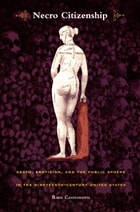
Necro Citizenship
Death, Eroticism, and the Public Sphere in the Nineteenth-Century United StatesRuss Castronovo
Duke University Press, 2001
In Necro Citizenship Russ Castronovo argues that the meaning of citizenship in the United States during the nineteenth century was bound to—and even dependent on—death. Deploying an impressive range of literary and cultural texts, Castronovo interrogates an American public sphere that fetishized death as a crucial point of political identification. This morbid politics idealized disembodiment over embodiment, spiritual conditions over material ones, amnesia over history, and passivity over engagement.
Moving from medical engravings, séances, and clairvoyant communication to Supreme Court decisions, popular literature, and physiological tracts, Necro Citizenship explores how rituals of inclusion and belonging have generated alienation and dispossession. Castronovo contends that citizenship does violence to bodies, especially those of blacks, women, and workers. “Necro ideology,” he argues, supplied citizens with the means to think about slavery, economic powerlessness, or social injustice as eternal questions, beyond the scope of politics or critique. By obsessing on sleepwalkers, drowned women, and other corpses, necro ideology fostered a collective demand for an abstract even antidemocratic sense of freedom. Examining issues involving the occult, white sexuality, ghosts, and suicide in conjunction with readings of Harriet Jacobs, Ralph Waldo Emerson, Frederick Douglass, Nathaniel Hawthorne, and Frances Harper, Necro Citizenship successfully demonstrates why Patrick Henry's “give me liberty or give me death” has resonated so strongly in the American imagination.
Moving from medical engravings, séances, and clairvoyant communication to Supreme Court decisions, popular literature, and physiological tracts, Necro Citizenship explores how rituals of inclusion and belonging have generated alienation and dispossession. Castronovo contends that citizenship does violence to bodies, especially those of blacks, women, and workers. “Necro ideology,” he argues, supplied citizens with the means to think about slavery, economic powerlessness, or social injustice as eternal questions, beyond the scope of politics or critique. By obsessing on sleepwalkers, drowned women, and other corpses, necro ideology fostered a collective demand for an abstract even antidemocratic sense of freedom. Examining issues involving the occult, white sexuality, ghosts, and suicide in conjunction with readings of Harriet Jacobs, Ralph Waldo Emerson, Frederick Douglass, Nathaniel Hawthorne, and Frances Harper, Necro Citizenship successfully demonstrates why Patrick Henry's “give me liberty or give me death” has resonated so strongly in the American imagination.
[more]
Negative Liberties
Morrison, Pynchon, and the Problem of Liberal IdeologyCyrus R. K. Patell
Duke University Press, 2001
Since the nineteenth century, ideas centered on the individual, on Emersonian self-reliance, and on the right of the individual to the pursuit of happiness have had a tremendous presence in the United States—and even more so after the Reagan era. But has this presence been for the good of all? In Negative Liberties Cyrus R. K. Patell revises important ideas in the debate about individualism and the political theory of liberalism. He does so by adding two new voices to the current discussion—Toni Morrison and Thomas Pynchon—to examine the different ways in which their writings embody, engage, and critique the official narrative generated by U.S. liberal ideology.
Pynchon and Morrison reveal the official narrative of individualism as encompassing a complex structure of contradiction held in abeyance. This narrative imagines that the goals of the individual are not at odds with the goals of the family or society and in fact obscures the existence of an unholy truce between individual liberty and forms of oppression. By bringing these two fiction writers into a discourse dominated by Ralph Waldo Emerson, Isaiah Berlin, John Rawls, George Kateb, Robert Bellah, and Michael Sandel, Patell unmasks the ways in which contemporary U.S. culture has not fully shed the oppressive patterns of reasoning handed down by the slaveholding culture from which American individualism emerged.
With its interdisciplinary approach, Negative Liberties will appeal to students and scholars of American literature, culture, sociology, and politics.
[more]