Results by title
212 books match the query 'Peru' and 3 start with n
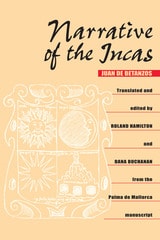
Narrative of the Incas
By Juan de Betanzos
University of Texas Press, 1996
One of the earliest chronicles of the Inca empire was written in the 1550s by Juan de Betanzos. Although scholars have long known of this work, only eighteen chapters were actually available until the 1980s when the remaining sixty-four chapters were discovered in the collection of the Fundación Bartolomé March in Palma de Mallorca, Spain.
Narrative of the Incas presents the first complete English translation of the original manuscript of this key document. Although written by a Spaniard, it presents an authentic Inca worldview, drawn from the personal experiences and oral traditions told to Betanzos by his Inca wife, Doña Angelina, and other members of her aristocratic family who lived during the reigns of the last Inca rulers, Huayna Capac Huascar and Atahualpa. Betanzos wrote a history of the Inca empire that focuses on the major rulers and the contributions each one made to the growth of the empire and of Inca culture.
Filled with new insights into Inca politics, marriage, laws, the calendar, warfare, and other matters, Narrative of the Incas is essential reading for everyone interested in this ancient civilization.
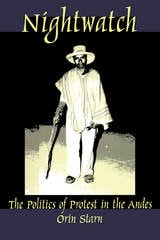
Nightwatch
The Politics of Protest in the AndesOrin Starn
Duke University Press, 1999
Drawing on fieldwork conducted over the course of a decade, Orin Starn chronicles the historical conditions that led to the formation of the rondas, the social and geographical expansion of the movement, and its gradual decline in the 1990s. Throughout this anecdotal yet deeply analytical account, the author relies on interviews with ronda participants, villagers, and Peru’s regional and national leaders to explore the role of women, the involvement of nongovernmental organizations, and struggles for leadership within the rondas. Starn moves easily from global to local contexts and from the fifteenth to the twentieth century, presenting this movement in a straightforward manner that makes it accessible to both specialists and nonspecialists.
An engagingly written story of village mobilization, Nightwatch is also a meditation on the nature of fieldwork, the representation of subaltern people, the relationship between resistance and power, and what it means to be politically active at the end of the century. It will appeal widely to scholars and students of anthropology, Latin American studies, cultural studies, history, subaltern studies, and those interested in the politics of social movements.
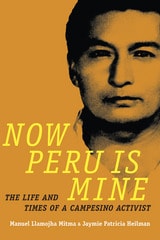
Now Peru Is Mine
The Life and Times of a Campesino ActivistManuel Llamojha Mitma and Jaymie Patricia Heilman
Duke University Press, 2016