Results by title
130 books match the query 'Philosophers' and 5 start with n

Nietzsche
Lou Salomé
University of Illinois Press, 1988
Published in 1894 as its subject languished in madness, Salomé's book rode the crest of a surge of interest in Nietzsche's iconoclastic philosophy. She discusses his writings and such biographical events as his break with Wagner, attempting to ferret out the man in the midst of his works.
Salomé's provocative conclusion -- that Nietzsche's madness was the inevitable result of his philosophical views -- generated considerable controversy. Nietzsche's sister, Elisabeth Förster-Nietzsche, dismissed the book as a work of fantasy. Yet the philosopher's longtime acquaintance Erwin Rohde wrote, "Nothing better or more deeply experienced or perceived has ever been written about Nietzsche."
Siegfried Mandel's extensive introduction examines the circumstances that brought Lou Salomé and Nietzsche together and the ideological conflicts that drove them apart.

Nietzsche's Kisses
A NovelLance Olsen
University of Alabama Press, 2006

Nietzsche's Philosophical Context
An Intellectual BiographyThomas Brobjer
University of Illinois Press, 2007
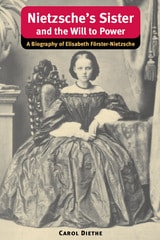
Nietzsche's Sister and the Will to Power
A Biography of Elisabeth Förster-NietzscheCarol Diethe
University of Illinois Press, 2002
In 1901, a year after her brother Friedrich's death, Elisabeth Förster-Nietzsche published The Will to Power, a hasty compilation of writings he had never intended for print. In Nietzsche's Sister and the Will to Power, Carol Diethe contends that Förster-Nietzsche's own will to power and her desire to place herself--not her brother--at the center of cultural life in Germany are centrally responsible for Nietzsche's reputation as a belligerent and proto-Fascist thinker.
Offering a new look at Nietzsche's sister from a feminist perspective, this spirited and erudite biography examines why Elisabeth Förster-Nietzsche recklessly consorted with anti-Semites, from her own husband to Hitler himself, out of convenience and a desire for revenge against a brother whose love for her waned after she caused the collapse of his friendship with Lou Salomé. The book also examines their family dynamics, Nietzsche's dismissal of his sister's early writing career, and the effects of limited education on intelligent women. Diethe concludes by detailing Förster-Nietzsche's brief marriage and her subsequent colonial venture in Paraguay, maintaining that her sporadic anti-Semitism was, like most things in her life, an expedient tool for cultivating personal success and status.
A volume in the series International Nietzsche Studies, edited by Richard Schacht
Nietzsche
Attempt at a MythologyErnst Bertram. Translated and with an Introduction by Robert E. Norton
University of Illinois Press, 2008
The only English translation of a crucial interpretation of Nietzsche
First published in 1918, Ernst Bertram's Nietzsche: Attempt at a Mythology substantially shaped the image of Nietzsche for the generation between the wars. It won the Nietzsche Society's first prize and was admired by luminous contemporaries including André Gide, Hermann Hesse, Gottfried Benn, and Thomas Mann. Although translated into French in 1932, the book was never translated into English following the decline of Nietzsche's and Bertram's reputations after 1945. Now, with Nietzsche's importance for twentieth-century thought undisputed, the work by one of his most influential interpreters can at last be read in English.Employing a perspectival technique inspired by Nietzsche himself, Bertram constructs a densely layered portrait of the thinker that shows him riven by deep and ultimately irresolvable cultural, historical, and psychological conflicts. At once lyrical and intensely probing, richly complex yet thematically coherent, Bertram's book is a masterpiece in a forgotten tradition of intellectual biography.