Results by title
210 books match the query 'Philosophy, Theory & Social Aspects' and 4 start with n

Naturalizing Philosophy of Education
John Dewey in the Postanalytic PeriodJerome A. Popp
Southern Illinois University Press, 1998
Jerome A. Popp examines the role of Dewey-based pragmatism in the past, present, and future of philosophy of education. He insists that even though Marx-ian utopian thought subjugated Dewey’s ideas during the 1970s, Dewey’s epistemological arguments are directly relevant to contemporary philosophy. He contends that not only are Dewey’s arguments related to how we think about philosophy of education; they actually improve the thinking reflected in the literature. Dewey’s arguments, he demonstrates, provide the basis for both a rejuvenated account of conceptual analysis and a criticism of the utopian relativism currently dominating the literature.
Popp notes that empiricism, manifested in the philosophy of education as analytic philosophy, holds that scientific findings, especially from psychology, have no place in philosophy. But contemporary writers in the philosophy of science contend that to justify the methods of science we must consider what is known about intelligence and cognitive processes. These arguments are relevant to the ways in which we justify claims about proper education.
Naturalizing epistemology (using the results of science in philosophic theories) leads to an enhanced account of Dewey’s instrumental approach to normative inquiry and strengthens attempts to justify educational practices. Dewey’s critique of utopian approaches to social theory is bolstered by contemporary arguments in epistemology and the philosophy of science. These arguments reject the attempt by some in philosophy of education to solve value questions through an appeal to utopian thinking. Popp agrees with Dewey’s view that the proper goals of education cannot be stated in these terms.

Negotiating Empire
The Cultural Politics of Schools in Puerto Rico, 1898–1952Solsiree del Moral
University of Wisconsin Press, 2013
Rather than seeing U.S. empire in Puerto Rico during this period as a contest between two sharply polarized groups, del Moral views their interaction as a process of negotiation. Although educators and families rejected some tenets of Americanization, such as English-language instruction, they also redefined and appropriated others to their benefit to increase literacy and skills required for better occupations and social mobility. Pushing their citizenship-building vision through the schools, Puerto Ricans negotiated a different school project—one that was reformist yet radical, modern yet traditional, colonial yet nationalist.
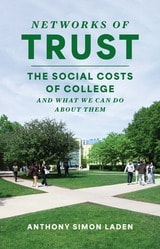
Networks of Trust
The Social Costs of College and What We Can Do about ThemAnthony Simon Laden
University of Chicago Press, 2024
Higher education is a familiar battlefield in today’s culture wars. The right accuses colleges and universities of indoctrinating conservative students with liberal values; the left, with failing to be sufficiently inclusive. The anxieties expressed on both sides of the political spectrum have much in common, however, and they are triggered not by colleges’ failures but by their successes.
So argues philosopher Anthony Simon Laden in Networks of Trust. He highlights how a college education shapes students’ informational trust networks: the complex set of people and institutions they rely on for the information they use to think about and understand the world. While the networks that colleges build for students have great value, learning to inhabit them pulls some students away from their families and communities. If many people distrust institutions of higher education, this is one reason why. Networks of Trust offers a path forward, one that preserves the value while reducing the harms of a college education. It includes concrete suggestions for how colleges and universities can educate students in a manner that inspires and deserves trust: one that bridges rather than deepens our social divides.
Networks of Trust
The Social Costs of College and What We Can Do about ThemAnthony Simon Laden
University of Chicago Press, 2024
An eye-opening look at how parents’ mistrust of colleges has less to do with what their kids are learning than with whom they come to trust.
Higher education is a familiar battlefield in today’s culture wars. The right accuses colleges and universities of indoctrinating conservative students with liberal values; the left, with failing to be sufficiently inclusive. The anxieties expressed on both sides of the political spectrum have much in common, however, and they are triggered not by colleges’ failures but by their successes.
So argues philosopher Anthony Simon Laden in Networks of Trust. He highlights how a college education shapes students’ informational trust networks: the complex set of people and institutions they rely on for the information they use to think about and understand the world. While the networks that colleges build for students have great value, learning to inhabit them pulls some students away from their families and communities. If many people distrust institutions of higher education, this is one reason why. Networks of Trust offers a path forward, one that preserves the value while reducing the harms of a college education. It includes concrete suggestions for how colleges and universities can educate students in a manner that inspires and deserves trust: one that bridges rather than deepens our social divides.