Results by title
426 books match the query 'Philosophy & Social Aspects' and 8 start with n
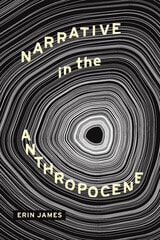
Narrative in the Anthropocene
Erin James
The Ohio State University Press, 2022
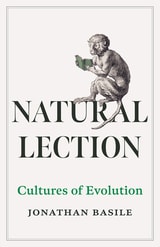
Natural Lection
Cultures of EvolutionJonathan Basile
University of Minnesota Press, 2026
A radical deconstructive approach to evolutionary theory
For as long as there has been evolutionary science, thinkers in the natural sciences, social sciences, and humanities have battled over whether evolutionary theory can or should provide insights into human nature and culture. Yet even the dissenters tend to agree that there is, somewhere, a natural foundation of instinctual or genetic inheritance; the debate is only whether and how human culture is an exception from it. Natural Lection complicates this fundamental boundary as it exposes how our scientific knowledge of nature rests on a faulty foundation that must be supplemented by humanist thought.
Jonathan Basile, as part of the emerging movement of biodeconstruction, extends the work of Jacques Derrida into the life sciences as he parses writing on cultural evolution to reveal the contradictions within our opposing notions of genealogically governed nature and networked or viral human culture. Holding this opposition in suspense, Basile proposes a new framework: natural lection, the view of nature not as original material but as the result of a shifting, always provisional act of reading. By paying careful attention to what biologists describe as a superficial layer of metaphor and rhetoric in their writing—but which he sees as an ineluctable textuality shaping the core of their work—Basile traces the political implications of scientific thought to its theoretical fragility, which calls for philosophical and literary modes of reading.
Showing how contemporary approaches to cultural evolution continue to repeat incoherent patterns of thought at least as old as Darwin—if not Aristotle—Natural Lection dismantles assumptions shared by evolutionary biology, cultural studies, and new materialism. By critically analyzing these foundations, Basile pushes back against the neoliberal and far-right weaponization of evolutionary theory, opening a novel terrain of scientific and political possibility.
Retail e-book files for this title are screen-reader friendly.
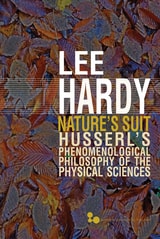
Nature’s Suit
Husserl’s Phenomenological Philosophy of the Physical SciencesLee Hardy
Ohio University Press, 2014
Edmund Husserl, founder of the phenomenological movement, is usually read as an idealist in his metaphysics and an instrumentalist in his philosophy of science. In Nature’s Suit, Lee Hardy argues that both views represent a serious misreading of Husserl’s texts.
Drawing upon the full range of Husserl’s major published works together with material from Husserl’s unpublished manuscripts, Hardy develops a consistent interpretation of Husserl’s conception of logic as a theory of science, his phenomenological account of truth and rationality, his ontology of the physical thing and mathematical objectivity, his account of the process of idealization in the physical sciences, and his approach to the phenomenological clarification and critique of scientific knowledge. Offering a jargon-free explanation of the basic principles of Husserl’s phenomenology, Nature’s Suit provides an excellent introduction to the philosophy of Edmund Husserl as well as a focused examination of his potential contributions to the philosophy of science.
While the majority of research on Husserl’s philosophy of the sciences focuses on the critique of science in his late work, The Crisis of European Sciences, Lee Hardy covers the entire breadth of Husserl’s reflections on science in a systematic fashion, contextualizing Husserl’s phenomenological critique to demonstrate that it is entirely compatible with the theoretical dimensions of contemporary science.
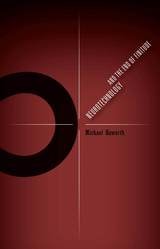
Neurotechnology and the End of Finitude
Michael Haworth
University of Minnesota Press, 2018
A bold philosophical investigation into technology and the limits of the human
A daring, original work of philosophical speculation, Neurotechnology and the End of Finitude mounts a sustained investigation into the possibility that human beings may technologically overcome the transcendental limits of possible experience and envisages what such a transition would look like. Focusing on emergent neurotechnologies, which establish a direct channel of communication between brain and machine, Michael Haworth argues that such technologies intervene at the border between interiority and exteriority, offering the promise of immediacy and the possibility of the mind directly affecting the outside world or even other minds.
Through detailed, targeted readings of Kant, Freud, Heidegger, Croce, Jung, and Derrida, Haworth explores the effect of this transformation on human creativity and our relationships with others. He pursues these questions across four distinct but interrelated spheres: the act of artistic creation and the potential for a technologically enabled coincidence of idea and object; the possibility of humanity achieving the infinite creativity that Kant attributed only to God; the relationship between the psyche and the external world in Freudian psychoanalysis and Jungian analytical psychology; and the viability and impact of techno-telepathic communication.
Addressing readers interested in contemporary continental philosophy and philosophy of technology, media and communications, and science and technology studies, Neurotechnology and the End of Finitude critically envisions a plausible posthuman future.
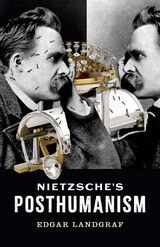
Nietzsche's Posthumanism
Edgar Landgraf
University of Minnesota Press, 2023
A timely and trenchant commentary on the centrality of Nietzsche’s thought for our time
While many posthumanists claim Nietzsche as one of their own, rarely do they engage his philosophy in any real depth. Nietzsche’s Posthumanism addresses this need by exploring the continuities and disagreements between Nietzsche’s philosophy and contemporary posthumanism. Focusing specifically on Nietzsche’s reception of the life sciences of his day and his reflections on technology—research areas as central to Nietzsche’s work as they are to posthumanism—Edgar Landgraf provides fresh readings of Nietzsche and a critique of post- and transhumanist philosophies.
Through Landgraf’s inquiry, lesser-known aspects of Nietzsche’s writings emerge, including the neurophysiological basis of his epistemology (which anticipates contemporary debates on embodiment), his concerns with insects and the emergent social properties they exhibit, and his reflections on the hominization and cultivation effects of technology. In the process, Landgraf challenges major commonplaces about Nietzsche’s philosophy, including the idea that his social theory asserts the rights of “the strong” over “the weak.” The ethos of critical posthumanism also offers a new perspective on key ethical and political contentions of Nietzsche’s writings.
Nietzsche’s Posthumanism presents a uniquely framed introduction to tenets of Nietzsche’s thought and major trends in posthumanism, making it an essential exploration for anyone invested in Nietzsche and his contemporary relevance, and in posthumanism and its genealogy.
Retail e-book files for this title are screen-reader friendly.
Nonhuman Humanitarians
Animal Interventions in Global PoliticsBenjamin Meiches
University of Minnesota Press, 2023
Examining the appearance of nonhuman animals laboring alongside humans in humanitarian operations
Both critical and mainstream scholarly work on humanitarianism have largely been framed from anthropocentric perspectives highlighting humanity as the rationale for providing care to others. In Nonhuman Humanitarians, Benjamin Meiches explores the role of animals laboring alongside humans in humanitarian operations, generating new ethical possibilities of care in humanitarian practice.
Nonhuman Humanitarians examines how these animals not only improve specific practices of humanitarian aid but have started to transform the basic tenets of humanitarianism. Analyzing case studies of mine-clearance dogs, milk-producing cows and goats, and disease-identifying rats, Nonhuman Humanitarians ultimately argues that nonhuman animal contributions problematize foundational assumptions about the emotional and rational capacities of humanitarian actors as well as the ethical focus on human suffering that defines humanitarianism.
Meiches reveals that by integrating nonhuman animals into humanitarian practice, several humanitarian organizations have effectively demonstrated that care, compassion, and creativity are creaturely rather than human and that responses to suffering and injustice do not—and cannot—stop at the boundaries of the human.
Nonsense on Stilts
Massimo Pigliucci
University of Chicago Press, 2018
In this era of fake news and alternative facts, there is more bunk than ever. But why do people believe in it? And what causes them to embrace such pseudoscientific beliefs and practices? In this fully revised second edition, noted skeptic Massimo Pigliucci sets out to separate the fact from the fantasy in an entertaining exploration of the nature of science, the borderlands of fringe science, and—borrowing a famous phrase from philosopher Jeremy Bentham—the nonsense on stilts. Presenting case studies on a number of controversial topics, Pigliucci cuts through the ambiguity surrounding science to look more closely at how science is conducted, how it is disseminated, how it is interpreted, and what it means to our society. The result is in many ways a “taxonomy of bunk” that explores the intersection of science and culture at large.
No one—neither the public intellectuals in the culture wars between defenders and detractors of science nor the believers of pseudoscience themselves—is spared Pigliucci’s incisive analysis in this timely reminder of the need to maintain a line between expertise and assumption. Broad in scope and implication, Nonsense on Stilts is a captivating guide for the intelligent citizen who wishes to make up her own mind while navigating the perilous debates that will shape the future of our planet.
Nonsense on Stilts
How to Tell Science from BunkMassimo Pigliucci
University of Chicago Press, 2010
Recent polls suggest that fewer than 40 percent of Americans believe in Darwin’s theory of evolution, despite it being one of science’s best-established findings. More and more parents are refusing to vaccinate their children for fear it causes autism, though this link can been consistently disproved. And about 40 percent of Americans believe that the threat of global warming is exaggerated, despite near consensus in the scientific community that manmade climate change is real.
Why do people believe bunk? And what causes them to embrace such pseudoscientific beliefs and practices? Noted skeptic Massimo Pigliucci sets out to separate the fact from the fantasy in this entertaining exploration of the nature of science, the borderlands of fringe science, and—borrowing a famous phrase from philosopher Jeremy Bentham—the nonsense on stilts. Presenting case studies on a number of controversial topics, Pigliucci cuts through the ambiguity surrounding science to look more closely at how science is conducted, how it is disseminated, how it is interpreted, and what it means to our society. The result is in many ways a “taxonomy of bunk” that explores the intersection of science and culture at large.
No one—not the public intellectuals in the culture wars between defenders and detractors of science nor the believers of pseudoscience themselves—is spared Pigliucci’s incisive analysis. In the end, Nonsense on Stilts is a timely reminder of the need to maintain a line between expertise and assumption. Broad in scope and implication, it is also ultimately a captivating guide for the intelligent citizen who wishes to make up her own mind while navigating the perilous debates that will affect the future of our planet.