Results by title
59 books match the query 'Philosophy and aesthetics' and 2 start with n
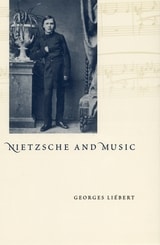
Nietzsche and Music
Georges Liébert
University of Chicago Press, 2003
"Without music, life would be an error."—Friedrich Nietzsche
In his youth, Friedrich Nietzsche yearned to become a great composer and wrote many pieces of music. He later claimed to be "the most musical of all philosophers." Yet most books on Nietzsche fail to explore the importance of music for his thought.
Nietzsche and Music provides the first in-depth examination of the fundamental significance of music for Nietzsche's life and work. Nietzsche's views on music are essential for understanding his philosophy as a whole. Part biography and part critical examination, Georges Liébert brilliantly demonstrates that despite failed attempts at a professional career as composer, Nietzsche never fully removed himself from the world of music, but instead, became a composer of philosophy, utilizing the musical form as a template for his own writings and creative thought. Liébert's study surveys Nietzsche's opinions about particular composers and compositions, as well as his more theoretical writings on music and its relation to the other arts. He also explores Nietzsche's listening habits, his playing and style of composition, and his many contacts in the musical world, including his controversial and contentious relationship with Richard Wagner. For Nietzsche, music gave access to a realm of wisdom that transcended thought. Music was Nietzsche's great solace; in his last years, it was his refuge from madness.
A virtuoso exploration of this little-known but crucial aspect of Nietzsche's life and work, this volume will be of enormous value to scholars of philosophy, music, aesthetics, and literature.
[more]
Nightingales in Berlin
Searching for the Perfect SoundDavid Rothenberg
University of Chicago Press, 2019
A celebrated figure in myth, song, and story, the nightingale has captivated the imagination for millennia, its complex song evoking a prism of human emotions,—from melancholy to joy, from the fear of death to the immortality of art.
But have you ever listened closely to a nightingale’s song? It’s a strange and unsettling sort of composition—an eclectic assortment of chirps, whirs, trills, clicks, whistles, twitters, and gurgles. At times it is mellifluous, at others downright guttural. It is a rhythmic assault, always eluding capture. What happens if you decide to join in?
As philosopher and musician David Rothenberg shows in this searching and personal new book, the nightingale’s song is so peculiar in part because it reflects our own cacophony back at us. As vocal learners, nightingales acquire their music through the world around them, singing amidst the sounds of humanity in all its contradictions of noise and beauty, hard machinery and soft melody. Rather than try to capture a sound not made for us to understand, Rothenberg seeks these musical creatures out, clarinet in tow, and makes a new sound with them. He takes us to the urban landscape of Berlin—longtime home to nightingale colonies where the birds sing ever louder in order to be heard—and invites us to listen in on their remarkable collaboration as birds and instruments riff off of each other’s sounds. Through dialogue, travel records, sonograms, tours of Berlin’s city parks, and musings on the place animal music occupies in our collective imagination, Rothenberg takes us on a quest for a new sonic alchemy, a music impossible for any one species to make alone. In the tradition of The Hidden Life of Trees and The Invention of Nature, Rothenberg has written a provocative and accessible book to attune us ever closer to the natural environment around us.
[more]