Results by title
267 books match the query 'Poetics' and 5 start with n
Names Of History
On the Poetics of KnowledgeJacques Ranciere
University of Minnesota Press, 1994
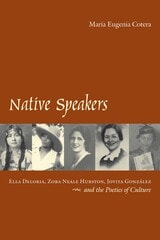
Native Speakers
Ella Deloria, Zora Neale Hurston, Jovita Gonzalez, and the Poetics of CultureBy María Eugenia Cotera
University of Texas Press, 2008
Gloria Anzaldua Book Prize, National Women's Studies Association, 2009
In the early twentieth century, three women of color helped shape a new world of ethnographic discovery. Ella Cara Deloria, a Sioux woman from South Dakota, Zora Neale Hurston, an African American woman from Florida, and Jovita González, a Mexican American woman from the Texas borderlands, achieved renown in the fields of folklore studies, anthropology, and ethnolinguistics during the 1920s and 1930s. While all three collaborated with leading male intellectuals in these disciplines to produce innovative ethnographic accounts of their own communities, they also turned away from ethnographic meaning making at key points in their careers and explored the realm of storytelling through vivid mixed-genre novels centered on the lives of women.
In this book, Cotera offers an intellectual history situated in the "borderlands" between conventional accounts of anthropology, women's history, and African American, Mexican American and Native American intellectual genealogies. At its core is also a meditation on what it means to draw three women—from disparate though nevertheless interconnected histories of marginalization—into conversation with one another. Can such a conversation reveal a shared history that has been erased due to institutional racism, sexism, and simple neglect? Is there a mode of comparative reading that can explore their points of connection even as it remains attentive to their differences? These are the questions at the core of this book, which offers not only a corrective history centered on the lives of women of color intellectuals, but also a methodology for comparative analysis shaped by their visions of the world.
No One's Witness
A Monstrous PoeticsSyd Zolf
Duke University Press, 2021
Noise That Stays Noise
EssaysCole Swensen
University of Michigan Press, 2011
Praise for Cole Swensen:
"One of the most assured voices in contemporary poetry."
---Library Journal
"Engaging and delightful."
---Publishers Weekly
A volume in the Poets on Poetry series, which collects critical works by contemporary poets, gathering together the articles, interviews, and book reviews by which they have articulated the poetics of a new generation.
Ezra Pound famously said that literature is "news that stays news," but recent experiments in poetry and the sciences allow us to enlarge the statement to bring information theory and biology to bear on the issue---in particular, how the information theory–based model of self-organization from noise offers a way to look at language as an art material as well as a mode of communication. This concept directs these essays on poetry by contemporary poet Cole Swensen.
Noise That Stays Noise covers a variety of subjects relevant to contemporary poetry and will give the general reader a broad notion of the issues that inform discourse around poetry today. Space---the conceptual geometry of poetry and its concrete mise-en-page---is an underlying theme of this collection, sometimes approached directly through the work of other twentieth-century poets, sometimes more obliquely through considerations of the role of the visual arts in contemporary poetry. This question of space and the shapes it includes and acquires offers a different way to look at some familiar writers, such as Mallarmé and Olson, and a way to introduce several more recent writers who may not yet be known to the general public.
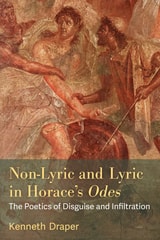
Non-Lyric and Lyric in Horace's Odes
The Poetics of Disguise and InfiltrationKenneth Draper
University of Michigan Press, 2026
Kenneth Draper’s new volume investigates genre, gender, and self-presentation in Horace’s first collection of Odes. It examines how Horace uses non-lyric genres—elegy, epic, invective, and philosophical discourse—to define his lyric project, responding to the rhetorical challenge of writing in the wake of civil war. It shows how Horace employs a “poetics of disguise and infiltration” in his engagement with these other genres. At times, he assimilates his lyric persona to an elegiac one, claiming to share elegy’s effeminacy and disinterest in politics. Similarly, he draws on philosophical discourse to present himself as too modest for heavy political themes. In both cases, he turns to clothing metaphors to identify the slight persona as a disguise that he may assume or discard as needed. Through this disingenuous self-presentation, he disavows interest in the masculine modes of epic and invective. Read as reflections on Horace’s own infiltration of epic territory, the examined scenes give clues about his motivations: focusing on the characters’ self-preservation amid dangers, he reminds readers of the risks and audacity of his project.