Results by title
637 books match the query 'Political activity' and 12 start with n

Naked Agency
Genital Cursing and Biopolitics in AfricaNaminata Diabate
Duke University Press, 2020

Narcissist Nation
Reflections of a Blue-State ConservativeGeorge J. Marlin
St. Augustine's Press, 2011
Nation as Network
Diaspora, Cyberspace, and CitizenshipVictoria Bernal
University of Chicago Press, 2014
Bernal argues that Benedict Anderson’s famous concept of nations as “imagined communities” must now be rethought because diasporas and information technologies have transformed the ways nations are sustained and challenged. She traces the development of Eritrean diaspora websites over two turbulent decades that saw the Eritrean state grow ever more tyrannical. Through Eritreans’ own words in posts and debates, she reveals how new subjectivities are formed and political action is galvanized online. She suggests that “infopolitics”—struggles over the management of information—make politics in the 21st century distinct, and she analyzes the innovative ways Eritreans deploy the internet to support and subvert state power. Nation as Network is a unique and compelling work that advances our understanding of the political significance of digital media.
National Liberation and the Political Life of Exile
Sex, Gender, and Nation in the Struggle Against ApartheidRachel Sandwell
Ohio University Press, 2025
The first book-length study to reveal how women in exile shaped South Africa’s antiapartheid movement
This groundbreaking book explores the often-overlooked role of women in South Africa’s liberation movements, particularly within the African National Congress during its years in exile from 1960 to 1990. It examines how transformations in gender roles—though contested—were central to imagining a postapartheid South Africa.
Through an analysis of women’s diplomatic work and their advocacy for policies on sexual education, birth control, family life, and childcare, Rachel Sandwell challenges traditional narratives that have ignored or minimized women’s contributions. She highlights how South African women played a crucial role in connecting exiles to left-wing international organizations like the Women’s International Democratic Federation, positioning women as key figures in global anticolonial politics.
The book also explores how gender transformation was at the heart of the exiled antiapartheid movement’s vision for a free South Africa. Women fought for recognition beyond the role of “mothers of the nation,” sparking internal debates over revolutionary morality, the compatibility of motherhood with military service, and responses to sexual and domestic violence within the movement. These struggles mirrored broader ideological conflicts over nation building, belonging, and political identity as the African National Congress sought legitimacy as a government-in-exile.
Ultimately, National Liberation and the Political Life of Exile asks how we write histories of revolutionary movements—especially those that, despite their transformative ambitions, did not fully realize their goals. A vital contribution to feminist history, anticolonial studies, and the history of global liberation struggles, this book reshapes our understanding of gender and politics in the antiapartheid movement.
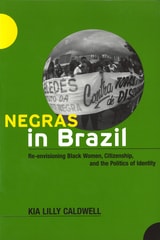
Negras in Brazil
Re-envisioning Black Women, Citizenship, and the Politics of IdentityCaldwell, Kia Lilly
Rutgers University Press, 2006
In Negras in Brazil, Kia Lilly Caldwell examines the life experiences of Afro-Brazilian women whose stories have until now been largely untold. This pathbreaking study analyzes the links between race and gender and broader processes of social, economic, and political exclusion. Drawing on ethnographic research with social movement organizations and thirty-five life history interviews, Caldwell explores the everyday struggles Afro-Brazilian women face in their efforts to achieve equal rights and full citizenship. She also shows how the black women's movement, which has emerged in recent decades, has sought to challenge racial and gender discrimination in Brazil. While proposing a broader view of citizenship that includes domains such as popular culture and the body, Negras in Brazil highlights the continuing relevance of identity politics for members of racially marginalized communities. Providing new insights into black women's social activism and a gendered perspective on Brazilian racial dynamics, this book will be of interest to students and scholars of Latin American Studies, African diaspora studies, women's studies, politics, and cultural anthropology.
New Perspectives on Environmental Justice
Gender, Sexuality, and ActivismStein, Rachel
Rutgers University Press, 2004
Women make up the vast majority of activists and organizers of grassroots movements fighting against environmental ills that threaten poor and people of color communities. New Perspectives on Environmental Justice is the first collection of essays that pays tribute to the enormous contributions women have made in these endeavors.
The writers offer varied examples of environmental justice issues such as children's environmental health campaigns, cancer research, AIDS/HIV activism, the Environmental Genome Project, and popular culture, among many others. Each one focuses on gender and sexuality as crucial factors in women's or gay men's activism and applies environmental justice principles to related struggles for sexual justice. The contributors represent a wide variety of activist and scholarly perspectives including law, environmental studies, sociology, political science, history, medical anthropology, American studies, English, African and African American studies, women's studies, and gay and lesbian studies, offering multiple vantage points on gender, sexuality, and activism.
Feminist/womanist impulses shape and sustain environmental justice movements around the world, making an understanding of gender roles and differences crucial for the success of these efforts.
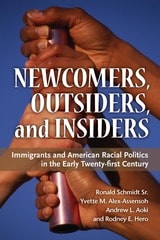
Newcomers, Outsiders, and Insiders
Immigrants and American Racial Politics in the Early Twenty-first CenturyRonald Schmidt Sr., Yvette M. Alex-Assensoh, Andrew L. Aoki, and Rodney E. Hero
University of Michigan Press, 2009
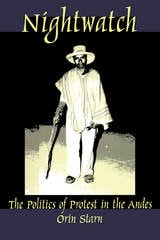
Nightwatch
The Politics of Protest in the AndesOrin Starn
Duke University Press, 1999
Drawing on fieldwork conducted over the course of a decade, Orin Starn chronicles the historical conditions that led to the formation of the rondas, the social and geographical expansion of the movement, and its gradual decline in the 1990s. Throughout this anecdotal yet deeply analytical account, the author relies on interviews with ronda participants, villagers, and Peru’s regional and national leaders to explore the role of women, the involvement of nongovernmental organizations, and struggles for leadership within the rondas. Starn moves easily from global to local contexts and from the fifteenth to the twentieth century, presenting this movement in a straightforward manner that makes it accessible to both specialists and nonspecialists.
An engagingly written story of village mobilization, Nightwatch is also a meditation on the nature of fieldwork, the representation of subaltern people, the relationship between resistance and power, and what it means to be politically active at the end of the century. It will appeal widely to scholars and students of anthropology, Latin American studies, cultural studies, history, subaltern studies, and those interested in the politics of social movements.

No God but Man
On Race, Knowledge, and TerrorismAtiya Husain
Duke University Press, 2025
Nomadic Identities
The Performance Of CitizenshipMay Joseph
University of Minnesota Press, 1999
A look at citizenship through the lens of performance.
In a modern world of vast migrations and relocations, the rights—and rites—of citizenship are increasingly perplexing, and ever more important. This book asks how citizenship is enacted when all the world’s the stage.
Kung Fu cinema, soul music, plays, and speeches are some of the media May Joseph considers as expressive negotiations for legal and cultural citizenship. Nomadic Identities combines material culture and historical approaches to forge connections between East Africa, India, Britain, the Caribbean, and the United States in the struggles for democratic citizenship. Exploring the notion of nomadic citizenship as a modern construct, Joseph emphasizes culture as the volatile mise-en-scène through which popular conceptions of local and national citizenship emerge. Joseph, an Asian African from Tanzania, brings a personal insight to the question of how citizenship is expressed—particularly the nomadic, conditional citizenship related to histories of migrancy and the tenuous status of immigrants. Nomadic Identities investigates the metaphoric, literal, and performed possibilities available in different arenas of the everyday through which individuals and communities experience citizenship, successfully or not. A unique inquiry into contemporary experiences of migrancy linking Tanzania, Britain, and the United States, this book blends political theory, performance studies, cultural studies, and historical writing. It offers vignettes that describe the official and informal cultural transactions that designate citizenship under the globalizing forces of decolonization, the cold war, and transnational networks.Crossing the globe, Nomadic Identities provides fresh insights into the contemporary phenomena of territorial displacement and the resulting local and transnational movements of people.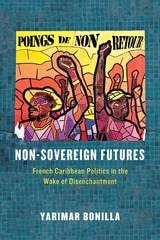
Non-Sovereign Futures
French Caribbean Politics in the Wake of DisenchantmentYarimar Bonilla
University of Chicago Press, 2015
Through a deep ethnography of Guadeloupean labor activism, Bonilla examines how Caribbean political actors navigate the conflicting norms and desires produced by the modernist project of postcolonial sovereignty. Exploring the political and historical imaginaries of activist communities, she examines their attempts to forge new visions for the future by reconfiguring narratives of the past, especially the histories of colonialism and slavery. Drawing from nearly a decade of ethnographic research, she shows that political participation—even in failed movements—has social impacts beyond simple material or economic gains. Ultimately, she uses the cases of Guadeloupe and the Caribbean at large to offer a more sophisticated conception of the possibilities of sovereignty in the postcolonial era.
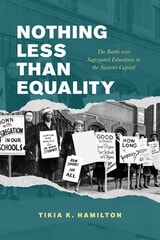
Nothing Less Than Equality
The Battle over Segregated Education in the Nation’s CapitalTikia K. Hamilton
University of Chicago Press, 2026
The landmark Brown v. Board of Education case, which barred racial segregation in American public schools, wasn’t the only path for Black parents, teachers, and activists who sought equality of educational opportunity. Some believed that the solution to inequality lay in pressing the federal government to live up to the Jim Crow doctrine of “separate but equal” by providing more resources to Black schools. And for a time, this seemed true in Washington, DC, where Black activists leveraged their status as residents of the nation’s capital to advocate on behalf of Black education. However, disappointments with the “separate but equal” strategy and a sea change in activism led to an embrace of integration.
In Nothing Less Than Equality, Tikia K. Hamilton reveals the rich and complex history of educational activism in Washington prior to Brown v. Board of Education, illuminating complex dynamics that provide a counterpoint and backdrop to the landmark Supreme Court case. Hamilton thoroughly examines the multipronged strategies employed by parents, teachers, attorneys, and activists to democratize education, demonstrating that there was no linear path to Brown.