Results by title
207 books match the query 'Political participation' and 7 start with n

NEWER IDEALS OF PEACE
Jane Addams
University of Illinois Press, 2006
In this her second book, Jane Addams moves beyond humanitarian appeals to sensibility and prudence, advancing a more aggressive, positive idea of peace as a dynamic social process emerging out of the poorer quarters of cosmopolitan cities. Her deep analysis of relations among diverse groups in U.S. society, exemplified by inter-ethnic and labor relations in Chicago, draws widely useful lessons for both domestic and global peace, in an early formulation of today’s "globalization from below."
In an unprecedented, revolutionary critique of the pervasive militarization of society, Addams applies her scathing pen to traditional advocates and philosophers of “negative” peace, founders of the U.S. constitution, militarists, bigots, imperialists, and theories of “democratic peace” and liberal capitalism. Instead she sees a slow, powerful emergence of forces from below--the poor, the despised, workers, women, ethnic and racial communities, oppressed groups at home and abroad--that would invent moral substitutes for war and gradually shape a just, peaceful, and varied social order. An extensive, in-depth introduction by Berenice Carroll and Clinton Fink provides historical context, analysis, and a reassessment of the theoretical and practical significance of Newer Ideals of Peace today.
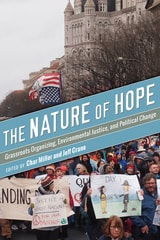
Nature of Hope
Grassroots Organizing, Environmental Justice, and Political ChangeChar Miller
University Press of Colorado, 2018
Through lively and accessible storytelling, The Nature of Hope reveals unsung and unstinting efforts to protect the physical environment and human health in the face of continuing economic growth and development and the failure of state and federal governments to deal adequately with the resulting degradation of air, water, and soils. In an age of environmental crisis, apathy, and deep-seated cynicism, these efforts suggest the dynamic power of a “politics of hope” to offer compelling models of resistance, regeneration, and resilience. The contributors frame their chapters around the drive for greater democracy and improved human and ecological health and demonstrate that local activism is essential to the preservation of democracy and the protection of the environment. The book also brings to light new styles of leadership and new structures for activist organizations, complicating assumptions about the environmental movement in the United States that have focused on particular leaders, agencies, thematic orientations, and human perceptions of nature.
The critical implications that emerge from these stories about ecological activism are crucial to understanding the essential role that protecting the environment plays in sustaining the health of civil society. The Nature of Hope will be crucial reading for scholars interested in environmentalism and the mechanics of social movements and will engage historians, geographers, political scientists, grassroots activists, humanists, and social scientists alike.
Neither Liberal nor Conservative
Ideological Innocence in the American PublicDonald R. Kinder and Nathan P. Kalmoe
University of Chicago Press, 2017
Well, American elites disagree fiercely. But average Americans do not. This, at least, was the position staked out by Philip Converse in his famous essay on belief systems, which drew on surveys carried out during the Eisenhower Era to conclude that most Americans were innocent of ideology. In Neither Liberal nor Conservative, Donald Kinder and
Nathan Kalmoe argue that ideological innocence applies nearly as well to the current state of American public opinion. Real liberals and real conservatives are found in impressive numbers only among those who are deeply engaged in political life. The ideological battles between American political elites show up as scattered skirmishes in the general public, if they show up at all.
If ideology is out of reach for all but a few who are deeply and seriously engaged in political life, how do Americans decide whom to elect president; whether affirmative action is good or bad? Kinder and Kalmoe offer a persuasive group-centered answer. Political preferences arise less from ideological differences than from the attachments and antagonisms of group life.
New Advances in the Study of Civic Voluntarism
Resources, Engagement, and RecruitmentCasey Klofstad
Temple University Press, 2016
Individuals who are civically active have three things in common: they have the capacity to do so, they want to, and they have been asked to participate. New Advances in the Study of Civic Voluntarism is dedicated to examining the continued influence of these factors—resources, engagement, and recruitment—on civic participation in the twenty-first century.
The contributors to this volume examine recent social, political, technological, and intellectual changes to provide the newest research in the field. Topics range from race and religion to youth in the digital age, to illustrate the continued importance of understanding the role of the everyday citizen in a democratic society.
Contributors include:Molly Andolina, Allison P. Anoll, Leticia Bode, Henry E. Brady, Traci Burch, Barry C. Burden, Andrea Louise Campbell, David E. Campbell, Sara Chatfield, Stephanie Edgerly, Zoltán Fazekas, Lisa García Bedoll, Peter K. Hatemi, John Henderson, Krista Jenkins, Yanna Krupnikov, Adam Seth Levine, Melissa R. Michelson, S. Karthick Ramakrishnan, Dinorah Sánchez Loza, Kay Lehman Schlozman, Dhavan Shah, Sono Shah, Kjerstin Thorson, Sidney Verba, Logan Vidal, Emily Vraga, Chris Wells, JungHwan Yang, and the editor.
Nomadic Identities
The Performance Of CitizenshipMay Joseph
University of Minnesota Press, 1999
A look at citizenship through the lens of performance.
In a modern world of vast migrations and relocations, the rights—and rites—of citizenship are increasingly perplexing, and ever more important. This book asks how citizenship is enacted when all the world’s the stage.
Kung Fu cinema, soul music, plays, and speeches are some of the media May Joseph considers as expressive negotiations for legal and cultural citizenship. Nomadic Identities combines material culture and historical approaches to forge connections between East Africa, India, Britain, the Caribbean, and the United States in the struggles for democratic citizenship. Exploring the notion of nomadic citizenship as a modern construct, Joseph emphasizes culture as the volatile mise-en-scène through which popular conceptions of local and national citizenship emerge. Joseph, an Asian African from Tanzania, brings a personal insight to the question of how citizenship is expressed—particularly the nomadic, conditional citizenship related to histories of migrancy and the tenuous status of immigrants. Nomadic Identities investigates the metaphoric, literal, and performed possibilities available in different arenas of the everyday through which individuals and communities experience citizenship, successfully or not. A unique inquiry into contemporary experiences of migrancy linking Tanzania, Britain, and the United States, this book blends political theory, performance studies, cultural studies, and historical writing. It offers vignettes that describe the official and informal cultural transactions that designate citizenship under the globalizing forces of decolonization, the cold war, and transnational networks.Crossing the globe, Nomadic Identities provides fresh insights into the contemporary phenomena of territorial displacement and the resulting local and transnational movements of people.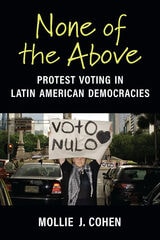
None of the Above
Protest Voting in Latin American DemocraciesMollie J. Cohen
University of Michigan Press, 2024
Winner of the 2025 International Society of Political Psychology David O. Sears Best Book on Mass Politics Award
Around the world each year, millions of citizens turn out to vote but leave their ballots empty or spoil them. Increasingly, campaigns have emerged that promote “invalid” votes like these. Why do citizens choose to cast blank and spoiled votes? And how do campaigns mobilizing the invalid vote influence this decision? None of the Above answers these questions using evidence from presidential and gubernatorial elections in eighteen Latin American democracies. Author Mollie J. Cohen draws on a broad range of methods and sources, incorporating data from electoral management bodies, nationally representative surveys, survey experiments, focus groups, semi-structured interviews, and news sources.
Contrary to received wisdom, this book shows that most citizens cast blank or spoiled votes in presidential elections on purpose. By participating in invalid vote campaigns, citizens can voice their concerns about low-quality candidates while also expressing a preference for high-quality democracy. Campaigns promoting blank and spoiled votes come about more often, and succeed at higher rates, when incumbent politicians undermine the quality of elections. Surprisingly, invalid vote campaigns can shore up the quality of democracy in the short term. None of the Above shows that swings in blank and spoiled vote rates can serve as a warning about the trajectory of a country’s democracy.
Numbered Voices
How Opinion Polling Has Shaped American PoliticsSusan Herbst
University of Chicago Press, 1993
Exploring the history of public opinion in the United States from the mid-nineteenth century to the present day, Herbst shows how numbers served both instrumental and symbolic functions, not only conveying neutral information but creating a basis authority. Addressing how the quantification of public opinion has affected contemporary politics and the democratic process, Herbst asks difficult but fundamental questions about the workings of American politics.
"An original and thought-provoking analysis of why we have polls, what they accomplish, and how they affect the current political scene. Herbst's scholarship is impeccable, her writing is clear and crisp, and her findings are original. . . . Every reader will benefit by carefully weighing the issues she raises and the conclusions she draws."—Doris A. Graber, Political Science Quarterly
"An intelligent, theoretically rich, and historically broad account of public opinion over several millennia. . . . The historical accounts are interesting and her interpretations are thought-provoking."—Paul Brace, Journal of American History