Results by title
272 books match the query 'Presidents' and 3 start with n
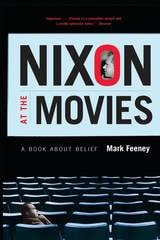
Nixon at the Movies
A Book about BeliefMark Feeney
University of Chicago Press, 2004
Was it an omen? Richard Nixon and the film industry arrived in Southern California in the same year, 1913. As Mark Feeney relates in this unusual and unusually absorbing book, Nixon and the movies have shared a long and complex history. Some of that history—the president's multiple screenings of Patton before and during the invasion of Cambodia, or Oliver Stone's Nixon—is well known. Yet much more is not. How many are aware, for example, that Nixon was an enthusiastic filmgoer who watched more than five hundred movies during his presidency?
Nixon at the Movies takes a new and often revelatory approach to looking at Nixon's career—and Hollywood's. From the obvious (All the President's Men) to the less so (Elvis Presley movies and Nixon's relationship to '60s youth culture) to several onscreen "alternate" Nixons (Fred MacMurray in Double Indemnity, Tony Curtis in The Sweet Smell of Success, Gene Hackman in The Conversation), Feeney sees aspects of Nixon's character, and the nation's, refracted and reimagined in film. Conversely, Feeney argues that Nixon can help us see the movies in a new light, making a strong case for Nixon as the movies' tutelary deity during the early '70s, playing a role in Hollywood's Silver Age comparable to FDR's during its Golden Age.
Stylishly written and bracingly eclectic, Nixon at the Movies draws on biography, politics, cultural history, and film criticism to show just how deeply in the twentieth-century American grain lies the pair of seemingly incongruous nouns in its title. As Nixon once remarked to Garry Wills: "Isn't that a hell of a thing, that the fate of a great country can depend on camera angles?"
[more]
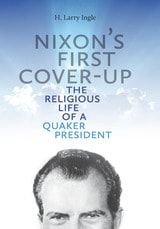
Nixon's First Cover-up
The Religious Life of a Quaker PresidentH. Larry Ingle
University of Missouri Press, 2015
Have you ever thought you completely knew a story, inside and out, only to see some new information that shatters what you had come to accept as unquestioned fact? Well, Richard Nixon is that story, and Nixon’s First Cover-up is that new information.
With few exceptions, the religious ideologies and backgrounds of U.S. presidents is a topic sorely lacking in analysis. H. Larry Ingle seeks to remedy this situation regarding Nixon—one of the most controversial and intriguing of the presidents. Ingle delves more deeply into Nixon’s Quaker background than any previous scholar to observe the role Nixon’s religion played in his political career.
Nixon’s unique and personally tailored brand of evangelical Quakerism stayed hidden when he wanted it to, but was on display whenever he felt it might help him advance his career in some way. Ingle’s unparalleled knowledge of Quakerism enables him to deftly point out how Nixon bent the traditional rules of the religion to suit his needs or, in some cases, simply ignored them entirely. This theme of the constant contradiction between Nixon’s actions and his apparent religious beliefs makes Nixon’s First Cover-up truly a groundbreaking study both in the field of Nixon research as well as the field of the influence of religion on the U.S. presidency. Forty years after Nixon’s resignation from office, Ingle’s work proves there remains much about the thirty-seventh president that the American public does not yet know.
[more]
Nothing to Read
Newspapers and Elections in a Social ExperimentJeffery J. Mondak
University of Michigan Press, 1995
How important are local newspapers for disseminating information during election campaigns? A large body of literature theorizes that they should have very little effect on political behavior since the electorate is largely immune to any media influence. To what lengths would the average citizen go to obtain information about candidates should a media source suddenly be suspended during an election? Most of the literature argues that the average citizen would not seek out any additional information to supplement what they passively acquire. A newspaper strike in Pittsburgh during the 1992 elections afforded Jeffery J. Mondak an unparalleled opportunity to test these assumptions--and to prove them both wrong.
Nothing to Read compares the information gathering and voting behavior of residents in Pittsburgh and Cleveland during the 1992 campaign season. Comparable in demographics and political behavior, the only significant difference between the two cities was the availability of local newspapers. Using a research design that combines elements of the opinion survey and the laboratory experiment, the author exploited this situation to produce an unusually sound and thorough examination of media effects on voters.
The results are startling. First and foremost, Nothing to Read reasserts the role of the newspaper in the dissemination of information acquisition. It is the only media source that can rival television in the electoral arena, and it is often more important to voters as a source for local information, including information about U.S. House races. Nothing to Read also shows that voters are more active in seeking out information than typically postulated. Indeed, many voters even differentiate between media sources for information about Senate and House contests and sources for the presidential campaign. Within limits, the electorate is clearly not a passive news audience. Nothing to Read provides a wealth of information on such related topics as the relationship between partisanship and media influence, the interplay between media exposure and interpersonal political conversations and other social interaction, and newspapers' effect on coattail voting. A unique book, Mondak's important study lays a solid foundation for all future work on the relationship between American media and politics.
Jeffery J. Mondak is Associate Professor of Political Science, University of Pittsburgh.
[more]