50 books match the query 'Press and politics' and 5 start with n

cover of NEWSPEAK in the 21st Century

NEWSPEAK in the 21st Century

David Cromwell and David Edwards

Pluto Press, 2009

Since 2001, Media Lens has encouraged thousands of readers to challenge the filtered and distorted version of the world provided by major newspapers and broadcasters. The media responses, collected in Newspeak, are an exposé of the arrogance and servility to power of our leading journalists and editors, starring Andrew Marr, Alan Rusbridger, Roger Alton, Jon Snow, Jeremy Bowen and even George Monbiot.

Picking up where the highly acclaimed and successful Guardians of Power (2006) left off, Newspeak is packed with forensic media analysis, revealing the lethal bias in "balanced" reporting. Even the "best" UK media -- the Guardian, the Independent, Channel 4 News and the BBC -- turn out to be cheerleaders for government, business and war.

Alongside an A-Z of BBC propaganda and chapters on Iraq and climate change, Newspeak focuses on the demonisation of Iran and Venezuela, the Israel-Palestine conflict, the myth of impartial reporting and the dark art of smearing dissidents.

[more]
cover of News: The Politics of Illusion, Tenth Edition

News

The Politics of Illusion, Tenth Edition

W. Lance Bennett

University of Chicago Press, 2016
For over thirty years, News: The Politics of Illusion has not simply reflected the political communication field—it has played a major role in shaping it. Today, the familiar news organizations of the legacy press are operating in a fragmenting and expanding mediaverse that resembles a big bang of proliferating online competitors that are challenging the very definition of news itself. Audience-powered sites such as the Huffington Post and Vox blend conventional political reporting with opinion blogs, celebrity gossip, and other ephemera aimed at getting clicks and shares. At the same time, the rise of serious investigative organizations such as ProPublica presents yet a different challenge to legacy journalism. Lance Bennett’s thoroughly revised tenth edition offers the most up-to-date guide to understanding how and why the media and news landscapes are being transformed. It explains the mix of old and new, and points to possible outcomes. Where areas of change are clearly established, key concepts from earlier editions have been revised. There are new case studies, updates on old favorites, and insightful analyses of how the new media system and novel kinds of information and engagement are affecting our politics. As always, News presents fresh evidence and arguments that invite new ways of thinking about the political information system and its place in democracy.
 
[more]
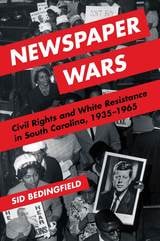
cover of Newspaper Wars: Civil Rights and White Resistance in South Carolina, 1935-1965

Newspaper Wars

Civil Rights and White Resistance in South Carolina, 1935-1965

Sid Bedingfield

University of Illinois Press, 2017
Against all odds, the seeds of social change found purchase in mid-twentieth century South Carolina. Newspaperman John McCray and his allies at the Lighthouse and Informer challenged readers to "rebel and fight"--to reject the "slavery of thought and action" and become "progressive fighters" for equality. Newspaper Wars traces the role journalism played in the fight for civil rights in South Carolina from the 1930s through the 1960s. Moving the press to the center of the political action, Sid Bedingfield tells the stories of the long-overlooked men and women on the front lines of a revolution. African American progress sparked a battle to shape South Carolina's civic life, with civil rights activists arrayed against white journalists determined to preserve segregation through massive resistance. As that strategy failed, white newspapers turned to overt political action and crafted the still-prevalent narratives that aligned southern whites with the national conservative movement. A fascinating portrait of a defining time, Newspaper Wars analyzes the role journalism played--and still can play--during times of social, cultural, and political change.
[more]
cover of Normative Theories of the Media: Journalism in Democratic Societies

Normative Theories of the Media

Journalism in Democratic Societies

Clifford G. Christians, Theodore Glasser, Denis McQuail, Kaarle Nordenstreng, Ro

University of Illinois Press, 2008
In this book, five leading scholars of media and communication take on the difficult but important task of explicating the role of journalism in democratic societies. Using Fred S. Siebert, Theodore Peterson, and Wilbur Schramm's classic Four Theories of the Press as their point of departure, the authors explore the philosophical underpinnings and the political realities that inform a normative approach to questions about the relationship between journalism and democracy, investigating not just what journalism is but what it ought to be. The authors identify four distinct yet overlapping roles for the media: the monitorial role of a vigilant informer collecting and publishing information of potential interest to the public; the facilitative role that not only reports on but also seeks to support and strengthen civil society; the radical role that challenges authority and voices support for reform; and the collaborative role that creates partnerships between journalists and centers of power in society, notably the state, to advance mutually acceptable interests. Demonstrating the value of a reconsideration of media roles, Normative Theories of the Media provides a sturdy foundation for subsequent discussions of the changing media landscape and what it portends for democratic ideals.
[more]
cover of Nothing to Read: Newspapers and Elections in a Social Experiment

Nothing to Read

Newspapers and Elections in a Social Experiment

Jeffery J. Mondak

University of Michigan Press, 1995

How important are local newspapers for disseminating information during election campaigns? A large body of literature theorizes that they should have very little effect on political behavior since the electorate is largely immune to any media influence. To what lengths would the average citizen go to obtain information about candidates should a media source suddenly be suspended during an election? Most of the literature argues that the average citizen would not seek out any additional information to supplement what they passively acquire. A newspaper strike in Pittsburgh during the 1992 elections afforded Jeffery J. Mondak an unparalleled opportunity to test these assumptions--and to prove them both wrong.
Nothing to Read compares the information gathering and voting behavior of residents in Pittsburgh and Cleveland during the 1992 campaign season. Comparable in demographics and political behavior, the only significant difference between the two cities was the availability of local newspapers. Using a research design that combines elements of the opinion survey and the laboratory experiment, the author exploited this situation to produce an unusually sound and thorough examination of media effects on voters.
The results are startling. First and foremost, Nothing to Read reasserts the role of the newspaper in the dissemination of information acquisition. It is the only media source that can rival television in the electoral arena, and it is often more important to voters as a source for local information, including information about U.S. House races. Nothing to Read also shows that voters are more active in seeking out information than typically postulated. Indeed, many voters even differentiate between media sources for information about Senate and House contests and sources for the presidential campaign. Within limits, the electorate is clearly not a passive news audience. Nothing to Read provides a wealth of information on such related topics as the relationship between partisanship and media influence, the interplay between media exposure and interpersonal political conversations and other social interaction, and newspapers' effect on coattail voting. A unique book, Mondak's important study lays a solid foundation for all future work on the relationship between American media and politics.
Jeffery J. Mondak is Associate Professor of Political Science, University of Pittsburgh.
[more]