Results by title
74 books match the query 'Puerto Rico' and 2 start with n
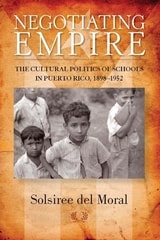
Negotiating Empire
The Cultural Politics of Schools in Puerto Rico, 1898–1952Solsiree del Moral
University of Wisconsin Press, 2013
After the United States invaded Puerto Rico in 1898, the new unincorporated territory sought to define its future. Seeking to shape the next generation and generate popular support for colonial rule, U.S. officials looked to education as a key venue for promoting the benefits of Americanization. At the same time, public schools became a site where Puerto Rican teachers, parents, and students could formulate and advance their own projects for building citizenship. In Negotiating Empire, Solsiree del Moral demonstrates how these colonial intermediaries aimed for regeneration and progress through education.
Rather than seeing U.S. empire in Puerto Rico during this period as a contest between two sharply polarized groups, del Moral views their interaction as a process of negotiation. Although educators and families rejected some tenets of Americanization, such as English-language instruction, they also redefined and appropriated others to their benefit to increase literacy and skills required for better occupations and social mobility. Pushing their citizenship-building vision through the schools, Puerto Ricans negotiated a different school project—one that was reformist yet radical, modern yet traditional, colonial yet nationalist.
Rather than seeing U.S. empire in Puerto Rico during this period as a contest between two sharply polarized groups, del Moral views their interaction as a process of negotiation. Although educators and families rejected some tenets of Americanization, such as English-language instruction, they also redefined and appropriated others to their benefit to increase literacy and skills required for better occupations and social mobility. Pushing their citizenship-building vision through the schools, Puerto Ricans negotiated a different school project—one that was reformist yet radical, modern yet traditional, colonial yet nationalist.
[more]

Not of Pure Blood
The Free People of Color and Racial Prejudice in Nineteenth-Century Puerto RicoJay Kinsbruner
Duke University Press, 1996
Countering the popular misconception that racial discrimination has largely not existed in Puerto Rico, Jay Kinsbruner’s Not of Pure Blood shows that racial prejudice has long had an insidious effect on Puerto Rican society. Kinsbruner’s study focuses on the free people of color—those of African descent who were considered nonwhite but were legally free during slavery—in order to explore the nature of racial prejudice in nineteenth-century Puerto Rico. In considering the consequences of these nineteenth-century attitudes on twentieth-century Puerto Rico, Kinsbruner suggests that racial discrimination continues to limit opportunities for people of color.
Following a discussion of Puerto Rican racial prejudice in historical perspective, Kinsbruner describes residential patterns, marriages, births, deaths, occupations, and family and household matters to demonstrate that free people of color were a disadvantaged community whose political, social, and economic status was diminished by racism. He analyzes the complexities and contradictions of Puerto Rican racial prejudice and discrimination, explains the subtleties of “shade discrimination,” and examines the profoundly negative impact on race relations of the U.S. occupation of the island following the Spanish American War.
Looking behind the myth of Puerto Rican racial equity, Not of Pure Blood will be of interest to specialists in Caribbean studies, Puerto Rican history, and Latin America studies, and to scholars in a variety of fields investigating questions of racism and discrimination.
[more]