140 books match the query 'Queer theory' and 5 start with n
cover of Narrative Theory Unbound: Queer and Feminist Interventions

Narrative Theory Unbound

Queer and Feminist Interventions

Edited by Robyn Warhol and Susan S. Lanser

The Ohio State University Press, 2015

Under the bold banner of Narrative Theory Unbound: Queer and Feminist Interventions, editors Robyn Warhol and Susan S. Lanser gather a diverse spectrum of queer and feminist challenges to the theory and interpretation of narrative. The first edited collection to bring feminist, queer, and narrative theories into direct conversation with one another, this anthology places gender and sexuality at the center of contemporary theorizing about the production, reception, forms, and functions of narrative texts.   
 
Through twenty-one essays prefaced by a cogent history of the field, Narrative Theory Unbound offers new perspectives on narrative discourse and its constituent elements; on intersectional approaches that recognize race, religion, and national culture as integral to understanding sexuality and gender; on queer temporalities; on cognitive research; and on lifewriting in graphic, print, and digital constellations. Exploring genres ranging from reality TV to fairy tales to classical fiction, contributors explore the thorny, contested relationships between feminist and queer theory, on the one hand, and between feminist/queer theory and contemporary narratologies, on the other. Rather than aiming for cohesiveness or conclusiveness, the collection stages open-ended debates designed to unbind the assumptions that have kept gender and sexuality on the periphery of narrative theory.
[more]
cover of Naturalization: A Queer Genealogy of US Citizenship, Race, and Sexuality

Naturalization

A Queer Genealogy of US Citizenship, Race, and Sexuality

Siobhan B. Somerville

Duke University Press, 2026
Amid contentious debates about citizenship, borders, and belonging, naturalization tends to stand apart, widely celebrated as the culmination of immigrant narratives and American ideals of liberalism. In Naturalization, Siobhan B. Somerville unsettles this story, showing how the process of citizen-making has historically been embedded in normative assumptions about race, indigeneity, and sexuality that have sustained the US settler colonial project. Tracing an alternative genealogy of naturalization from the eighteenth century through the mid-twentieth, Somerville investigates overlooked stories not only of immigrants but also of Indigenous people, formerly enslaved people of African descent, and inhabitants of US territories, many of whom became US citizens through collective naturalization, often without their consent. Somerville’s interdisciplinary approach to a wide-ranging archive—including federal law, photographs, letters, and memoirs—shows how naturalization has long functioned as both a powerful metaphor and a contradictory material practice at the core of the US settler colonial state.
[more]
cover of Nature's Wild: Love, Sex, and Law in the Caribbean

Nature's Wild

Love, Sex, and Law in the Caribbean

Andil Gosine

Duke University Press, 2021

In Nature's Wild, Andil Gosine engages with questions of humanism, queer theory, and animality to examine and revise understandings of queer desire in the Caribbean. Surveying colonial law, visual art practices, and contemporary activism, Gosine shows how the very concept of homosexuality in the Caribbean (and in the Americas more broadly) has been overdetermined by a colonially influenced human/animal divide. Gosine refutes this presupposed binary and embraces animality through a series of case studies: a homoerotic game called puhngah, the institution of gender-based dress codes in Guyana, and efforts toward the decriminalization of sodomy in Trinidad and Tobago—including the work of famed activist Colin Robinson, paintings of human animality by Guadeloupean artist Kelly Sinnapah Mary, and Gosine's own artistic practice. In so doing, he troubles the ways in which individual and collective anxieties about “wild natures” have shaped the existence of Caribbean people while calling for a reassessment of what political liberation might look like.

Duke University Press Scholars of Color First Book Award recipient
[more]
cover of Never on Time, Always in Time: Narrative Form and the Queer Sensorium

Never on Time, Always in Time

Narrative Form and the Queer Sensorium

Kate McCullough

The Ohio State University Press, 2024
Queer futures begin with the body. In Never on Time, Always in Time, Kate McCullough explores how writers summon queer bodily experiences by way of the senses: these experiences have much to tell us about the pasts, presents, and futures of queer life. The author discusses how narrative form and techniques represent the senses in order to open a more expansive temporality for writers and readers. Can queer futures contain the utopic, while also addressing the violence of the past and present? McCullough argues that a narratology that incorporates the senses is integral to conceptions of queer time, which in its most potent, palpable, and radical expression depends on a rendering of the senses. Never on Time, Always in Time looks at works by Monique Truong, Carol Rifka Brunt, Mia McKenzie, and Alison Bechdel to explore how they invoke the senses to narrate what otherwise seems to be non-narrativizable. McCullough thus reveals a vital queer narratology at work, a mode of reading and writing the senses toward a survivable future. She calls this cluster of contemporary texts “narratives of the queer sensorium” and argues that representations of the senses in these texts open new perspectives onto history, futurity, and relationality.
[more]
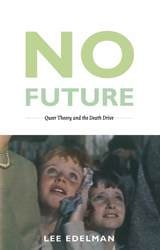
cover of No Future: Queer Theory and the Death Drive

No Future

Queer Theory and the Death Drive

Lee Edelman

Duke University Press, 2004

In this searing polemic, Lee Edelman outlines a radically uncompromising new ethics of queer theory. His main target is the all-pervasive figure of the child, which he reads as the linchpin of our universal politics of “reproductive futurism.” Edelman argues that the child, understood as innocence in need of protection, represents the possibility of the future against which the queer is positioned as the embodiment of a relentlessly narcissistic, antisocial, and future-negating drive. He boldly insists that the efficacy of queerness lies in its very willingness to embrace this refusal of the social and political order. In No Future, Edelman urges queers to abandon the stance of accommodation and accede to their status as figures for the force of a negativity that he links with irony, jouissance, and, ultimately, the death drive itself.

Closely engaging with literary texts, Edelman makes a compelling case for imagining Scrooge without Tiny Tim and Silas Marner without little Eppie. Looking to Alfred Hitchcock’s films, he embraces two of the director’s most notorious creations: the sadistic Leonard of North by Northwest, who steps on the hand that holds the couple precariously above the abyss, and the terrifying title figures of The Birds, with their predilection for children. Edelman enlarges the reach of contemporary psychoanalytic theory as he brings it to bear not only on works of literature and film but also on such current political flashpoints as gay marriage and gay parenting. Throwing down the theoretical gauntlet, No Future reimagines queerness with a passion certain to spark an equally impassioned debate among its readers.

[more]