Results by title
753 books match the query 'Race' and 20 start with n
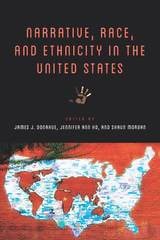
Narrative, Race, and Ethnicity in the United States
Edited by James J. Donahue, Jennifer Ann Ho, and Shaun Morgan
The Ohio State University Press, 2017
Recognizing that racial/ethnic issues and tensions are often contextualized geographically, this volume focuses on narratives associated with various racial and ethnic communities in the United States. By engaging with new developments in narrative theory and critical race studies, this volume demonstrates the vitality of using the tools of narratology and critical race theory together to understand how race influences narrative and how narratology illuminates a reading of race in ethnic American literature.
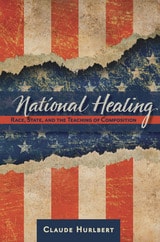
National Healing
Race, State, and the Teaching of CompositionClaude Hurlbert
Utah State University Press, 2013
In National Healing, author Claude Hurlbert persuasively relates nationalism to institutional racism and contends that these are both symptoms of a national ill health afflicting American higher education and found even in the field of writing studies. Teachers and scholars, even in progressive fields like composition, are unwittingly at odds with their own most liberatory purposes, he says, and he advocates consciously broadening our understanding of rhetoric and writing instruction to include rhetorical traditions of non-Western cultures.
Threading a personal narrative of his own experiences as a student, professor, and citizen through a wide ranging discussion of theory, pedagogy, and philosophy in the writing classroom, Hurlbert weaves a vision that moves beyond simple polemic and simplistic multiculturalism. National Healing offers a compelling new aesthetic, epistemological, and rhetorical configuration.
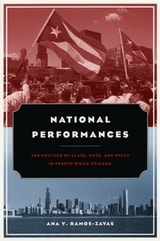
National Performances
The Politics of Class, Race, and Space in Puerto Rican ChicagoAna Y. Ramos-Zayas
University of Chicago Press, 2003
Drawing on extensive ethnographic research, Ramos-Zayas shows how the performance of Puerto Rican nationalism in Chicago serves as a critique of social inequality, colonialism, and imperialism, allowing barrio residents and others to challenge the notion that upward social mobility is equally available to all Americans—or all Puerto Ricans. Paradoxically, however, these activists' efforts also promote upward social mobility, overturning previous notions that resentment and marginalization are the main results of nationalist strategies.
Ramos-Zayas's groundbreaking work allows her here to offer one of the most original and complex analyses of contemporary nationalism and Latino identity in the United States.
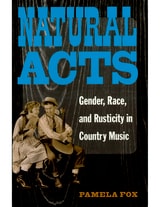
Natural Acts
Gender, Race, and Rusticity in Country MusicPamela Fox
University of Michigan Press, 2009
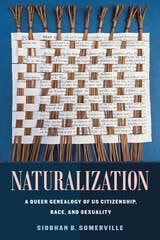
Naturalization
A Queer Genealogy of US Citizenship, Race, and SexualitySiobhan B. Somerville
Duke University Press, 2026
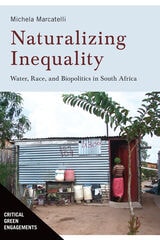
Naturalizing Inequality
Water, Race, and Biopolitics in South AfricaMichela Marcatelli
University of Arizona Press, 2021
Michela Marcatelli unravels this inequality paradox through an ethnography of water in a rural region of the country. The Waterberg Plateau is a space where agriculture, conservation, and extraction coexist and intersect. Marcatelli examines the connections between neoliberalism, race, and the environment by showing that racialized property relations around water and land are still recognized and protected by the post-apartheid state to sustain green growth. She argues that the government depicts growth as the best, if not only, solution to inequality. While white landowners maintain access to water, however, black ex-farmworkers are dispossessed once again of this essential-to-life resource.
If the promise of growth serves to normalize inequality, the call to save nature has the effect of naturalizing it even further.
Negative Originals
Race and Early Photography in ColombiaJuanita Solano Roa
Duke University Press, 2025
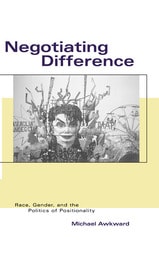
Negotiating Difference
Race, Gender, and the Politics of PositionalityMichael Awkward
University of Chicago Press, 1995
From Spike Lee's She's Gotta Have It to Michael Jackson's physical transmutations, from Toni Morrison's Song of Solomon to August Wilson's Fences, from male scholars' investments in feminism to white scholars' in black texts—Awkward explores cultural moments that challenge the exclusive critical authority of race and gender. In each instance he confronts the question: What do artists, scholars, and others concerned with representations of Afro-American life make of the view that gender, race, and sexuality circumscribe their own and others' lives and narratives? Throughout he demonstrates the perils and merits of the sort of "boundary crossing" this book ultimately makes: a black male feminism.
In pursuing a black male feminist criticism, Awkward's study acknowledges the complexities of interpretation in an age when a variety of powerful discourses have proliferated on the subject of racial, gendered, and sexual difference; at the same time, it identifies this proliferation as an opportunity to negotiate seemingly fixed cultural and critical positions.
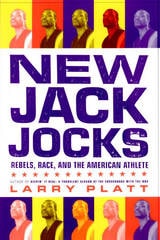
New Jack Jocks
Rebels, Race, And The American AthleteLarry Platt
Temple University Press, 2003
New Politics Of Race
Globalism, Difference, JusticeHoward Winant
University of Minnesota Press, 2004
New Roots in America's Sacred Ground
Religion, Race, and Ethnicity in Indian AmericaJoshi, Khyati Y
Rutgers University Press, 2006
In this compelling look at second-generation Indian Americans, Khyati Y. Joshi draws on case studies and interviews with forty-one second-generation Indian Americans, analyzing their experiences involving religion, race, and ethnicity from elementary school to adulthood. As she maps the crossroads they encounter as they navigate between their homes and the wider American milieu, Joshi shows how their identities have developed differently from their parents’ and their non-Indian peers’ and how religion often exerted a dramatic effect.
The experiences of Joshi’s research participants reveal how race and religion interact, intersect, and affect each other in a society where Christianity and whiteness are the norm. Joshi shows how religion is racialized for Indian Americans and offers important insights in the wake of 9/11 and the backlash against Americans who look Middle Eastern and South Asian.
Through her candid insights into the internal conflicts contemporary Indian Americans face and the religious and racial discrimination they encounter, Joshi provides a timely window into the ways that race, religion, and ethnicity interact in day-to-day life.
Nietzsche and Race
Marc de Launay
University of Chicago Press, 2023
The caricature of Friedrich Nietzsche as a proto-Nazi is still with us, having originated with his own Nazi sister, Elisabeth Förster, who curated Nietzsche’s disparate texts to suit her own purposes. In Nietzsche and Race, Marc de Launay deftly counters this persistent narrative in a series of concise and highly accessible reflections on the concept of race in Nietzsche’s publications, notebooks, and correspondence. Through a fresh reading of Nietzsche’s core philosophical project, de Launay articulates a new understanding of race in Nietzsche’s body of work free from the misunderstanding of his detractors.
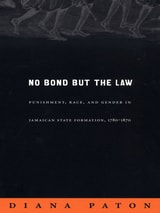
No Bond but the Law
Punishment, Race, and Gender in Jamaican State Formation, 1780–1870Diana Paton
Duke University Press, 2004
No Bond but the Law reveals the longstanding and intimate relationship between state formation and private punishment. The construction of a dense, state-organized system of prisons began not with emancipation but at the peak of slave-based wealth in Jamaica, in the 1780s. Jamaica provided the paradigmatic case for British observers imagining and evaluating the emancipation process. Paton’s analysis moves between imperial processes on the one hand and Jamaican specificities on the other, within a framework comparing developments regarding punishment in Jamaica with those in the U.S. South and elsewhere. Emphasizing the gendered nature of penal policy and practice throughout the emancipation period, Paton is attentive to the ways in which the actions of ordinary Jamaicans and, in particular, of women prisoners, shaped state decisions.
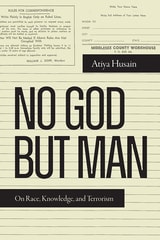
No God but Man
On Race, Knowledge, and TerrorismAtiya Husain
Duke University Press, 2025
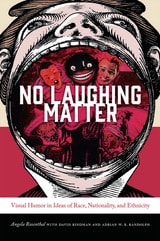
No Laughing Matter
Visual Humor in Ideas of Race, Nationality, and EthnicityEdited by Angela Rosenthal, David Bindman, and Adrian W. B. Randolph
Dartmouth College Press, 2015
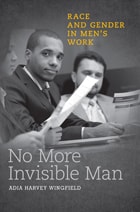
No More Invisible Man
Race and Gender in Men's WorkAdia Harvey Wingfield
Temple University Press, 2012
The “invisible men” of sociologist Adia Harvey Wingfield’s urgent and timely No More Invisible Man are African American professionals who fall between extremely high status, high-profile black men and the urban underclass. Her compelling interview study considers middle-class, professional black men and the challenges, obstacles, and opportunities they encounter in white male–dominated occupations.
No More Invisible Man chronicles these men’s experiences as a tokenized minority in the workplace to show how issues of power and inequality exist—especially as they relate to promotion, mobility, and developing occupational networks. Wingfield’s intersectional analysis deftly charts the ways that gender, race, and class collectively shape black professional men’s work experiences.
In its examination of men’s interactions with women and other men, as well as men’s performances of masculinity and their emotional demeanors in these jobs, No More Invisible Man extends our understanding of racial- and gender-based dynamics in professional work.
No Peace Without Freedom
Race and The Women's International League For Peace and Freedom 1915-1975Joyce Blackwell
Southern Illinois University Press, 2004
Just as women changed the direction and agenda of the peace movement when they became progressively more involved in an all-male club, black women altered a cause that had previously lacked racial diversity when they were first granted admission to the Women’s International League for Peace and Freedom in 1915. As Joyce Blackwell illustrates in this first study of collective black peace activism, the increased presence of black women in the WILPF over the next sixty years brought to the movement historical experiences shaped by societal racism.
No Peace Without Freedom: Race and the Women’s International League for Peace and Freedom, 1915–1975 explores how black women, fueled by the desire to eradicate racial injustice, compelled the white leadership of the WILPF to revisit its own conceptions of peace and freedom. Blackwell offers a renewed examination of peace movements in American history, one that points out the implications of black women’s participation for the study of social activism, African American history, and women’s history. This new perspective on interracial and black female global activism helps redefine the often-covert systemic violence necessary to maintain systems of social and economic hierarchy, moving peace and war discourse away from its narrow focus on European and European-American issues.
Blackwell looks closely at the reasons why white women organized their own peace group at the start of World War I and assesses several bold steps taken by these groups in their first ten years. Addressing white peace activists’ continuous search for the “perfect” African American woman, Blackwell considers when and why black women joined the WILPF, why so few of them were interested in the organization, and what the small number who did join had in common with their white counterparts. She also shows how the WILPF, frustrated at its inability to successfully appeal to black women, established a controversial interracial committee to deal with the dilemma of recruiting black women while attempting to maintain all of its white members.
Tracing the black activists’ peace reform activities on an international level from World War I to the end of the Vietnam War, No Peace Without Freedom examines the links black activists established within the African American community as well as the connections they made with peoples of the black Diaspora and later with colonized people irrespective of race. The volume is complemented by eighteen illustrations.
No Place for Home
Terror and Race in Literature After 9/11Jay Shelat
University of Minnesota Press, 2027
Exploring contemporary literature to expose how post-9/11 counterterror strategies are used to unhome families of color
More than a quarter of a century after 9/11, the global war on terror continues to rage in the name of homeland security. Through literature and archival research, Jay Shelat shows how war, Islamophobia, police brutality, and other state-sponsored legal and social maneuvers are used to revoke and control Brown and Black families and their belonging, and why the empire always starts at home.
By exploring insurgent narratives in fiction and poetry by writers of color such as Kamila Shamsie, N. K. Jemisin, and Dur e Aziz Amna, No Place for Home traces the long history of white supremacy infiltrating family life. Shelat expands this picture to include records, laws, brochures, executive orders, and other forms of documentation to illuminate how domesticity is posited as conditional—dependent on racial permission—in the United States. Woven through this nuanced exploration of radicalized violence in the US since the attacks are discussions of stubborn identity, queer kinship, and community organizing.
No Place for Home analyzes post-9/11 literature as a crucial informant for our understanding of how the war on terror has evolved into its current state. In doing so, Shelat charts a radical, healing way forward.
Retail e-book files for this title are screen-reader friendly with images accompanied by short alt text and/or extended descriptions.

No Winners Here Tonight
Race, Politics, and Geography in One of the Country’s Busiest Death Penalty StatesAndrew Welsh-Huggins
Ohio University Press, 2009
Few subjects are as intensely debated in the United States as the death penalty. Some form of capital punishment has existed in America for hundreds of years, yet the justification for carrying out the ultimate sentence is a continuing source of controversy. No Winners Here Tonight explores the history of the death penalty and the question of its fairness through the experience of a single state, Ohio, which, despite its moderate midwestern values, has long had one of the country’s most active death chambers.
In 1958, just four states accounted for half of the forty-eight executions carried out nationwide, each with six: California, Georgia, Ohio, and Texas. By the first decade of the new century, Ohio was second only to Texas in the number of people put to death each year. No Winners Here Tonight looks at this trend and determines that capital punishment has been carried out in an uneven fashion from its earliest days, with outcomes based not on blind justice but on the color of a person’s skin, the whim of a local prosecutor, or the biases of the jury pool in the county in which a crime was committed.
Andrew Welsh-Huggins’s work is the only comprehensive study of the history of the death penalty in Ohio. His analysis concludes that the current law, crafted by lawmakers to punish the worst of the state’s killers, doesn’t come close to its intended purpose and instead varies widely in its implementation. Welsh-Huggins takes on this controversial topic evenhandedly and with respect for the humanity of the accused and the victim alike. This exploration of the law of capital punishment and its application will appeal to students of criminal justice as well as those with an interest in law and public policy.
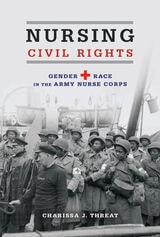
Nursing Civil Rights
Gender and Race in the Army Nurse CorpsCharissa J. Threat
University of Illinois Press, 2015
As Threat reveals, both groups viewed their circumstances with the Army Nurse Corps as a civil rights matter. Each conducted separate integration campaigns to end the discrimination they suffered. Yet their stories defy the narrative that civil rights struggles inevitably arced toward social justice. Threat tells how progressive elements in the campaigns did indeed break down barriers in both military and civilian nursing. At the same time, she follows conservative threads to portray how some of the women who succeeded as agents of change became defenders of exclusionary practices when men sought military nursing careers. The ironic result was a struggle that simultaneously confronted and reaffirmed the social hierarchies that nurtured discrimination.