Results by title
376 books match the query 'Racism' and 5 start with n
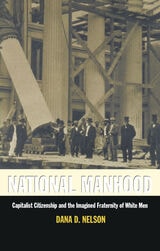
National Manhood
Capitalist Citizenship and the Imagined Fraternity of White MenDana D. Nelson
Duke University Press, 1998
Using political, scientific, medical, personal, and literary texts ranging from the Federalist papers to the ethnographic work associated with the Lewis and Clark expedition to the medical lectures of early gynecologists, Nelson explores the referential power of white manhood, how and under what conditions it came to stand for the nation, and how it came to be a fraternal articulation of a representative and civic identity in the United States. In examining early exemplary models of national manhood and by tracing its cultural generalization, National Manhood reveals not only how an impossible ideal has helped to form racist and sexist practices, but also how this ideal has simultaneously privileged and oppressed white men, who, in measuring themselves against it, are able to disavow their part in those oppressions.
Historically broad and theoretically informed, National Manhood reaches across disciplines to engage those studying early national culture, race and gender issues, and American history, literature, and culture.
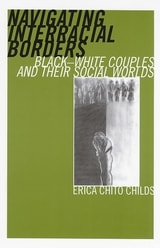
Navigating Interracial Borders
Black-White Couples and Their Social WorldsChilds, Erica Chito
Rutgers University Press, 2005
Is love color-blind, or at least becoming increasingly so? Today’s popular rhetoric and evidence of more interracial couples than ever might suggest that it is. But is it the idea of racially mixed relationships that we are growing to accept or is it the reality? What is the actual experience of individuals in these partnerships as they navigate their way through public spheres and intermingle in small, close-knit communities?
In Navigating Interracial Borders, Erica Chito Childs explores the social worlds of black-white interracial couples and examines the ways that collective attitudes shape private relationships. Drawing on personal accounts, in-depth interviews, focus group responses, and cultural analysis of media sources, she provides compelling evidence that sizable opposition still exists toward black-white unions. Disapproval is merely being expressed in more subtle, color-blind terms.
Childs reveals that frequently the same individuals who attest in surveys that they approve of interracial dating will also list various reasons why they and their families wouldn’t, shouldn’t, and couldn’t marry someone of another race. Even college students, who are heralded as racially tolerant and open-minded, do not view interracial couples as acceptable when those partnerships move beyond the point of casual dating. Popular films, Internet images, and pornography also continue to reinforce the idea that sexual relations between blacks and whites are deviant.
Well-researched, candidly written, and enriched with personal narratives, Navigating Interracial Borders offers important new insights into the still fraught racial hierarchies of contemporary society in the United States.
Nietzsche and Race
Marc de Launay
University of Chicago Press, 2023
The caricature of Friedrich Nietzsche as a proto-Nazi is still with us, having originated with his own Nazi sister, Elisabeth Förster, who curated Nietzsche’s disparate texts to suit her own purposes. In Nietzsche and Race, Marc de Launay deftly counters this persistent narrative in a series of concise and highly accessible reflections on the concept of race in Nietzsche’s publications, notebooks, and correspondence. Through a fresh reading of Nietzsche’s core philosophical project, de Launay articulates a new understanding of race in Nietzsche’s body of work free from the misunderstanding of his detractors.

Not of Pure Blood
The Free People of Color and Racial Prejudice in Nineteenth-Century Puerto RicoJay Kinsbruner
Duke University Press, 1996
Following a discussion of Puerto Rican racial prejudice in historical perspective, Kinsbruner describes residential patterns, marriages, births, deaths, occupations, and family and household matters to demonstrate that free people of color were a disadvantaged community whose political, social, and economic status was diminished by racism. He analyzes the complexities and contradictions of Puerto Rican racial prejudice and discrimination, explains the subtleties of “shade discrimination,” and examines the profoundly negative impact on race relations of the U.S. occupation of the island following the Spanish American War.
Looking behind the myth of Puerto Rican racial equity, Not of Pure Blood will be of interest to specialists in Caribbean studies, Puerto Rican history, and Latin America studies, and to scholars in a variety of fields investigating questions of racism and discrimination.
Nothing Has to Make Sense
Upholding White Supremacy through Anti-Muslim RacismSherene H. Razack
University of Minnesota Press, 2022
How Western nations have consolidated their whiteness through the figure of the Muslim in the post-9/11 world
While much has been written about post-9/11 anti-Muslim racism (often termed Islamophobia), insufficient attention has been given to how anti-Muslim racism operates through law and is a vital part of law’s protection of whiteness. This book fills this gap while also providing a unique new global perspective on white supremacy. Sherene H. Razack, a leading critical race and feminist scholar, takes an innovative approach by situating law within media discourses and historical and contemporary realities. We may think of law as logical, but, argues Razack, its logic breaks down when the subject is Muslim.
Tracing how white subjects and majority-white nations in the post-9/11 era have consolidated their whiteness through the figure of the Muslim, Razack examines four sites of anti-Muslim racism: efforts by American evangelical Christians to ban Islam in the school curriculum; Canadian and European bans on Muslim women’s clothing; racial science and the sentencing of Muslims as terrorists; and American national memory of the torture of Muslims during wars and occupations. Arguing that nothing has to make sense when the subject is Muslim, she maintains that these legal and cultural sites reveal the dread, phobia, hysteria, and desire that mark the encounter between Muslims and the West.
Through the prism of racism, Nothing Has to Make Sense argues that the figure of the Muslim reveals a world divided between the deserving and the disposable, where people of European origin are the former and all others are confined in various ways to regimes of disposability. Emerging from critical race theory, and bridging with Islamophobia/critical religious studies, it demonstrates that anti-Muslim racism is a revelatory window into the operation of white supremacy as a global force.