Results by title
1017 books match the query 'Reference' and 13 start with n
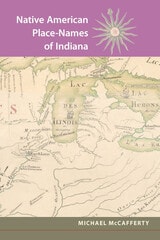
Native American Place Names of Indiana
Michael McCafferty
University of Illinois Press, 2007
A linguistic history of Native American place-names in Indiana
In tracing the roots of Indiana place names, Michael McCafferty focuses on those created and used by local Native Americans. Drawing from exciting new sources that include three Illinois dictionaries from the eighteenth century, the author documents the language used to describe landmarks essential to fur traders in Les Pays d’en Haut and settlers of the Old Northwest territory. Impeccably researched, this study details who created each name, as well as when, where, how and why they were used. The result is a detailed linguistic history of lakes, streams, cities, counties, and other Indiana names. Each entry includes native language forms, translations, and pronunciation guides, offering fresh historical insight into the state of Indiana.

Nature Journal
L. J. Davenport, with a Foreword by John C. Hall
University of Alabama Press, 2010
Explore Nature. Record Wonder. Keep Your Own Journal.
Nature Journal is an innovative presentation of the best columns and photographs from L. J. Davenport’s popular column in Alabama Heritage magazine. Readers of the magazine have come to relish his artful and often witty descriptions of common species encountered in the Alabama outdoors. But Nature Journal is designed to be much more than a mere collection of entertaining essays; it is also an educational tool—a means of instructing and encouraging readers in the art of keeping a nature journal for themselves.
Each of the 25 chapters is a self-contained lesson in close observation of species morphology, behavior, and habitat; research in the literature; nondestructive capture of the subject by photography or drawing; and written description of the total observed natural phenomenon. At the end of each account, stimulating questions and gentle directives guide the reader into making his or her own observations and recordings.
This book is intended for broad nature-study use in Alabama and throughout the southeast by the general reader and nature enthusiast alike, as well as visitors to museums and outdoor centers, and students of nature and nature writing at the high school and college levels. Beautifully designed to look like a personal journal, it is a perfect gift and treasured keepsake for all lovers of the natural world.
Publication supported in part by Samford University

Nature of the Physical World
Sir Arthur Eddington
University of Michigan Press, 1958
Navigating Academia
Writing Supporting GenresJohn M. Swales & Christine B. Feak
University of Michigan Press, 2011
Navigating Academia is a bit different from the other volumes in the series because it focuses on the supporting genres that facilitate the more public genres that form the building blocks of an academic and/or research career. Included are statements of purpose for graduate school applications, letters of recommendation, and responses to journal reviewers.
One feature that these genres have in common is that they are largely hidden from public view; it is difficult to find examples of them in university libraries. Although guidance about these genres can increasingly be found on the Internet, this guidance is often too general to be helpful in an individual particular situation. This is unfortunate because in almost all cases, the individual needs to be seen as both a serious scholar, researcher, or instructor (whether beginning or getting established) and as a collegial but objective person. As a result, many of these academic communications need to be carefully considered, particularly with regard to the likely effect this communication will have on its intended recipients, who, more often than not, are established figures in the field (as with a job application letter). Because of the roles of these genres, this volume also differs somewhat from the others in that it is as much concerned with social academic practice as it is with more formal academic texts.
This volume represents a revision and expansion of the material on academic correspondence that appeared in English in Today's Research World.

Navigating Tenure and Beyond
A Guide for Early Career FacultySundar A. Christopher
American Meteorological Society, 2019
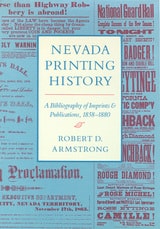
Nevada Printing History
A Bibliography Of Imprints And Publications, 1858-1880Robert D. Armstrong
University of Nevada Press, 1981
A detailed look at Nevada's printing history from 1858 through 1880. Includes proclamations, pamphlets, menus, government publications, church programs, and more. For Nevada historians, bibliographers, book collectors, and people who are interested in the printed records produced in Nevada toward the end of the nineteenth century.
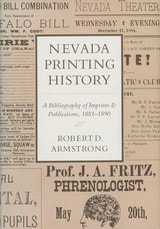
Nevada Printing History
A Bibliography Of Imprints And Publications, 1881-1890Robert D. Armstrong
University of Nevada Press, 1991
A detailed look at Nevada's printing history from 1881 through 1890. With over 1400 entries describing books, pamphlets, broadsides, state and local documents, fraternal and church publications, and a variety of other printed matter, this intriguing compilation serves as the companion volume to Armstrong's Nevada Printing History, 1858-1880. Armstrong includes annual summaries of events affecting the printing trade in Nevada as well as the locations and kinds of printing technology in use. This second volume also documents the planning and erection of a state printing office. Of particular interest are the summaries of individual publications that provide the reader with a picture of social, economic, and political viewpoints of the period. The author's research led him to more than 125 public institutions over a period of nearly twenty years. Historians, bibliographers, students of printing history and practice, collectors of Western Americana, antiquarian booksellers, and librarians will find this book to be an invaluable guide to Nevada's printing, its printers, and its history.
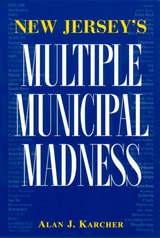
New Jersey's Multiple Municipal Madness
Karcher, Alan
Rutgers University Press, 1998
Alan Karcher looks at the history and high cost of New Jersey's multiple municipalities. He investigates the economic considerations, political pressures, and personal agendas that created the bizarre configurations dividing the Garden State, while analyzing the public policies that allowed and even encouraged the formation of new municipalities. Karcher also examines the political dynamics that thwarted every effort of New Jersey metropolises to join the front ranks of major American cities.
Karcher identifies the major motivations behind the unparalleled experience of New Jersey's municipal multiplication. He delves deeply into the primary causes of new lines being drawn, such as road appropriations, the location of a railroad station, control of a local school district, the regulation of alcohol sales, and the preservation of exclusivity prior to the acceptance of zoning. He also assesses the present situation and what has happened in the past 60 years since the municipal multiplication madness ceased, calling on elected officials to confront reality and correct yesterday's excesses.
The genesis of the present political map of the state is a story that while interesting is not always charming, while fascinating is far from edifying. Little in the history can be called quaint. Rather it is a story of separation and exclusion, of division and greed, of preservation of prerogatives and prejudices. It is a story that supports the conclusion that these lines are rarely the product of chance, rather they were drawn by politicians with very human foibles and frailties, and with very narrow agendas-agendas that have proven to be egregiously expensive for today's taxpayers.
Alan Karcher, the former Speaker of the New Jersey Assembly during the activist 1980s, currently practices municipal law in Middlesex County. He represents the third generation of his family to serve as a member of the New Jersey State Legislature.
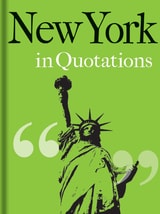
New York in Quotations
Compiled by Jaqueline Mitchell
Bodleian Library Publishing, 2014

Nineteenth-Century Philosophy
Revolutionary Responses to the Existing OrderEdited by Alan D. Schrift and Daniel Conway
University of Chicago Press, 2010
From Kant to Kierkegaard, from Hegel to Heidegger, continental philosophers have indelibly shaped the trajectory of Western thought since the eighteenth century. Although much has been written about these monumental thinkers, students and scholars lack a definitive guide to the entire scope of the continental tradition. The most comprehensive reference work to date, this eight-volume History of Continental Philosophy will both encapsulate the subject and reorient our understanding of it. Beginning with an overview of Kant’s philosophy and its initial reception, the History traces the evolution of continental philosophy through major figures as well as movements such as existentialism, phenomenology, hermeneutics, and poststructuralism. The final volume outlines the current state of the field, bringing the work of both historical and modern thinkers to bear on such contemporary topics as feminism, globalization, and the environment. Throughout, the volumes examine important philosophical figures and developments in their historical, political, and cultural contexts.
The first reference of its kind, A History of Continental Philosophy has been written and edited by internationally recognized experts with a commitment to explaining complex thinkers, texts, and movements in rigorous yet jargon-free essays suitable for both undergraduates and seasoned specialists. These volumes also elucidate ongoing debates about the nature of continental and analytic philosophy, surveying the distinctive, sometimes overlapping characteristics and approaches of each tradition. Featuring helpful overviews of major topics and plotting road maps to their underlying contexts, A History of Continental Philosophy is destined to be the resource of first and last resort for students and scholars alike.
Northern Paiute–Bannock Dictionary
Compiled by Sven Liljeblad, Catherine S. Fowler, and Glenda Powell
University of Utah Press, 2011
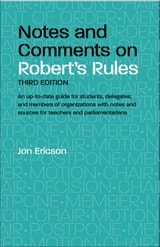
Notes and Comments on Robert's Rules, 3rd Edition
Jon L. Ericson
Southern Illinois University Press, 2004
This third edition of Jon Ericson’s Notes and Comments on Robert’s Rules updates all references and page numbers to the tenth edition of Robert’s Rules of Order Newly Revised, published in 2000. Ericson’s guide to the authoritative parliamentary resource clarifies many of the concepts and rules that intimidate or confuse the members of organizations who use it, stressing that they have a choice in—and may, in fact, modify—the rules by which they are bound.
Ericson begins with the Order of Precedence, which he defines as the key concept in understanding and utilizing parliamentary procedure. He then uses a question-and-answer format in which a logical progression of essential parliamentary questions is explicitly answered, with a rationale for each rule. Throughout, he provides specific page references to Robert’s Rules. Through these three elements, he makes classic doctrine intelligible and workable, leading the reader step-by-step through the rules and their applications and, in the process, encouraging people to feel more positive about parliamentary procedure and their ability to use it.
“Far too many members, armed—or more accurately disarmed—with a misconception of parliamentary procedure, choose to spend a lifetime wondering what is going on and lamenting or blaming others when things fail to go their way,” writes Ericson in the Introduction. “Understanding parliamentary procedure also allows a person to have more fun—not just the fun of socializing outside the business meeting—but the fun of performing in the public arena.”
A popular, concise, and clear handbook, Notes and Comments on Robert’s Rules emphasizes the simple machinery of the system, relates its concepts to the procedures most commonly used in meetings and conventions, and encourages members to obtain and study, rather than shy away from Robert’s Rules of Order Newly Revised. This new edition also expands the number of question-and-answer sections and surveys the research in and commentary on the field since 1991. A laminated, removable card featuring simplified charts of parliamentary motions serves as an additional resource and is included with the volume.
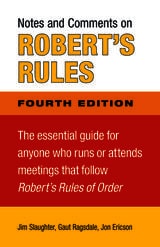
Notes and Comments on Robert's Rules, Fourth Edition
Jim Slaughter, Gaut Ragsdale, Jon Ericson
Southern Illinois University Press, 2012
While Robert’s Rules of Order has long been the standard guide to parliamentary procedure, many readers find the manual too daunting and complex to utilize its full potential. In Notes and Comments on "Robert’s Rules", fourth edition, authors Jim Slaughter, Gaut Ragsdale, and Jon Ericson skillfully guide users through the intricate pathways of the latest edition of Robert’s Rules, transforming the often intimidating parliamentary guidebook into an easy-to-use tool. Notes and Comments explains in simple terms the individual motions found in Robert’s Rules, presents extensive tips and suggestions regarding possible modifications to Robert’s practices; allows readers to witness the vigorous debate about the rules within the notes section; and compares major parliamentary authorities. A reader-friendly question-and-answer format provides immediate solutions to the most common quandaries that arise during the meeting process, and a card featuring simplified charts of parliamentary motions is available for the user’s quick reference.
An essential volume for members of nonprofits, voluntary associations, unions, condo and homeowner associations, student organizations, and government bodies, Notes and Comments on “Robert’s Rules” makes parliamentary procedure accessible to meeting participants as never before. Each section of this authoritative, straightforward guide is designed to empower participants with the confidence and knowledge necessary to navigate any meeting, large or small, with the utmost efficiency.
2013 Winner of the Phifer Award from the National Communication Association