Results by title
322 books match the query 'Regional' and 12 start with n
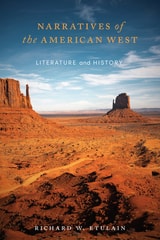
Narratives of the American West
Literature and HistoryRichard W. Etulain
University of Nevada Press, 2027
Narratives of the American West: Literature and History brings together Richard W. Etulain’s most resonant work—along with newly written essays—to reveal how history and storytelling have continually shaped each other in the making of the West. Part historiographical memoir, part wide‑ranging critical survey, the collection moves from Etulain’s Basque upbringing in eastern Washington to his lifetime of teaching, editing, and writing, showing how personal experience and intellectual inquiry converge on the page.
In the tradition of Elliott West’s The Essential West, Etulain maps the field’s major interpretive turns, from Frederick Jackson Turner to Earl Pomeroy to West’s“Greater Reconstruction,” and demonstrates how literary craft and historical method inform each other. Along the way, he demythologizes the stories of iconic figures, such as Billy the Kid, Calamity Jane, Chief Joseph, and Sacagawea, tracing how cultural memory evolves across novels, films, and archives.
Featuring new essays on Wallace Stegner and Elliott West, alongside revised classics on western myths, genres, regions, and peoples, this accessible yet rigorous volume invites readers to embrace narratives that are complex and morally engaged. Essential for scholars, students, and curious general readers alike, Narratives of the American West is a compelling guide to how the West has been written and remembered—and why those stories still matter.
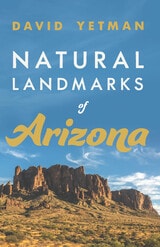
Natural Landmarks of Arizona
David Yetman
University of Arizona Press, 2021
Whether you have climbed these peaks many times, enjoy seeing them from your car window, or simply want to learn more about southwestern geology and history, reading Natural Landmarks of Arizona is a fascinating way to learn about the ancient and recent history of beloved places such as Cathedral Rock, Granite Dells, Kitt Peak, and many others. With Yetman as your guide, you can tuck this book into your glove box and hit the road with profound new knowledge about the towering natural monuments that define our beautiful Arizona landscapes.
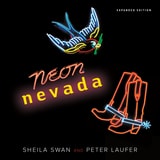
Neon Nevada
Expanded EditionSheila Swan
University of Nevada Press, 2023
Sheila Swan and Peter Laufer take readers on a journey, not only along the Las Vegas Strip, but down quiet, two-lane rural roads punctuated occasionally by a neon sign—those glistening beacons that represent civilization in our vast Great Basin. The photographers’ stunning work captures the argon violets, krypton purples, helium golds, and xenon blues that glow amidst the nighttime desert sky.
The book makes clear that neon is not just a medium for casino advertising. The colorful images of cowboys and cowgirls, animals, desert landscapes, and countless other creative designs all illuminate an aspect of Americana—the neon sign—that helps define Nevada and its businesses, from bars and casinos to hardware stores, restaurants, motels, and theaters that line the streets of the Silver State’s cities and towns, and those rural areas that are barely a blip on the map. With a compelling blend of striking full-color photographs and fascinating historical commentary, the book celebrates an artform that wholly embraces the state’s unique personality.
First published in 1994, this newly updated and expanded edition of Neon Nevada explores the resurgence of this artform during the last decade, which has resulted in an appreciation of Nevada neon that is not likely to fade. Swan and Laufer’s project, this survey of neon, casts the new edition as a defining source for neon scholars and attracts neon aficionados to what can only be defined as a medium as distinctive and interesting as Nevada itself.
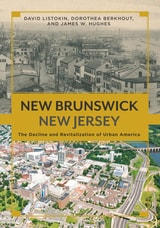
New Brunswick, New Jersey
The Decline and Revitalization of Urban AmericaListokin, David
Rutgers University Press, 2016
New Deal Photographs of West Virginia, 1934-1943
Betty Rivard
West Virginia University Press, 2012

New Jersey Ferns and Fern Allies
Montgomery, James D.
Rutgers University Press, 1993
New Jersey is exceptionally rich in ferns, as three centuries of naturalists have recognized. Both amateur and professional botanists will welcome this new, complete, fully illustrated guide to the state's ferns and fern allies (the lycopods and horsetails). After an introduction to fern classification and nomenclature, the history of fern collecting, and the ecology and distribution of ferns within New Jersey, the authors describe eighty-three species, in thirty genera, and thiry-two hybrid forms (more than any other state). They include a fascinating account of the rare curly-grass fern, Schizaea pusilla, "New Jersy's most famous plant."
For each species, the authors provide a detailed drawing and comments on taxonomy, habitat, chromosome counts, habits of growth, and status as endangered species. Distribution maps show not only where plants have been collected, but also the time period for the most recent date of collectionÐÐa convenient way of showing the plant's spread or depletion. Throughout, the book reflects the latest research by fern experts.
An essential field guide and reference for naturalists, botanists, hikers, gardeners, and conservationists in New Jersey and the mid-Atlantic states.
New Jersey Parks, Forests, and Natural Areas
A GuideBrown, Michael P
Rutgers University Press, 2004
Want to know where in New Jersey you can go fossil hunting? How about cranberry harvesting? Perhaps you’d like to find the most accessible Garden State fishing areas for people with disabilities? Or maybe you’ve just been wondering how Double Trouble State Park got its name?
Now in its third edition, this updated guide—the first of its kind for New Jersey—lists over 250 parks, forests, and natural areas in the Garden State, from national, state, city, and county parks to nature preserves run by non-profit groups, arboretums, and undeveloped wildlife management areas. Wherever you live in New Jersey, you can find a beautiful place nearby for picnicking, hiking, camping, hunting, fishing, boating, and a host of other outdoor activities. All are open to the public, and most are free or charge only a small fee. Michael Brown divides the state into six regions along county lines and includes helpful maps, so outdoor enthusiasts can easily plan excursions.
For each park, the guide provides up-to-date, practical information about locations and phone numbers, fees, hours, seasons, acreage, regulations, handicap access, special facilities and activities, campsites, swimming and boat launching sites, restrooms, playgrounds and picnic sites, hunting and fishing, and hiking. Also included in this edition is broadened coverage of mountain biking and horseback riding.
New Jersey's Environments
Past, Present, and FutureMaher, Neil M
Rutgers University Press, 2006
Americans often think of New Jersey as an environmental nightmare. As seen from its infamous turnpike, which is how many travelers experience the Garden State, it is difficult not to be troubled by the wealth of industrial plants, belching smokestacks, and hills upon hills of landfills. Yet those living and working in New Jersey often experience a very different environment. Despite its dense population and urban growth, two-thirds of the state remains covered in farmland and forest, and New Jersey has a larger percentage of land dedicated to state parks and forestland than the average for all states. It is this ecological paradox that makes New Jersey important for understanding the relationship between Americans and their natural world.
In New Jersey’s Environments,historians, policy-makers, and earth scientists use a case study approach to uncover the causes and consequences of decisions regarding land use, resources, and conservation. Nine essays consider topics ranging from solid waste and wildlife management to the effects of sprawl on natural disaster preparedness. The state is astonishingly diverse and faces more than the usual competing interests from environmentalists, citizens, and businesses.
This book documents the innovations and compromises created on behalf of and in response to growing environmental concerns in New Jersey, all of which set examples on the local level for nationwide and worldwide efforts that share the goal of protecting the natural world.
No Place Like Home
Notes from a Western LifeLinda M. Hasselstrom
University of Nevada Press, 2010
In No Place Like Home, Linda Hasselstrom ponders the changing nature of community in the modern West, where old family ranches are being turned into subdivisions and historic towns are evolving into mean, congested cities. Her scrutiny, like her life, moves back and forth between her ranch on the South Dakota prairie and her house in an old neighborhood at the edge of downtown Cheyenne, Wyoming. The vignettes that form the foundation of her consideration are drawn from the communities she has known during her life in the West, reflecting on how they have grown, thrived, failed, and changed, and highlighting the people and decisions that shaped them. Hasselstrom’s ruminations are both intensely personal and universal. She laments the disappearance of the old prairie ranches and the rural sense of community and mutual responsibility that sustained them, but she also discovers that a spirit of community can be found in unlikely places and among unlikely people. The book defines her idea of how a true community should work, and the kind of place she wants to live in. Her voice is unique and honest, both compassionate and cranky, full of love for the harsh, hauntingly beautiful short-grass prairie that is her home, and rich in understanding of the intricacies of the natural world around her and the infinite potentials of human commitment, hope, and greed. For anyone curious about the state of the contemporary West, Hasselstrom offers a report from the front, where nature and human aspirations are often at odds, and where the concepts of community and mutual responsibility are being redefined.
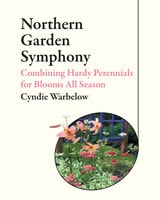
Northern Garden Symphony
Combining Hardy Perennials for Blooms All SeasonCyndie Warbelow
University of Alaska Press, 2021
Using narrative, figures, photographs, and a groundbreaking set of layout charts that can aid even the most experienced horticulturist in the process of flower garden planning, Northern Garden Symphony gives gardeners the tools they need to be a successful northern perennial gardener.
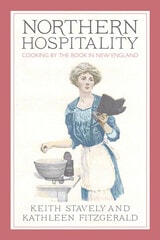
Northern Hospitality
Cooking by the Book in New EnglandKeith Stavely
University of Massachusetts Press, 2011
Beginning with four chapters placing the region's best-known cookbook authors and their works in nuanced historical context, Keith Stavely and Kathleen Fitzgerald then proceed to offer a ten-chapter cornucopia of culinary temptation. Readers can sample regional offerings grouped into the categories of the liquid one-pot meal, fish, fowl, meat and game, pie, pudding, bread, and cake. Recipes are presented in their original textual forms and are accompanied by commentaries designed to make them more accessible to the modern reader. Each chapter, and each section within each chapter, is also prefaced by a brief introductory essay. From pottage to pie crust, from caudle to calf's head, historic methods and obscure meanings are thoroughly—sometimes humorously—explained.
Going beyond reprints of single cookbooks and bland adaptations of historic recipes, this richly contextualized critical anthology puts the New England cooking tradition on display in all its unexpected--and delicious--complexity. Northern Hospitality will equip readers with all the tools they need for both historical understanding and kitchen adventure.
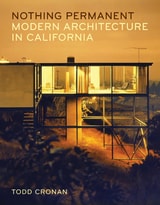
Nothing Permanent
Modern Architecture in CaliforniaTodd Cronan
University of Minnesota Press, 2023
A critical look at the competing motivations behind one of modern architecture’s most widely known and misunderstood movements
Although “mid-century modern” has evolved into a highly popular and ubiquitous architectural style, this term obscures the varied perspectives and approaches of its original practitioners. In Nothing Permanent, Todd Cronan displaces generalizations with a nuanced intellectual history of architectural innovation in California between 1920 and 1970, uncovering the conflicting intentions that would go on to reshape the future of American domestic life.
Focusing on four primary figures—R. M. Schindler, Richard Neutra, and Charles and Ray Eames—Nothing Permanent demonstrates how this prolific era of modern architecture in California, rather than constituting a homogenous movement, was propelled by disparate approaches and aims. Exemplified by the twin pillars of Schindler and Neutra and their respective ideological factions, these two groups of architects represent opposing poles of architectural intentionality, embodying divergent views about the dynamic between interior and exterior, the idea of permanence, and the extent to which architects could exercise control over the inhabitants of their structures.
Looking past California modernism’s surface-level idealization in present-day style guides, home decor publications, films, and television shows, Nothing Permanent details the intellectual, aesthetic, and practical debates that lie at the roots of this complex architectural moment. Extracting this period from its diffusion into visual culture, Cronan argues that mid-century architecture in California raised questions about the meaning of architecture and design that remain urgent today.