Results by title
436 books match the query 'Renaissance' and 8 start with n
Neo-Aristotelianism and the Medieval Renaissance
On Aquinas, Ockham, and EckhartReiner Schürmann
Diaphanes, 2020
New Technologies and Renaissance Studies
Edited by William R. Bowen and Raymond G. Siemens
Iter Press, 2008
The first volume of the series, New Technologies and Renaissance Studies, presents a collection of contributions to one ongoing forum for the dialogue which lies at the heart of the book series, the annual "conference within a conference" of the same name which takes place during the Renaissance Society of America gathering, dedicated specifically to the intersection of computational methods and Renaissance studies. Papers in this volume exemplify those fruitful and productive exchanges, from their inception at the 2001 meeting in Chicago to the 2005 meeting in Cambridge.
New Technologies and Renaissance Studies II
Edited by Tassie Gniady, Kris McAbee, Jessica Murphy
Iter Press, 2014
In the fourth volume of the New Technologies in Medieval and Renaissance Studies series, volume editors Tassie Gniady, Kris McAbee, and Jessica Murphy bring together some of the best work from the New Technologies in Medieval and Renaissance Studies panels at the Renaissance Society of America (RSA) annual meetings for the years 2004–2010. These essays demonstrate a dedication to grounding the use of “newest” practices in the theories of the early modern period. At the same time, the essays are interested in the moment—the needs of scholars then, the theories of media that informed current understanding, and the tools used to conduct studies.
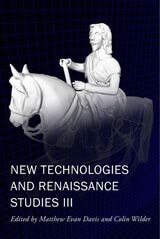
New Technologies and Renaissance Studies III
Edited by Matthew Evan Davis and Colin Wilder
Iter Press, 2022

New Technologies and Renaissance Studies IV
The Changing Shape of Digital Early Modern StudiesEdited by Randa El Khatib and Caroline Winter
Iter Press, 2025
A collection of essays engaging with digital scholarship and new technologies.
Contributors to this volume engage with digital scholarship in several ways: by creating digital projects, often in multidisciplinary, collaborative environments; by applying digital methodologies and tools to explore research questions; and by speculating about the potential directions that digital scholarship can take to tackle existing research areas that could benefit from new perspectives. Together, the chapters demonstrate how various digital approaches—from network analysis to web mapping, VR and AR technologies, digital editions, databases, and archives—are all contributing in creative and effective ways to expand our knowledge of the past, to help ask and answer questions at a scale that was unimaginable before the digital turn, and to reshape early modern studies in the twenty-first century.
None a Stranger There
England and/in Europe on the Early Modern StageEdited by Scott Oldenburg and Matteo Pangallo
University of Alabama Press, 2025
Notebooks, English Virtuosi, and Early Modern Science
Richard Yeo
University of Chicago Press, 2014
Nuremberg, a Renaissance City, 1500-1618
By Jeffrey Chipps Smith
University of Texas Press, 1983
Although renowned for the excellence of its medieval art, the German city of Nuremberg reached the height of its artistic brilliance during the Renaissance. Beginning its ascendancy during the late fifteenth century, by 1500 the city had blossomed into both Germany's preeminent artistic center and one of the foremost cultural centers in all of Europe. Nuremberg was the home of Albrecht Dürer, the greatest Northern Renaissance master, whose creative genius inspired two generations of German artists. However, Dürer was only one of a host of extraordinary painters, printmakers, sculptors, and goldsmiths working in the city. Georg Pencz, Hans and Barthel Beham, Hans Schäufelein, Jost Amman, and Hans Lautensack were among the most accomplished printmakers of the day. Veit Stoss, Adam Kraft, Peter Flötner, and the Vischer family dominated early sixteenth-century German sculpture. Goldsmith Wenzel Jamnitzer was rivaled only by Florentine master Benvenuto Cellini in his inventiveness and technical virtuosity.
This remarkably comprehensive volume is the first English-language examination of Nuremberg at its creative peak. Following a mapping of the city's principal landmarks, Guy Fitch Lytle provides a compact historical background for Jeffrey Chipps Smith's detailed discussions of the city's social and artistic history. Smith examines the religious function of art before and during the Reformation to demonstrate the magnitude of the cultural transformations that resulted from the adoption of Lutheranism in 1525. He considers the early manifestations of humanism in Nuremberg and its influence on the art of Dürer and his contemporaries, and he reviews the central role of Dürer's pedagogical ideas and his workshop in the dissemination of Renaissance artistic concepts. Finally, Smith surveys the principal artists and stylistic trends in Nuremberg from 1500 to the outbreak of the Thirty Years War in 1618.
Nuremberg: A Renaissance City, 1500-1618 is the permanent record of an exhibition organized by the Archer M. Huntington Art Gallery as part of the centennial celebration of the University of Texas at Austin. As such, it represents not only a thorough introduction to the cultural heritage of Nuremberg during its period of greatest glory but also a catalogue of the more than two hundred objects borrowed for the exhibition from public and private collections in the United States, Canada, and Germany. The catalogue contains biographical sketches of forty-five major artists of the period. Over three hundred illustrations depict the city and its most magnificent artistic treasures.