Results by title
1095 books match the query 'Rhetoric' and 27 start with n
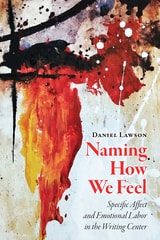
Naming How We Feel
Specific Affect and Emotional Labor In the Writing CenterDaniel Lawson
Utah State University Press, 2026
Writing centers are the locus for a wide range of emotional labor on campus, often serving students beyond the typical educational purpose. Naming How We Feel grapples with the question of how writing center administrators account for, train for, and theorize emotion and affect in the writing center to facilitate better and more ethical practices and considers how writing center administrators might ameliorate the costs of such emotional labor to faculty, tutors, and students.
Beginning with a discussion of how writing center scholars might identify and understand emotional labor, the book then expands to examine richly varied case studies and anecdotes to showcase how tutors tend to experience such labor and consider its relationship and association with emotional intelligence and burnout. Lawson considers how the field might better prepare and train tutors for affect and emotional labor, ultimately advocating for more equitable conditions for emotional labor within writing centers.
Naming How We Feel examines the critical role feelings play in writing and writing center work, offering advice on training tutors for emotional labor and literacy and suggestions for how administrators might engage institutional stakeholders to create and support more equitable conditions for emotional labor within their writing centers.
Naming What We Know, Classroom Edition
Threshold Concepts of Writing StudiesLinda Adler-Kassner
Utah State University Press, 2016
Naming What We Know
Threshold Concepts of Writing StudiesLinda Adler-Kassner
Utah State University Press, 2015
Naming What We Know examines the core principles of knowledge in the discipline of writing studies using the lens of “threshold concepts”—concepts that are critical for epistemological participation in a discipline. The first part of the book defines and describes thirty-seven threshold concepts of the discipline in entries written by some of the field’s most active researchers and teachers, all of whom participated in a collaborative wiki discussion guided by the editors. These entries are clear and accessible, written for an audience of writing scholars, students, and colleagues in other disciplines and policy makers outside the academy. Contributors describe the conceptual background of the field and the principles that run throughout practice, whether in research, teaching, assessment, or public work around writing. Chapters in the second part of the book describe the benefits and challenges of using threshold concepts in specific sites—first-year writing programs, WAC/WID programs, writing centers, writing majors—and for professional development to present this framework in action.
Naming What We Know opens a dialogue about the concepts that writing scholars and teachers agree are critical and about why those concepts should and do matter to people outside the field.
Narrative As Communication
Didier Coste
University of Minnesota Press, 1989
Narrative as Communication is the first major treatise on narrative and narrative theory to make use of all the analytic tools developed in the twenty years. Intended as an up-to-date introduction, it carefully defines narrative discourse, distinguishing it from other discourses, and analyzes what it entails by referring to numerous examples spanning a wide range of media and literary works. At the same time, it orients narrative theory in the current debates surrounding the “New Historicism” and postmodern ideology, showing that theories of narrative are necessarily central to any understanding of history.
Not restricted to any single genre, Coste’s text emphasizes the production of narrative meaning in diverse contexts: The Epic of Gilgamesh, a John Ford film classic, French American, and Spanish new fiction, Dante, Shakespeare, the pastoral, the fairy tale, The Communist Manifesto, Prescott’s History of the Conquest of Peru, a painting by Gustave Moreau. Coste thoroughly and critically examines the usual concepts of voice, character, point of view and narrative syntax, and he develops radical revisions in the notion of fictionality, character, narrative economy and the function of narrative meaning itself. The book is a remarkable synthesis that will likely become a reference for future studies in narratology.
Narratives of Joy and Failure in Antiracist Assessment
Exploring Collaborative Writing AssessmentsAsao B. Inoue
University Press of Colorado, 2024
National Healing
Race, State, and the Teaching of CompositionClaude Hurlbert
Utah State University Press, 2013
In National Healing, author Claude Hurlbert persuasively relates nationalism to institutional racism and contends that these are both symptoms of a national ill health afflicting American higher education and found even in the field of writing studies. Teachers and scholars, even in progressive fields like composition, are unwittingly at odds with their own most liberatory purposes, he says, and he advocates consciously broadening our understanding of rhetoric and writing instruction to include rhetorical traditions of non-Western cultures.
Threading a personal narrative of his own experiences as a student, professor, and citizen through a wide ranging discussion of theory, pedagogy, and philosophy in the writing classroom, Hurlbert weaves a vision that moves beyond simple polemic and simplistic multiculturalism. National Healing offers a compelling new aesthetic, epistemological, and rhetorical configuration.
National Rhetorics in the Syrian Immigration Crisis
Victims, Frauds, and FloodsClarke Rountree
Michigan State University Press, 2019

Natural-Born Proud
A ReveryS.R. Martin Jr.
Utah State University Press, 2010
A young man from Monterey and his younger brother go on their first deer hunt with their minister father and his friends. The setting is 1950s northern California, in country where, from the right height, one can see Mt. Shasta in one direction, Mt. Lassen in the other. It is a region of small, insular towns, and although it is a familiar hunting ground for the Reverend and his buddies, not everyone there welcomes black hunters. Father and son both shoulder their pride, and a racial confrontation seems inevitable.
Among the lessons young Satch learns is the sometime advantage of wit and spine. During their days in the wilderness, the brothers are initiated to the right practice of the hunt and camp and to the ribald talk, needling banter, camp tales, and occasional aggravation of sundry friends. Hunting has a primal nature, but as Satch sees, so may the variable interactions of men.
Navigating Academia
Writing Supporting GenresJohn M. Swales & Christine B. Feak
University of Michigan Press, 2011
Navigating Academia is a bit different from the other volumes in the series because it focuses on the supporting genres that facilitate the more public genres that form the building blocks of an academic and/or research career. Included are statements of purpose for graduate school applications, letters of recommendation, and responses to journal reviewers.
One feature that these genres have in common is that they are largely hidden from public view; it is difficult to find examples of them in university libraries. Although guidance about these genres can increasingly be found on the Internet, this guidance is often too general to be helpful in an individual particular situation. This is unfortunate because in almost all cases, the individual needs to be seen as both a serious scholar, researcher, or instructor (whether beginning or getting established) and as a collegial but objective person. As a result, many of these academic communications need to be carefully considered, particularly with regard to the likely effect this communication will have on its intended recipients, who, more often than not, are established figures in the field (as with a job application letter). Because of the roles of these genres, this volume also differs somewhat from the others in that it is as much concerned with social academic practice as it is with more formal academic texts.
This volume represents a revision and expansion of the material on academic correspondence that appeared in English in Today's Research World.
Navigating Space On and Beyond Campus
Eric Detweiler
Utah State University Press, 2026
Offering practical applications of scholarship in spatial theory and rhetorics of space and place, Navigating Space On and Beyond Campus profiles how writing and rhetoric programs across the United States have responded to the spatial challenges and possibilities facing higher education. Exploring how instructors creatively and critically navigate actual, virtual, and inaccessible spaces in the pursuit of effective, ethically informed rhetoric and writing education, this book also reveals how the use of space contributes to the creation and/or denial of equity among students, faculty, and programs.
Contributors document how they have secured and repurposed campus real estate, literally and metaphorically navigated relationships with other campus resources, and responded to austerity measures that have threatened the spaces they have historically called their own. Individual sections focus on the historical pressures that have shaped programs’ locations and resources, developments in the work and design of writing centers, the creation of new labs and centers, and the relationship between writing programs and the broader places and communities with which they are intertwined.
How spaces are allocated, structured, and regulated is a key determinant of access and equity in higher education. Navigating Space On and Beyond Campus offers timely strategies for and reflections on the place of rhetoric and writing on college and university campuses.
Negotiating the Intersections of Writing and Writing Instruction
Proceedings from the 2019 Conference of the European Association for the Teaching of Academic Writingedited by Magnus Gustafsson and Andreas Eriksson
University Press of Colorado, 2022
Network Sense
Methods for Visualizing a DisciplineDerek N. Mueller
University Press of Colorado, 2018
New Work of Writing Across the Curriculum
Diversity and Inclusion, Collaborative Partnerships, and Faculty DevelopmentStaci M. Perryman-Clark
Utah State University Press, 2023
Many of these initiatives are created in isolation, reinforcing institutional silos that are not used strategically to gain the attention of senior administrators, particularly those working at state-supported public institutions who must manage shrinking institutional budgets. Yet teaching and learning centers and WAC programs gain tremendously from one another by building explicit partnerships on campus-wide diversity initiatives that emphasize cultural competence. In addition, both cultural competence and written proficiency enhance the transferable skills necessary for completing undergraduate education requirements, and this work can be leveraged to draw the attention of senior administrative leadership.
Faculty development and WAC need to make diversity and inclusion initiatives a priority for professional development. The New Work of Writing Across the Curriculum reviews initiatives that point to increased understanding of diversity and inclusion that will be of significance to administrators, WAC specialists, faculty developers, and diversity officers across the spectrum of institutions of higher learning.
New Writing Classroom
Listening, Motivation, and Habits of MindPatrick Sullivan
Utah State University Press, 2014
In A New Writing Classroom, Patrick Sullivan provides a new generation of teachers a means and a rationale to reconceive their approach to teaching writing, calling into question the discipline's dependence on argument.
Including secondary writing teachers within his purview, Sullivan advocates a more diverse, exploratory, and flexible approach to writing activities in grades six through thirteen. A New Writing Classroom encourages teachers to pay more attention to research in learning theory, transfer of learning, international models for nurturing excellence in the classroom, and recent work in listening to teach students the sort of dialogic stance that leads to higher-order thinking and more sophisticated communication.
The conventional argumentative essay is often a simplistic form of argument, widely believed to be the most appropriate type of writing in English classes, but other kinds of writing may be more valuable to students and offer more important kinds of cognitive challenges. Focusing on listening and dispositions or "habits of mind” as central elements of this new composition pedagogy, A New Writing Classroom draws not just on composition studies but also on cognitive psychology, philosophy, learning theory, literature, and history, making an exciting and significant contribution to the field.
Next Steps
New Directions for/in Writing about WritingBarbara Bird
Utah State University Press, 2019
For more than ten years, WAW approaches have been emerging in all these sites and scenes of college writing instruction, and Next Steps offers an original look at the breadth of ways WAW pedagogy has been taken up by writing instructors and into an array of writing courses. Organized by some of the key foci of WAW instruction—writerly identity, process, and engagement—the book takes readers into thick classroom descriptions as well as vignettes offering shorter takes on particular strategies. The classroom descriptions are fleshed out in more personal ways by student vignettes, reflections on encountering writing about writing in college writing classes. As its theoretical basis, Next Steps includes chapters on threshold concepts, transfer of writing-related learning, and the history of WAW pedagogies.
As the first extensive look into WAW pedagogies across courses and institutions, Next Steps is ideal for writing instructors looking for new approaches to college composition instruction or curious about what “writing about writing” pedagogy actually is, for graduate students in composition pedagogy and their faculty, and for those researching composition pedagogy, threshold concepts, and learning transfer.
Contributors:
Linda Adler-Kassner, Olga Aksakalova, Joy Arbor, Matthew Bryan, Shawn Casey, Gabriel Cutrufello, Jennifer deWinter, Kristen di Gennaro, Emma Gaier, Christina Grant, Gwen Hart, Kimberly Hoover, Rebecca Jackson, Frances Johnson, Elizabeth Kleinfeld, Katie Jo LaRiviere, Andrew Lucchesi, Cat Mahaffey, Michael Michaud, Rebecca S. Nowacek, Andrew Ogilvie, Sarah Read, Rebecca Robinson, Kevin Roozen, Mysti Rudd, Christian Smith, Nichole Stack, Samuel Stinson, Hiroki Sugimoto, Lisa Tremain, Valerie Vera, Megan Wallace, Elizabeth Wardle, Christy I. Wenger, Nancy Wilson, Dominique Zino
Next-Gen Perspectives on Leadership
Coalitional Strategies for Launching Careers, Renewing Curricula, and Defending DemocracyCharles McMartin
Utah State University Press, 2026
Next-gen faculty are leading now. Through coalition-building, care work, and equity-driven initiatives, they are transforming institutions from the ground up. From labor organizing and culturally responsive curriculum design to the care-work of academic parents and the leadership of writing program administrators, the contributors in this collection model the type of coalitional leadership needed in our institutions. Structured around intergenerational dialogues, the book brings together early-career scholars with mid-career leaders—Jennifer Sano-Franchini, Christina Cedillo, and Staci Perryman-Clark—who offer sharp, reflective responses to each section, and culminates in a powerful closing essay by Carmen Kynard. These voices trace a lineage of resistance and renewal, showing how the leadership strategies of today’s emerging scholars echo and evolve the activist traditions that have long shaped writing studies. Next-gen leaders are moving beyond individualistic models of success and embracing collective, justice-oriented leadership practices. This collection invites scholars to study and teach forms of leadership that help faculty and students step into the challenging opportunities they face.
For graduate students and early-career faculty, this book offers a model of leadership that creates meaningful change outside designated leadership roles or institutional metrics. For mid-career and senior faculty, it provides a framework for recognizing and supporting the ground-level leadership already happening in their contexts. This collection is for anyone committed to leading more inclusive and sustainable academic communities and encourages faculty across generations to reimagine how to mentor, collaborate, and lead in ways that reflect the values of equity, care, and coalition.
Contributors: Felicita Arzu-Carmichael, Amerdeep Bajwa, Christina Cedillo, Alexandra Chapa, Anicca Cox, Tom Do, Mena Hannakachl, Alice Hays, Charisse Iglesias, Brad Jacobson, Carmen Kynard, Adele Leon, Shaylyn Marks, Sean Moxley-Kelly, Abigail Oakley, Staci Perryman-Clark, Ana Milena Ribero, Jennifer Sano-Franchini
Nineteenth-Century Rhetoric in North America
Nan Johnson
Southern Illinois University Press, 1991
Johnson argues that nineteenth-century rhetoric was primarily synthetic, derived from the combination of classical elements and eighteenth-century belletristic and epistemological approaches to theory and practice. She reveals that nineteenth-century rhetoric supported several rhetorical arts, each conceived systematically from a similar theoretical foundation.

Nineteenth-Century Scottish Rhetoric
The American ConnectionWinifred Bryan Horner
Southern Illinois University Press, 1992
Winifred Bryan Horner argues that an understanding of the changes that occurred in the content of nineteenth-century courses in logic, rhetoric, and belles lettres taught in Scottish universities provides important critical insight into the development of the twentieth-century American composition course, as well as courses in English literature and critical theory.
Because of the inaccessibility of primary materials documenting the changes in courses taught at Scottish universities, the impression remains that the nineteenth century represents a break with the traditional school curriculum rather than a logical transition to a new focus of study. Horner has discovered that the notes of students who attended these classes—meticulously transcribed records of the lectures that professors dictated in lieu of printed texts—provide reliable documentation of the content of courses taught during the period. Using these records, Horner traces the evolution of current traditional composition, developed in the United States in the first part of the twentieth century, from courses taught in nineteenth-century, northern Scottish universities. She locates the beginning of courses in English literature and belletristic composition in the southern schools, particularly Edinburgh.
Horner’s study opens new vistas for the study of the evolution of university curricula, especially the never before acknowledged influence of belletristric rhetoric on the development of the North American composition course.
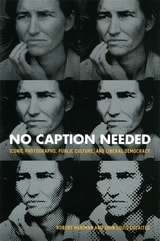
No Caption Needed
Iconic Photographs, Public Culture, and Liberal DemocracyRobert Hariman and John Louis Lucaites
University of Chicago Press, 2007
In No Caption Needed, Robert Hariman and John Louis Lucaites provide the definitive study of the iconic photograph as a dynamic form of public art. Their critical analyses of nine individual icons explore the photographs themselves and their subsequent circulation through an astonishing array of media, including stamps, posters, billboards, editorial cartoons, TV shows, Web pages, tattoos, and more. Iconic images are revealed as models of visual eloquence, signposts for collective memory, means of persuasion across the political spectrum, and a crucial resource for critical reflection.
Arguing against the conventional belief that visual images short-circuit rational deliberation and radical critique, Hariman and Lucaites make a bold case for the value of visual imagery in a liberal-democratic society. No Caption Needed is a compelling demonstration of photojournalism’s vital contribution to public life.
Noise From The Writing Center
Elizabeth H. Boquet
Utah State University Press, 2002
In Noise from the Writing Center, Boquet develops a theory of "noise" and excess as an important element of difference between the pedagogy of writing centers and the academy in general. Addressing administrative issues, Boquet strains against the bean-counting anxiety that seems to drive so much of writing center administration. Pedagogically, she urges a more courageous practice, developed via metaphors of music and improvisation, and argues for "noise," excess, and performance as uniquely appropriate to the education of writers and tutors in the center.
Personal, even irreverent in style, Boquet is also theoretically sophisticated, and she draws from an eclectic range of work in academic and popular culture-from Foucault to Attali to Jimi Hendrix. She includes, as well, the voices of writing center tutors with whom she conducted research, and she finds some of her most inspiring moments in the words and work of those tutors.

Nonfiction, the Teaching of Writing, and the Influence of Richard Lloyd-Jones
Doug Hesse
University Press of Colorado, 2023

Not One More!
Feminicidio on the BorderNina Maria Lozano
The Ohio State University Press, 2019
Finding theories of new materialism inadequate to explain the feminicidios, Lozano critiques and extends this approach—advancing instead a new theoretical framework, border materialism, to argue that capitalist systems of neoliberalism and free trade are directly correlated to the killing of women on the US–Mexico border. Through the author’s fifteen-plus years of on-the-ground fieldwork, readers are presented with firsthand accounts, testimonies, and new social movement strategies from family members and activists attempting to stop these gendered crimes.
By offering concrete case studies—including analysis of maquiladoras/factories and free trade zones, public monuments and murals memorializing the victims, rastreos/searches by family members for victims’ DNA remains, and testimony from Mothers, family members, and activists—Not One More! lays bare the socioeconomic and geopolitical forces at work in the killing of women in Juárez.
Notes on the Heart
Affective Issues in the Writing ClassroomSusan H. McLeod
Southern Illinois University Press, 1997
It has long been recognized that affect (that is, the noncognitive aspect of mental activity) plays a large role in writing and in learning to write. According to Susan H. McLeod, however, the model that has been most used for empirical research on the writing process is based on cognitive psychology and does not take into account affective phenomena. Nor does the social constructionist view of the writing process acknowledge the affective realm except in a very general way. To understand the complete picture, McLeod insists, we need to explore how cognitive, affective, and social elements interact as people write.
In this book, McLeod follows a group of students through a semester of writing assignments, tracking the students’ progress and examining the affective elements relevant to their writing. To facilitate future discussion of these phenomena, McLeod also provides suggested definitions for terms in the affective domain.
In a very real sense, this book is the result of a collaboration of three Susans: Susan McLeod, who researched and wrote the book; Sue Hallett, an instructor in Washington State University’s composition program whose classes McLeod observed and who helped provide much of the data; and Susan Parker, a graduate student who observed Hallett’s class and who ran a tutorial connected to that class. To provide a narrative structure, McLeod and her two collaborators have constructed a simulated semester, conflating the year and a half of the study into one semester and creating a class that is a composite drawn from seven classrooms over three semesters.
Although philosophers have had much to say about the affective domain, Notes on the Heart is based for the most part on research from the social sciences. Discussions of pedagogy, while meant to have practical value, are suggestive rather than prescriptive. The goal is to help teachers see their practice in new way.
Teachers will be particularly interested in McLeod’s discussion of teacher affect/effect. This section examines both the issue of the "Pygmalion effect" (students becoming better because the teacher believes they are) and perhaps the more common opposite, the "golem effect" (students becoming less capable because their teachers view them that way).

Novelties in the Heavens
Rhetoric and Science in the Copernican ControversyJean Dietz Moss
University of Chicago Press, 1993
Moss describes the nature of dialectical and rhetorical discourse in the period of the Copernican debate to shed new light on the argumentative strategies used by the participants. Against the background of Ptolemy's Almagest, she analyzes the gradual increase of rhetoric beginning with Copernicus's De Revolutionibus and Galileo's Siderius nuncius, through Galileo's debates with the Jesuits Scheiner and Grassi, to the most persuasive work of all, Galileo's Dialogue. The arguments of the Dominicans Bruno and Campanella, the testimony of Johannes Kepler, and the pleas of Scriptural exegetes and the speculations of John Wilkins furnish a counterpoint to the writings of Galileo, the centerpiece of this study.
The author places the controversy within its historical frame, creating a coherent narrative movement. She illuminates the reactions of key ecclesiastical and academic figures figures and the general public to the issues.
Blending history and rhetorical analysis, this first study to look at rhetoric as defined by sixteenth- and seventeenth-century participants is an original contribution to our understanding of the use of persuasion as an instrument of scientific debate.
Now Don't Try to Reason with Me
Essays and Ironies for a Credulous AgeWayne C. Booth
University of Chicago Press, 1970
“Professor Booth’s earnestness is graced by wit, irony, and generous humor.”—Louis Coxe, New Republic
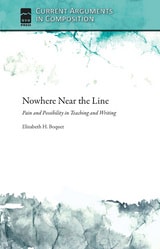
Nowhere Near the Line
Pain and Possibility in Teaching and WritingElizabeth H. Boquet
Utah State University Press, 2016
In this short work, Elizabeth Boquet explores the line Lawrence Schall describes above, tracing the overlaps and intersections of a lifelong education around guns and violence, as a student, a teacher, a feminist, a daughter, a wife, a citizen and across the dislocations and relocations that are part of a life lived in and around school. Weaving narratives of family, the university classroom and administration, her husband’s work as a police officer, and her work with students and the Poetry for Peace effort that her writing center sponsors in the local schools, she recounts her efforts to respond to moments of violence with a pedagogy of peace. “Can we not acknowledge that our experiences with pain anywhere should render us more, not less, capable of responding to it everywhere?” she asks. “Compassion, it seems to me, is an infinitely renewable resource.”
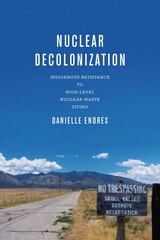
Nuclear Decolonization
Indigenous Resistance to High-Level Nuclear Waste SitingDanielle Endres
The Ohio State University Press, 2023
Honorable Mention, 2024 NCA Public Address Division’s Marie Hochmuth Nichols Award
Honorable Mention, 2025 Association for the Rhetoric of Science, Technology, and Medicine Book Award
While research demonstrates how Indigenous populations have been disproportionately affected by the global nuclear production complex, less attention has been given to tactics that have successfully resisted such projects. Danielle Endres’s Nuclear Decolonization shifts the conversation around nuclear colonialism in important ways, offering an account of how the Western Shoshone, Southern Paiute, and Skull Valley Goshute peoples and nations prevented two high-level nuclear waste sites from being built on their lands.
Using a decolonial approach, Endres highlights two sets of rhetorical tactics—Indigenous Lands rhetorics and national interest rhetorics—used to fight nuclear colonialism. The book reframes nuclear decolonization as fundamentally a struggle for the return of Indigenous lands while also revealing how Native activists selectively move between Indigenous nationhood and US citizenship in order to resist settler decision-making. Working at the intersection of Indigenous antinuclear advocacy, Indigenized environmental justice, and decolonization, Nuclear Decolonization centers Native activism and voices while amplifying the power and resilience of Indigenous peoples and nations.