Results by title
424 books match the query 'Russian & Soviet' and 11 start with n
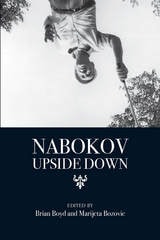
Nabokov Upside Down
Edited by Brian Boyd and Marijeta Bozovic
Northwestern University Press, 2017
Nabokov Upside Down brings together essays that explicitly diverge from conventional topics and points of reference when interpreting a writer whose influence on contemporary literature is unrivaled. Scholars from around the world here read Nabokov in terms of bodies rather than minds, belly-laughs rather than erudite wit, servants rather than master-artists, or Asian rather than Western perspectives. The first part of the volume is dedicated to surveys of Nabokov’s oeuvre that transform some long-held assumptions concerning the nature of and significance of his work.
Often thought of as among the most cerebral of artists, Nabokov comes across in these essays as profoundly aware of the physical world, as evidenced by his masterly representation of physical movement, his bawdy humor, and his attention to gustatory pleasure, among other aspects of his writing. The volume’s second half focuses on individual works or phases in Nabokov’s career, noting connections among them as well as to other fields of inquiry beyond literature. Engaged in conversation with each other and, in his editorial comments, with Brian Boyd, the essays in this volume show Nabokov scholarship continuing to renew itself.
Nabokov and Indeterminacy
The Case of The Real Life of Sebastian KnightPriscilla Meyer
Northwestern University Press, 2018
In Nabokov and Indeterminacy, Priscilla Meyer shows how Vladimir Nabokov’s early novel The Real Life of Sebastian Knight illuminates his later work. Meyer first focuses on Sebastian Knight, exploring how Nabokov associates his characters with systems of subtextual references to Russian, British, and American literary and philosophical works. She then turns to Lolita and Pale Fire, applying these insights to show that these later novels clearly differentiate the characters through subtextual references, and that Sebastian Knight’s construction models that of Pale Fire.
Meyer argues that the dialogue Nabokov constructs among subtexts explores his central concern: the continued existence of the spirit beyond bodily death. She suggests that because Nabokov’s art was a quest for an unattainable knowledge of the otherworldly, knowledge which can never be conclusive, Nabokov’s novels are never closed in plot, theme, or resolution—they take as their hidden theme the unfinalizability that Bakhtin says characterizes all novels.
The conclusions of Nabokov's novels demand a rereading, and each rereading yields a different novel. The reader can never get back to the same beginning, never attain a conclusion, and instead becomes an adept of Nabokov’s quest. Meyer emphasizes that, unlike much postmodern fiction, the contradictions created by Nabokov’s multiple paths do not imply that existence is constructed arbitrarily of pre-existing fragments, but rather that these fragments lead to an ever-deepening approach to the unknowable.
Nabokov's "Invitation to a Beheading"
A Critical CompanionJulian Connolly
Northwestern University Press, 1997
Nabokov's Canon
From "Onegin" to "Ada"Marijeta Bozovic
Northwestern University Press, 2016
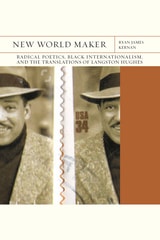
New World Maker
Radical Poetics, Black Internationalism, and the Translations of Langston HughesRyan James Kernan, foreword by Robin D. G. Kelley
Northwestern University Press, 2022
Through original research and close readings alert to the foreign prosody underlying Hughes’s work, New World Maker recuperates his political writing, which had been widely maligned by Cold War detractors and adherents of New Criticism, and affirms his place as a progenitor of African diasporic literature and within the pantheon of US modernists. Demonstrating the integral part translation played in Hughes’s creative process, this book challenges a number of common assumptions about this canonical thinker and offers important insights for scholars of African diasporic literature, comparative literature, and American, Caribbean, and translation studies.
Nietzsche and Dostoevsky
Philosophy, Morality, TragedyEdited by Jeff Love and Jeffrey Metzger
Northwestern University Press, 2016

Night Patrol and Other Stories
Mikhail Kuraev
Duke University Press, 1994
Though steeped in history, his stories pluck from obscurity the little people history ignores—and, in the Soviet Union of Stalin, often crushed. In the complex "Captain Dikshtein," a fictional account of an incident in the 1921 Kronstad, Kuraev evokes life within Soviet military culture and draws a vivid, difficult portrait of one particular life amid the ships and artillery. In "Night Patrol," a lowly member of the Soviet secret police narrates his evening rounds, interspersing the nightly arrests with reflections on his long career in the KGB. In "Petya on His Way to the Heavenly Kingdom," set in a construction site for a hydroelectric dam near Murmansk, a soldier’s murder of the village simpleton resonates through a small community committed to an enormous and enormously dubious technological project. Ranging over a broad landscape of historical foibles, Kuraev’s sympathetic wit and satiric brilliance have invited comparison to Gogol, but are finally unique. In this book, English-reading audiences will discover a new and challenging voice in a tradition that has given the world some of its greatest stories.
Nikolai Klyuev
Time and Text, Place and PoetMichael Makin
Northwestern University Press, 2009
Nikolai Klyuev is the first book in English to examine the life and work of this enigmatic poet. Klyuev (1884–1937) rose to prominence in the early twentieth century as the first of the so-called "new peasant poets" but later fell victim to Stalinist hostility to both his cultural ideology and his homosexuality. He was arrested and exiled in 1933, then shot in 1937.
Klyuev’s work incorporates rich elements of folklore, mysticism, politics, and religion, and he sometimes invokes arcane Russian syntax and vocabulary. Makin’s feat is particularly notable because Klyuev was often elusive in his own accounts of his life, and Makin successfully brings into focus the poet’s deliberate strategies of self-mythologization. Nikolai Klyuev is an indispensable guide to the life and the work of an important poet winning wider recognition outside of Russia.
Nikolai Zabolotsky
Enigma and Cultural ParadigmSarah Pratt
Northwestern University Press, 2000

No Good without Reward
Selected Writings: A Bilingual EditionLiubov Krichevskaya
Iter Press, 2011
—Helena Goscilo
Chair and Professor of Slavic, The Ohio State University
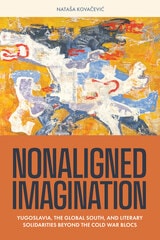
Nonaligned Imagination
Yugoslavia, the Global South, and Literary Solidarities Beyond the Cold War BlocsNataša Kovacevic
Northwestern University Press, 2026
Recovering the literary and intellectual history of anticolonial collaborations
Preoccupied with developing a multiethnic, postcolonial culture and seeking an alternative to Cold War–bloc politics, socialist Yugoslavia turned to the decolonizing countries of the Global South. It forged political, economic, and cultural links with postcolonial states and anticolonial liberation movements through the Non-Aligned Movement, of which it was a founding member in 1961. NAM spanned political and economic systems, uniting members in opposition to superpower politics and around policies of nuclear disarmament, active peaceful coexistence, anticolonialism, and respect for national sovereignty.
Nataša Kovačević reconstructs the forgotten literary and cultural history of this movement, tracing the development of new networks of intellectual engagement and cultural exchange between writers, journalists, and scholars who connected postwar Yugoslavia with 1950s India, 1960s Algeria and Guinea, 1970s Vietnam, and beyond. Nonaligned narratives attempted to reconfigure the understanding of the globe outside Eurocentric tropes and hegemonic political stratifications and to articulate Yugoslavs’ own internationalist sensibility. With Cold War–era rhetoric intensifying again in the twenty-first century, Nonaligned Imagination assumes the urgent task of unearthing a history of engaged writing and cultural diplomacy that imagined alternatives to superpower conflicts and a bipolar vision of the world.