Results by title
113 books match the query 'Selected Poems' and 4 start with n
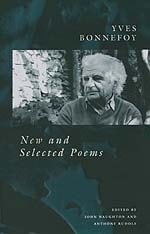
New and Selected Poems
Yves Bonnefoy
University of Chicago Press, 1995
Spanning four decades and drawing on all of Bonnefoy's major collections, this selection provides a comprehensive overview of and an ideal introduction to his work. The elegant translations, many of them new, are presented in this dual-language edition alongside the original French. Several significant works appear here in English for the first time, among them, in its entirety, Bonnefoy's 1991 book of verse, The Beginning and the End of the Snow, the 1988 prose poem Where the Arrow Falls, and an important long poem from 1993, "Wind and Smoke." Together with poems from such classic volumes as "In the Lure of the Threshold", these new works shed light on the growth as well as the continuity of Bonnefoy's work.
John Naughton's detailed introduction looks at the evolution of Bonnefoy's poetry from the 1953 publication of "On the Motion and Immobility of Douve", which immediately established his reputation as one of France's leading poets, through the 1993 publication of The Wandering Life and its centerpiece "Wind and Smoke."
"This is a comprehensive selection that contains examples of work spanning [Bonnefoy's] full career of forty years, from the ground-breaking "Du Mouvement et de l'Immobilité de Douve" through the celebratory "Pierre Ecrite" to the magical winter landscapes of America's East Coast and an unsettling reworking of myth in the recent "La Vie Errante" . . . The translations, which are the work of a variety of hands, including Galway Kinnell, Emily Grosholz and Anthony Rudolf, nevertheless fit well together and all are sensitive to the register and subtleties of both languages, while the introductory essay by John Naughton expertly explains Bonnefoy's importance as a poet and the influences which have shaped him. This is definitely a volume worth having, for layman and French specialist alike."—Hilary Davies, Times Literary Supplement
"Anyone not familiar with Bonnefoy's work will benefit from the background information and explanations given by John Naughton in his excellent introduction . . . . The book as a whole provides an excellent introduction to Bonnefoy's poetry and to his concerns of a lifetime."—Don Rodgers, Poetry Wales
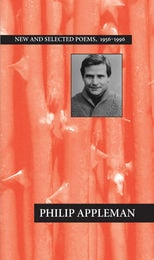
New and Selected Poems
1956-1996Philip Appleman
University of Arkansas Press, 1996
With an astonishing command of nature imagery, from sparrows to mastodons, Philip Appleman can deftly weave into a single poem an intricate pattern of ideas drawn from evolution, humanism, anthropology, religious skepticism, and everyday experience. Appealing to reason as well as to emotion and imagination, he writes poems of lyrical intensity and remarkable narrative depth. He creates characters—Eve or Darwin or a failed priest—with such wit, compassion, and subtle humor that they live on the page and surprise us with new insights into joy and sorrow, life and death. Set on the beach at Malibu, in the port of Trieste, or in a Manhattan subway, his poems evoke genuine feeling with out sentimentality and transform the personal into the universal.
Drawn from six previous books of poetry written over four decades, and with fourteen new poems, this collection shows the power and complexity of Appleman’s wide-ranging talent.
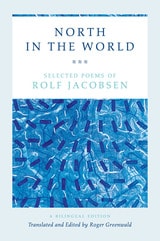
North in the World
Selected Poems of Rolf Jacobsen, A Bilingual EditionRolf Jacobsen
University of Chicago Press, 2002
Drawing from all twelve of his books, and including one poem collected posthumously, North in the World offers award-winning English translations of Jacobsen's poems, accompanied by the original Norwegian texts. The translator, the American poet Roger Greenwald, worked with Jacobsen himself to correct errors that had crept into the Norwegian texts over the years. An in-depth introduction by Greenwald highlights the main features of Jacobsen's poetry, and extensive endnotes, as well as indexes to titles and first lines in both languages, enhance the usefulness of the book for general readers and scholars alike. The result is the definitive bilingual edition of Jacobsen's marvelous poetry.
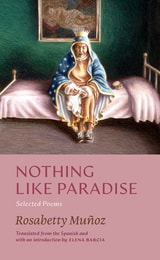
Nothing Like Paradise
Selected PoemsRosabetty Muñoz, Elena Barcia
Northwestern University Press, 2027
The first English-language translation of Rosabetty Muñoz’s vital and innovative poetry from across her extraordinary body of work
Rosabetty Muñoz is one of Chile’s most acclaimed and innovative contemporary poets. Her poems highlight the lives of girls and women on the islands of the Chilean archipelago, portraying the hardships they encounter in this often-overlooked region of the world. In this meticulous and compelling translation from Elena Barcia, Nothing Like Paradise offers a collection of selected works from across Muñoz’s oeuvre, offering a close look into the breadth and emotional intensity of her poetry.
These poems depict the wounds inflicted by the Pinochet dictatorship, foreign invasions, sexual exploitation, the incursions of global capitalism, and political exile. Renowned for her powerful use of multiple voices and striking images, Muñoz channels the thoughts and emotions of the islands’ female inhabitants, bringing immediacy and drama to their stories and transforming readers into their witnesses and confidants. Her poems invite us to confront pain and injustice with empathy and to turn understanding into a collective act of compassion and resistance.