Results by title
70 books match the query 'Selected Writings' and 3 start with n
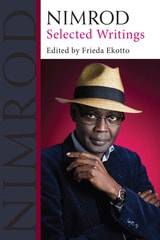
Nimrod
Selected WritingsFrieda Ekotto, editor
University of Michigan Press, 2018
The Chadian writer Nimrod—philosopher, poet, novelist, and essayist—is one of the most dynamic and vital voices in contemporary African literature and thought. Yet little of Nimrod’s writing has been translated into English until now. Introductory material by Frieda Ekotto provides context for Nimrod’s work and demonstrates the urgency of making it available beyond Francophone Africa to a broader global audience.
At the heart of this volume are Nimrod’s essays on Léopold Sédar Senghor, a key figure in the literary and aesthetic Négritude movement of the 1930s and president of Senegal from 1945 through 1980. Widely dismissed in recent decades as problematically essentialist, Senghorian Negritude articulated notions of “blackness” as a way of transcending deep divisions across a Black Diaspora under French colonial rule. Nimrod offers a nuanced reading of Senghor, drawing out the full complexities of Senghor’s philosophy and reevaluating how race and colonialism function in a French-speaking space.
Also included in this volume are Nimrod’s essays on literature from the 2008 collection, The New French Matter (La nouvelle chose française). Representing his prose fiction is his 2010 work, Rivers’ Gold (L’or des rivières). Also featured are some of Nimrod’s best-loved poems, in both English translation and the original French.
The works selected and translated for this volume showcase Nimrod’s versatility, his intellectual liveliness, and his exploration of questions of aesthetics in African literature, philosophy, and linguistics. Nimrod: Selected Writings marks a significant contribution toward engaging a broader audience with one of the vital voices of our time. This book will be essential reading for Anglophone students and scholars of African philosophy, literature, poetry, and critical theory, and will offer a welcome introduction to Nimrod for general readers of contemporary international writing.
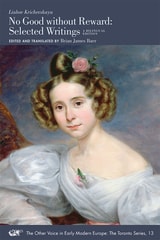
No Good without Reward
Selected Writings: A Bilingual EditionLiubov Krichevskaya
Iter Press, 2011
—Helena Goscilo
Chair and Professor of Slavic, The Ohio State University
Novas
Selected WritingsHaroldo de Campos
Northwestern University Press, 2007
A generous introduction to one of the key literary figures to emerge from Brazil in the second half of the twentieth century, this book offers English-speaking readers an ample selection of this prodigious writer's celebrated poetry and widely influential critical work. As a poet and as a cofounder of the renowned group Noigandres, Haroldo de Campos has made a unique and substantial contribution to the theory and practice of experimental writing, particularly the form known as concrete poetry, and to the Latin American avant-garde as a whole. These contributions, acclaimed worldwide by figures such as Umberto Eco, Jacques Derrida, Octavio Paz, and Guillermo Cabrera Infante, can be observed unfolding here, first in poetry selections ranging from de Campos' early work before concretism through his most recent production; then in theoretical texts that trace his evolution as a critic from an early interest in baroque and modernist writers to his development of an innovative model for reading, translating, and writing. This second, critical section of the book includes de Campos' encounters with the tasks of translating and reading some of the most important texts of Eastern and Western culture-from Ecclesiastes to the No play Hagoromo, from Dante to Paz-thus charting a genealogy of modern literature.
Together, these poems and critical writings afford English-speaking readers their first sustained exposure to a unique personality within the international avant-garde, a writer described by Brazilian poet João Cabral de Melo Neto as "that wonderful thing: / a poet and a translator who came to literature armed with an enviable / knowledge of the literary phenomenon."