Results by title
94 books match the query 'Services for' and 2 start with n
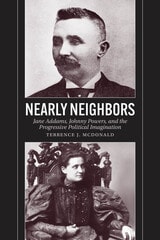
Nearly Neighbors
Jane Addams, Johnny Powers, and the Progressive Political ImaginationTerrence J. McDonald
University of Chicago Press, 2026
An engaging look at the encounter between Jane Addams, Hull House settlement co-founder and Progressive reformer, and Alderman Johnny Powers.
Jane Addams was full of courage and goodwill when she opened Hull House in Chicago’s Nineteenth Ward in 1889. However, she failed to understand that her immigrant neighbors had been well-organized around mostly Catholic churches and schools for decades before her arrival. Her ultimate political rival, Johnny Powers, grew up in this culture but was no ethnic hero or deep political thinker. Nearly Neighbors is the first book to provide a contextualized history of their encounter, embedding it in the social and political culture and structures of Chicago and the Nineteenth Ward in the 1890s.
Terrence J. McDonald provides a crucial analysis of two pivotal figures in Chicago’s political history, in part by providing the first detailed assessment of Powers’s life and practices, but also by demonstrating Addams’s misconception of him and her neighbors—and why it matters for understanding her Progressive work overall. In both her political work and writings, Addams saw her ethnic neighbors as bundles of economic need, rather than bearers of ethnic culture. At the same time, she was recruited by elite allies into causes that appeared to be opposed by her neighbors. These views and practices permitted Powers to win in their climactic political battle in 1898 simply by claiming to be the neighborhood defender against Addams and her “downtown” allies. Nearly Neighbors offers a new way of understanding Addams and the complicated legacy of her famous political work and writings.
[more]
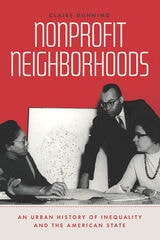
Nonprofit Neighborhoods
An Urban History of Inequality and the American StateClaire Dunning
University of Chicago Press, 2022
An exploration of how and why American city governments delegated the responsibility for solving urban inequality to the nonprofit sector.
Nonprofits serving a range of municipal and cultural needs are now so ubiquitous in US cities, it can be difficult to envision a time when they were more limited in number, size, and influence. Turning back the clock, however, uncovers both an illuminating story of how the nonprofit sector became such a dominant force in American society, as well as a troubling one of why this growth occurred alongside persistent poverty and widening inequality. Claire Dunning’s book connects these two stories in histories of race, democracy, and capitalism, revealing how the federal government funded and deputized nonprofits to help individuals in need, and in so doing avoided addressing the structural inequities that necessitated such action in the first place.
Nonprofit Neighborhoods begins after World War II, when suburbanization, segregation, and deindustrialization inaugurated an era of urban policymaking that applied private solutions to public problems. Dunning introduces readers to the activists, corporate executives, and politicians who advocated addressing poverty and racial exclusion through local organizations, while also raising provocative questions about the politics and possibilities of social change. The lessons of Nonprofit Neighborhoods exceed the bounds of Boston, where the story unfolds, providing a timely history of the shift from urban crisis to urban renaissance for anyone concerned about American inequality—past, present, or future.
[more]