Results by title
72 books match the query 'Social structure' and 3 start with n
Nahuat Myth and Social Structure
By James M. Taggart
University of Texas Press, 1997
First published in 1983, Nahuat Myth and Social Structure brings together an important collection of modern-day Aztec Indian folktales and vividly demonstrates how these tales have been shaped by the social structure of the communities in which they are told.
[more]
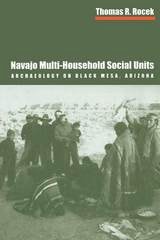
Navajo Multi-Household Social Units
Archaeology on Black Mesa, ArizonaThomas R. Rocek
University of Arizona Press, 1995
In a rigorous and innovative study, Thomas R. Rocek examines the 150-year-old ethnohistorical and archaeological record of Navajo settlement on Black Mesa in northern Arizona. Rocek's study, the first of its kind, not only reveals a rich array of interacting factors that have helped to shape Navajo life during this period but also constructs a valuable case study in archaeological method and theory, certain to be useful to other researchers of nonurban societies.
Rocek explores a neglected but major source of social flexibility in these societies. While many studies have focused on household and community-level organization, few have examined the flexible, intermediate-sized, "middle-level" cooperative units that bind small groups of households together. Middle-level units, says the author, must be recognized as important sources of social flexibility in many such cultural contexts. Futhermore, attention to middle-level units is critical for understanding household or community-level organization, because the flexibility they offer can fundamentally alter the behavior of social units of a larger or smaller scale.
In examining the archaeological record of Navajo settlement, Rocek develops archaeological methods for examing multiple-household social units (variously called "outfits or "cooperating groups") through spatial analysis, investigates evidence of change in middle-level units over time, relates these changes to economic and demographic flux, and compares the Navajo case study to the broader ethnographic literature of middle-level units. Rocek finds similarities with social organization in non-unilineally organized societies, in groups that have been traditionally described as characterized by network organization, and particularly in pastoral societies. The results of Rocek's study offer a new perspective on variability in Navajo social organization while suggesting general patterns of the response of social groups to change.
Rocek's work will be of significant interest not only to those with a professional interest in Navajo history and culture, but also, for its methodological insights, to a far broader range of archaeologists, social anthropologists, ethnohistorians, ethnoarchaeologists, historians, cultural geographers, and political scientists.
[more]
Navigating Normative Orders
Interdisciplinary PerspectivesEdited by Matthias C. Kettemann
Campus Verlag, 2020
Normative orders emerge and pollinate everywhere. Whether it be with Kant or among conservatives, posts on the internet, in environmental discourses, or in our raising of our children: Norms populate and spread. This book explains how norms are created, why they are adopted, how they can be legitimated, and how they are contested and disappear. Combining twelve contributions from a diverse range of disciplines, the book unites, for the first time, younger scholars from the Research Centre “Normative Orders” at the University of Frankfurt. Even as certainties are questioned, norms are shown to play a central and vital role in regulating our behavior and understandings. Together, these norms form normative orders, with and through which political authority and the distribution of rights and goods are legitimized, in criminal law, educational systems, the territorial state, the discourse on progress, and in the Anthropocene. As Navigating Normative Orders shows, these norms control our personal and political lives in ways we may not even realize.
[more]