Results by title
247 books match the query 'South Africa' and 10 start with n

Natal Command
Peter Sacks
University of Chicago Press, 1997
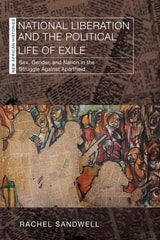
National Liberation and the Political Life of Exile
Sex, Gender, and Nation in the Struggle Against ApartheidRachel Sandwell
Ohio University Press, 2025
The first book-length study to reveal how women in exile shaped South Africa’s antiapartheid movement
This groundbreaking book explores the often-overlooked role of women in South Africa’s liberation movements, particularly within the African National Congress during its years in exile from 1960 to 1990. It examines how transformations in gender roles—though contested—were central to imagining a postapartheid South Africa.
Through an analysis of women’s diplomatic work and their advocacy for policies on sexual education, birth control, family life, and childcare, Rachel Sandwell challenges traditional narratives that have ignored or minimized women’s contributions. She highlights how South African women played a crucial role in connecting exiles to left-wing international organizations like the Women’s International Democratic Federation, positioning women as key figures in global anticolonial politics.
The book also explores how gender transformation was at the heart of the exiled antiapartheid movement’s vision for a free South Africa. Women fought for recognition beyond the role of “mothers of the nation,” sparking internal debates over revolutionary morality, the compatibility of motherhood with military service, and responses to sexual and domestic violence within the movement. These struggles mirrored broader ideological conflicts over nation building, belonging, and political identity as the African National Congress sought legitimacy as a government-in-exile.
Ultimately, National Liberation and the Political Life of Exile asks how we write histories of revolutionary movements—especially those that, despite their transformative ambitions, did not fully realize their goals. A vital contribution to feminist history, anticolonial studies, and the history of global liberation struggles, this book reshapes our understanding of gender and politics in the antiapartheid movement.
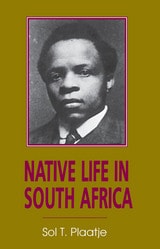
Native Life In South Africa
Before and Since the European War and the Boer RebellionSol T. Plaatje
Ohio University Press, 1991
First published in 1916 and one of South Africa’s great political books, Native Life in South Africa was first and foremost a response to the Native’s Land Act of 1913, and was written by one of the most gifted and influential writers and journalists of his generation. Sol T. Plaatje provides an account of the origins of this crucially important piece of legislation and a devastating description of its immediate effects.
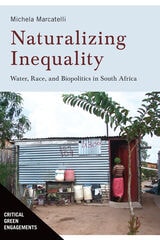
Naturalizing Inequality
Water, Race, and Biopolitics in South AfricaMichela Marcatelli
University of Arizona Press, 2021
Michela Marcatelli unravels this inequality paradox through an ethnography of water in a rural region of the country. The Waterberg Plateau is a space where agriculture, conservation, and extraction coexist and intersect. Marcatelli examines the connections between neoliberalism, race, and the environment by showing that racialized property relations around water and land are still recognized and protected by the post-apartheid state to sustain green growth. She argues that the government depicts growth as the best, if not only, solution to inequality. While white landowners maintain access to water, however, black ex-farmworkers are dispossessed once again of this essential-to-life resource.
If the promise of growth serves to normalize inequality, the call to save nature has the effect of naturalizing it even further.
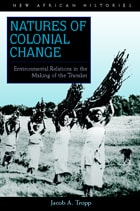
Natures of Colonial Change
Environmental Relations in the Making of the TranskeiJacob A. Tropp
Ohio University Press, 2006
In this groundbreaking study, Jacob A. Tropp explores the interconnections between negotiations over the environment and an emerging colonial relationship in a particular South African context—the Transkei—subsequently the largest of the notorious “homelands” under apartheid.
In the late nineteenth century, South Africa’s Cape Colony completed its incorporation of the area beyond the Kei River, known as the Transkei, and began transforming the region into a labor reserve. It simultaneously restructured popular access to local forests, reserving those resources for the benefit of the white settler economy. This placed new constraints on local Africans in accessing resources for agriculture, livestock management, hunting, building materials, fuel, medicine, and ritual practices.
Drawing from a diverse array of oral and written sources, Tropp reveals how bargaining over resources—between and among colonial officials, chiefs and headmen, and local African men and women—was interwoven with major changes in local political authority, gendered economic relations, and cultural practices as well as with intense struggles over the very meaning and scope of colonial rule itself.
Natures of Colonial Change sheds new light on the colonial era in the Transkei by looking at significant yet neglected dimensions of this history: how both “colonizing” and “colonized” groups negotiated environmental access and how such negotiations helped shape the broader making and meaning of life in the new colonial order.
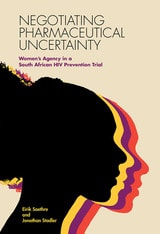
Negotiating Pharmaceutical Uncertainty
Women's Agency in a South African HIV Prevention TrialEirik Saethre
Vanderbilt University Press, 2017
As embedded anthropologists, Saethre and Stadler provide a unique and nuanced perspective of the reality of a clinical trial that is often hidden from view.
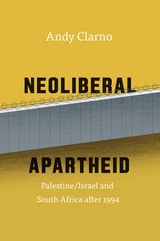
Neoliberal Apartheid
Palestine/Israel and South Africa after 1994Andy Clarno
University of Chicago Press, 2017
After a decade of research in the Johannesburg and Jerusalem regions, Andy Clarno presents here a detailed ethnographic study of the precariousness of the poor in Alexandra township, the dynamics of colonization and enclosure in Bethlehem, the growth of fortress suburbs and private security in Johannesburg, and the regime of security coordination between the Israeli military and the Palestinian Authority in the West Bank. The first comparative study of the changes in these two areas since the early 1990s, the book addresses the limitations of liberation in South Africa, highlights the impact of neoliberal restructuring in Palestine, and argues that a new form of neoliberal apartheid has emerged in both contexts.
New South African Keywords
Nick Shepherd
Ohio University Press, 2008
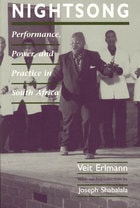
Nightsong
Performance, Power, and Practice in South AfricaVeit Erlmann
University of Chicago Press, 1996
Veit Erlmann provides the first comprehensive interpretation of isicathamiya performance practice and its relation to the culture and consciousness of the Zulu migrant laborers who largely compose its choirs. In songs and dances, the performers oppose the class and racial oppression that reduces them to "labor units." At the same time, Erlmann argues, the performers rework dominant images to symbolically reconstruct their "home," an imagined world of Zulu rural tradition and identity.
By contrasting the live performance of isicathamiya to its reproduction in mass media, recordings, and international concerts, Erlmann addresses important issues in performance studies and anthropology, and looks to the future of isicathamiya live performance in the new South Africa. Featuring an Introduction by Joseph Shabalala, the lead singer and founder of Ladysmith Black Mambazo, this book will be essential reading for anyone interested in the study of music, performance, popular culture, or South Africa.
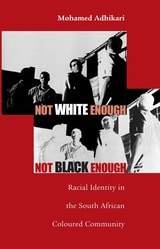
Not White Enough, Not Black Enough
Racial Identity in the South African Coloured CommunityMohamed Adhikari
Ohio University Press, 2005