Results by title
661 books match the query 'South America' and 15 start with n

Narrative Threads
Accounting and Recounting in Andean KhipuEdited by Jeffrey Quilter and Gary Urton
University of Texas Press, 2002
The Inka Empire stretched over much of the length and breadth of the South American Andes, encompassed elaborately planned cities linked by a complex network of roads and messengers, and created astonishing works of architecture and artistry and a compelling mythology—all without the aid of a graphic writing system. Instead, the Inkas' records consisted of devices made of knotted and dyed strings—called khipu—on which they recorded information pertaining to the organization and history of their empire. Despite more than a century of research on these remarkable devices, the khipu remain largely undeciphered.
In this benchmark book, twelve international scholars tackle the most vexed question in khipu studies: how did the Inkas record and transmit narrative records by means of knotted strings? The authors approach the problem from a variety of angles. Several essays mine Spanish colonial sources for details about the kinds of narrative encoded in the khipu. Others look at the uses to which khipu were put before and after the Conquest, as well as their current use in some contemporary Andean communities. Still others analyze the formal characteristics of khipu and seek to explain how they encode various kinds of numerical and narrative data.
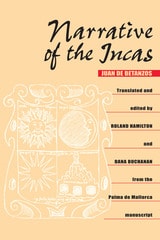
Narrative of the Incas
By Juan de Betanzos
University of Texas Press, 1996
One of the earliest chronicles of the Inca empire was written in the 1550s by Juan de Betanzos. Although scholars have long known of this work, only eighteen chapters were actually available until the 1980s when the remaining sixty-four chapters were discovered in the collection of the Fundación Bartolomé March in Palma de Mallorca, Spain.
Narrative of the Incas presents the first complete English translation of the original manuscript of this key document. Although written by a Spaniard, it presents an authentic Inca worldview, drawn from the personal experiences and oral traditions told to Betanzos by his Inca wife, Doña Angelina, and other members of her aristocratic family who lived during the reigns of the last Inca rulers, Huayna Capac Huascar and Atahualpa. Betanzos wrote a history of the Inca empire that focuses on the major rulers and the contributions each one made to the growth of the empire and of Inca culture.
Filled with new insights into Inca politics, marriage, laws, the calendar, warfare, and other matters, Narrative of the Incas is essential reading for everyone interested in this ancient civilization.
Natives Making Nation
Gender, Indigeneity, and the State in the AndesAndrew Canessa
University of Arizona Press, 2005
This volume looks at how metropolitan ideas of nation employed by politicians, the media and education are produced, reproduced, and contested by people of the rural Andes—people who have long been regarded as ethnically and racially distinct from more culturally European urban citizens. Yet these peripheral “natives” are shown to be actively engaged with the idea of the nation in their own communities, forcing us to re-think the ways in which indigeneity is defined by its marginality.
The contributors examine the ways in which numerous identities—racial, generational, ethnic, regional, national, gender, and sexual—are both mutually informing and contradictory among subaltern Andean people who are more likely now to claim an allegiance to a nation than ever before. Although indians are less often confronted with crude assimilationist policies, they continue to face racism and discrimination as they struggle to assert an identity that is more than a mere refraction of the dominant culture. Yet despite the language of multiculturalism employed even in constitutional reform, any assertion of indian identity is likely to be resisted. By exploring topics as varied as nation-building in the 1930s or the chuqila dance, these authors expose a paradox in the relation between indians and the nation: that the nation can be claimed as a source of power and distinct identity while simultaneously making some types of national imaginings unattainable.
Whether dancing together or simply talking to one another, the people described in these essays are shown creating identity through processes that are inherently social and interactive. To sing, to eat, to weave . . . In the performance of these simple acts, bodies move in particular spaces and contexts and do so within certain understandings of gender, race and nation. Through its presentation of this rich variety of ethnographic and historical contexts, Natives Making Nation provides a finely nuanced view of contemporary Andean life.
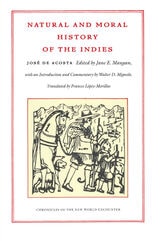
Natural and Moral History of the Indies
José de Acosta
Duke University Press, 2002
A significant contribution to Renaissance Europe's thinking about the New World, Acosta's Natural and Moral History of the Indies reveals an effort to incorporate new information into a Christian, Renaissance worldview. He attempted to confirm for his European readers that a "new" continent did indeed exist and that human beings could and did live in equatorial climates. A keen observer and prescient thinker, Acosta hypothesized that Latin America's indigenous peoples migrated to the region from Asia, an idea put forth more than a century before Europeans learned of the Bering Strait. Acosta's work established a hierarchical classification of Amerindian peoples and thus contributed to what today is understood as the colonial difference in Renaissance European thinking.
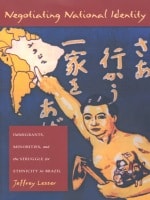
Negotiating National Identity
Immigrants, Minorities, and the Struggle for Ethnicity in BrazilJeffrey Lesser
Duke University Press, 1999
Employing a cross-cultural approach, Lesser examines a variety of acculturating responses by minority groups, from insisting on their own whiteness to becoming ultra-nationalists and even entering secret societies that insisted Japan had won World War II. He discusses how various minority groups engaged in similar, and successful, strategies of integration even as they faced immense discrimination and prejudice. Some believed that their ethnic heritage was too high a price to pay for the “privilege” of being white and created alternative categories for themselves, such as Syrian-Lebanese, Japanese-Brazilian, and so on. By giving voice to the role ethnic minorities have played in weaving a broader definition of national identity, this book challenges the notion that elite discourse is hegemonic and provides the first comprehensive look at Brazilian worlds often ignored by scholars.
Based on extensive research, Negotiating National Identity will be valuable to scholars and students in Brazilian and Latin American studies, as well as those in the fields of immigrant history, ethnic studies, and race relations.
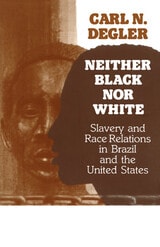
Neither Black Nor White
Slavery and Race Relations in Brazil and the United StatesCarl Degler
University of Wisconsin Press, 1986
Carl Degler’s 1971 Pulitzer-Prize-winning study of comparative slavery in Brazil and the United States is reissued in the Wisconsin paperback edition, making it accessible for all students of American and Latin American history and sociology.
Until Degler’s groundbreaking work, scholars were puzzled by the differing courses of slavery and race relations in the two countries. Brazil never developed a system of rigid segregation, such as appeared in the United States, and blacks in Brazil were able to gain economically and retain far more of their African culture. Rejecting the theory of Giberto Freyre and Frank Tannenbaum—that Brazilian slavery was more humane—Degler instead points to a combination of demographic, economic, and cultural factors as the real reason for the differences.
“In the early 1970s when studies in social history were beginning to blossom on the North American scene, Carl Degler’s prize-winning contribution was a thoughtful provocative essay in comparative history. Its thoughtfulness has not diminished with the years. Indeed, it is as topical today as when it was first published. The Brazilian experience with rapid industrialization and its attempt to restore democratic government indicates that the issues which Degler treated in the early 1970s are more pertinent than ever today.”—Franklin W. Knight, Department of History, Johns Hopkins University.
Neoliberalism from Below
Popular Pragmatics and Baroque EconomiesVerónica Gago
Duke University Press, 2017
New Approaches to Resistance in Brazil and Mexico
John Gledhill and Patience A. Schell, eds.
Duke University Press, 2012
Contributors. Helga Baitenmann, Marcus J. M. de Carvalho, Guillermo de la Peña, John Gledhill, Matthew Gutmann, Maria Gabriela Hita, Alan Knight, Ilka Boaventura Leite, Jean Meyer, John Monteiro, Luis Nicolau Parés, Patricia R. Pessar, Patience A. Schell, Robert Slenes, Juan Pedro Viqueira, Margarita Zárate
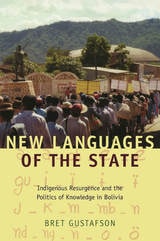
New Languages of the State
Indigenous Resurgence and the Politics of Knowledge in BoliviaBret Gustafson
Duke University Press, 2009
Gustafson shows that bilingual education is an issue that extends far beyond the classroom. Public schools are at the center of a broader battle over territory, power, and knowledge as indigenous movements across Latin America actively defend their languages and knowledge systems. In attempting to decolonize nation-states, the indigenous movements are challenging deep-rooted colonial racism and neoliberal reforms intended to mold public education to serve the market. Meanwhile, market reformers nominally embrace cultural pluralism while implementing political and economic policies that exacerbate inequality. Juxtaposing Guarani life, language, and activism with intimate portraits of reform politics among academics, bureaucrats, and others in and beyond La Paz, Gustafson illuminates the issues, strategic dilemmas, and imperfect alliances behind bilingual intercultural education.

New Narratives for Old
The Historical Method of Reading Early Christian Theology: Essays in Honor of Michel Rene BarnesAnthony Briggman
Catholic University of America Press, 2022

Nicaragua's Mosquito Shore
The Years of British and American PresenceCraig L. Dozier
University of Alabama Press, 1985
An essential interdisciplinary study of culture, history, and identity on Nicaragua’s Caribbean frontier.
Separated from Nicaragua’s Pacific plain by mountains, the Atlantic coastal plain extends between 70 and 100 miles into the interior. Early Spanish settlers were ousted by the British, who engaged in the mahogany trade, and who also hoped for trade with Americans seeking a short route to California. In 1850, with the signing of the Clayton-Bulwer Treaty, the U.S. and Britain agreed that neither country would seek to acquire exclusive control over a Nicaraguan canal. Plans for the development of a Nicaraguan canal had a marked influence on the region for the next 100 years.
During the second half of the 19th century both rubber and bananas were produced commercially in eastern Nicaragua, and the Standard Fruit Company of New Orleans became the larges single commercial influence in the region. The first over American intervention in eastern Nicaragua occurred in 1912, when a contingent of Marines was dispatched to protect American commercial interests. The Marines remained for thirteen years.
Dozier develops the history of the current political troubles in Nicaragua, which had their origin in the early 1930s and which center about the control of the rich area inhabited by the Mosquitos. His book presents the historical background for the tragic events that are taking place in that region.
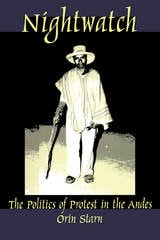
Nightwatch
The Politics of Protest in the AndesOrin Starn
Duke University Press, 1999
Drawing on fieldwork conducted over the course of a decade, Orin Starn chronicles the historical conditions that led to the formation of the rondas, the social and geographical expansion of the movement, and its gradual decline in the 1990s. Throughout this anecdotal yet deeply analytical account, the author relies on interviews with ronda participants, villagers, and Peru’s regional and national leaders to explore the role of women, the involvement of nongovernmental organizations, and struggles for leadership within the rondas. Starn moves easily from global to local contexts and from the fifteenth to the twentieth century, presenting this movement in a straightforward manner that makes it accessible to both specialists and nonspecialists.
An engagingly written story of village mobilization, Nightwatch is also a meditation on the nature of fieldwork, the representation of subaltern people, the relationship between resistance and power, and what it means to be politically active at the end of the century. It will appeal widely to scholars and students of anthropology, Latin American studies, cultural studies, history, subaltern studies, and those interested in the politics of social movements.

No Limits to Their Sway
Cartagena's Privateers and the Masterless Caribbean in the Age of RevolutionsEdgardo Pérez Morales
Vanderbilt University Press, 2018
Most of Cartagena's privateers were people of color and descendants of slaves who benefited from the relative freedom and flexibility of life at sea, but also faced kidnapping, enslavement, and brutality. Many came from Haiti and Guadeloupe; some had been directly involved in the Haitian Revolution. While their manpower proved crucial in the early Anti-Spanish struggles, Afro-Caribbean privateers were also perceived as a threat, suspected of holding questionable loyalties, disorderly tendencies, and too strong a commitment to political and social privileges for people of color. Based on handwritten and printed sources in Spanish, English, and French, this book tells the story of Cartagena's multinational and multicultural seafarers, revealing the Trans-Atlantic and maritime dimensions of South American independence.

No Limits to Their Sway
Cartagena's Privateers and the Masterless Caribbean in the Age of RevolutionsEdgardo Pérez Morales
Vanderbilt University Press, 2022
Most of Cartagena's privateers were people of color and descendants of slaves who benefited from the relative freedom and flexibility of life at sea, but also faced kidnapping, enslavement, and brutality. Many came from Haiti and Guadeloupe; some had been directly involved in the Haitian Revolution. While their manpower proved crucial in the early Anti-Spanish struggles, Afro-Caribbean privateers were also perceived as a threat, suspected of holding questionable loyalties, disorderly tendencies, and too strong a commitment to political and social privileges for people of color. Based on handwritten and printed sources in Spanish, English, and French, this book tells the story of Cartagena's multinational and multicultural seafarers, revealing the Trans-Atlantic and maritime dimensions of South American independence.
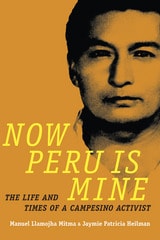
Now Peru Is Mine
The Life and Times of a Campesino ActivistManuel Llamojha Mitma and Jaymie Patricia Heilman
Duke University Press, 2016