Results by title
260 books match the query 'Soviet Union' and 7 start with n

NOTES OF A RED GUARD
Eduard M. Dune. Translated and Edited by Diane P. Koenker and S. A. Smith
University of Illinois Press, 1993
account takes the reader into Red Guard and Red Army units, Moscow factories,
workers' homes, and to the unfamiliar world of feudal Dagestan. Worker-revolutionary
Eduard Dune was seventeen when the Russian revolution began. He joined the Bolshevik
party and fought with the Moscow Red Guard during the October revolution. Notes
of a Red Guard is his candid account of what happened through 1921. This
uncensored account offers a rare glimpse of revolutionary Russia from the perspective
of an educated, skilled worker who became a rank-and-file participant.
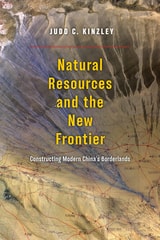
Natural Resources and the New Frontier
Constructing Modern China's BorderlandsJudd C. Kinzley
University of Chicago Press, 2018
China’s westernmost province of Xinjiang has experienced escalating cycles of violence, interethnic strife, and state repression since the 1990s. In their search for the roots of these growing tensions, scholars have tended to focus on ethnic clashes and political disputes. In Natural Resources and the New Frontier, historian Judd C. Kinzley takes a different approach—one that works from the ground up to explore the infrastructural and material foundation of state power in the region.
As Kinzley argues, Xinjiang’s role in producing various natural resources for regional powers has been an important but largely overlooked factor in fueling unrest. He carefully traces the buildup to this unstable situation over the course of the twentieth century by focusing on the shifting priorities of Chinese, Soviet, and provincial officials regarding the production of various resources, including gold, furs, and oil among others. Through his archival work, Kinzley offers a new way of viewing Xinjiang that will shape the conversation about this important region and offer a model for understanding the development of other frontier zones in China as well as across the global south.
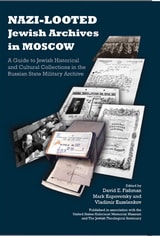
Nazi-Looted Jewish Archives in Moscow
A Guide to Jewish Historical and Cultural Collections in the Russian State Military ArchiveEdited by David E. Fishman, Mark Kupovetsky, and Vladimir Kuzelenkov
University of Scranton Press, 2010

Night Patrol and Other Stories
Mikhail Kuraev
Duke University Press, 1994
Though steeped in history, his stories pluck from obscurity the little people history ignores—and, in the Soviet Union of Stalin, often crushed. In the complex "Captain Dikshtein," a fictional account of an incident in the 1921 Kronstad, Kuraev evokes life within Soviet military culture and draws a vivid, difficult portrait of one particular life amid the ships and artillery. In "Night Patrol," a lowly member of the Soviet secret police narrates his evening rounds, interspersing the nightly arrests with reflections on his long career in the KGB. In "Petya on His Way to the Heavenly Kingdom," set in a construction site for a hydroelectric dam near Murmansk, a soldier’s murder of the village simpleton resonates through a small community committed to an enormous and enormously dubious technological project. Ranging over a broad landscape of historical foibles, Kuraev’s sympathetic wit and satiric brilliance have invited comparison to Gogol, but are finally unique. In this book, English-reading audiences will discover a new and challenging voice in a tradition that has given the world some of its greatest stories.
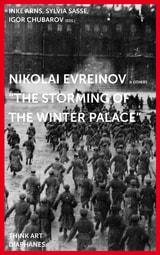
Nikolai Evreinov & Others
»The Storming of the Winter Palace«Edited by Inke Arns, Sylvia Sasse, and Igor Chubarov
Diaphanes, 2017
Nikolaj Evreinov: “The Storming of the Winter Palace” tells the fascinating story of this production. Taking readers through the relevant history, the authors describe the role of The Storming of the Winter Palace in commemorating Soviet power. With a wealth of illustrations, they also show how photographs of Evreinov’s theatrical storming eventually became historical documents of the October Revolution themselves.

No Love Without Poetry
The Memoirs of Marina Tsvetaeva's DaughterAriadna Efron
Northwestern University Press, 2009
The memoirs of Ariadna Efron provide an intimate and indispensable perspective on the poet Marina Tsvetaeva’s life and work, told from the point of view of her daughter. This wrenching story about the difficulty of living with genius charts Efron’s relationship with her parents as they navigate art and exile.
Efron’s rapport with her mother, already intense, became strained under the hardships imposed by early twentieth century Russian political upheaval. Efron recounts the family’s travels from Moscow to Germany, to Czechoslovakia, and finally to France, where, against her mother’s advice, Efron decided to return to Russia. Diane Nemec Ignashev draws on Efron’s short stories and her mother’s notebooks to supplement the original memoirs. Haunting and poignant, No Love without Poetry completes extant historical records on Tsvetaeva—and showcases Efron as a literary force in her own right.
Novel with Cocaine
M. Ageyev
Northwestern University Press, 1991