Results by title
149 books match the query 'Spanish & Portuguese' and 4 start with n
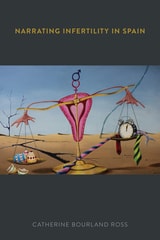
Narrating Infertility in Spain
Catherine Bourland Ross
Bucknell University Press, 2026
The drop in Spanish birth rates in 1998 to their lowest level of 1.1 births per woman was accompanied by a boom in publishing about motherhood. New narrative forms, ranging from blogs to diaries to comics, expressed women’s experiences, including ambivalence about motherhood in the face of societal pressures. Narrating Infertility in Spain, the first study of infertility in post-2008 female-authored texts, analyzes discussions of adoption, assisted reproduction, egg and sperm donation, and the decision not to have children due to economic or social instability. By examining the work of writers and vocal activists Silvia Nanclares, Raquel Sánchez-Silva, Samanta Villar, Laura Freixas, and Diana López Varela, Ross situates infertility in Spain within the cultural context of the Great Recession, while considering it as a business, a crisis, a stigma, and a class issue, and offering broader understandings of contemporary fertility challenges in Spain and beyond.
Published by Bucknell University Press. Distributed worldwide by Rutgers University Press.
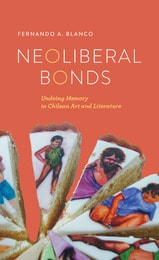
Neoliberal Bonds
Undoing Memory in Chilean Art and LiteratureFernando A. Blanco
The Ohio State University Press, 2015
Neoliberal Bonds vehemently criticizes how Chile’s transition governments, through a series of political and legal maneuvers, created the state’s official memory narratives. Blanco argues that the state, the media, academia, and the neoliberal market colluded to colonize and mediatize the “memory scene.” In contrast to these official narratives, Neoliberal Bonds analyzes alternative memory accounts within the visual arts and literature that push back against the state, its institutions, and its economic allies. These alternative memory narratives highlight the ontological fracture of the new neoliberal subjects; they also bring into sharp relief the urgent need for democratization that still poses a challenge to Chile a quarter century after its “transition to democracy” began.
New Spain, New Literatures
Luis Martín-Estudillo
Vanderbilt University Press, 2010

New World Maker
Radical Poetics, Black Internationalism, and the Translations of Langston HughesRyan James Kernan, foreword by Robin D. G. Kelley
Northwestern University Press, 2022
Through original research and close readings alert to the foreign prosody underlying Hughes’s work, New World Maker recuperates his political writing, which had been widely maligned by Cold War detractors and adherents of New Criticism, and affirms his place as a progenitor of African diasporic literature and within the pantheon of US modernists. Demonstrating the integral part translation played in Hughes’s creative process, this book challenges a number of common assumptions about this canonical thinker and offers important insights for scholars of African diasporic literature, comparative literature, and American, Caribbean, and translation studies.