Results by title
660 books match the query 'Texas' and 12 start with n
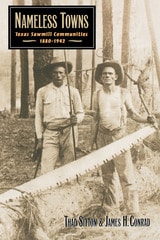
Nameless Towns
Texas Sawmill Communities, 1880-1942By Thad Sitton and James H. Conrad
University of Texas Press, 1998
Winner, T. H. Fehrenbach Award, Texas Historical Commission
Sawmill communities were once the thriving centers of East Texas life. Many sprang up almost overnight in a pine forest clearing, and many disappeared just as quickly after the company "cut out" its last trees. But during their heyday, these company towns made Texas the nation's third-largest lumber producer and created a colorful way of life that lingers in the memories of the remaining former residents and their children and grandchildren.
Drawing on oral history, company records, and other archival sources, Sitton and Conrad recreate the lifeways of the sawmill communities. They describe the companies that ran the mills and the different kinds of jobs involved in logging and milling. They depict the usually rough-hewn towns, with their central mill, unpainted houses, company store, and schools, churches, and community centers. And they characterize the lives of the people, from the hard, awesomely dangerous mill work to the dances, picnics, and other recreations that offered welcome diversions.
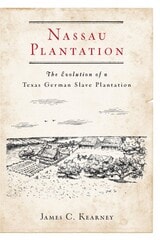
Nassau Plantation
The Evolution of a Texas-German Slave PlantationJames C. Kearney
University of North Texas Press, 2010
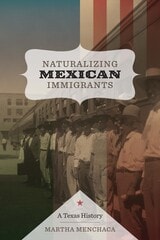
Naturalizing Mexican Immigrants
A Texas HistoryBy Martha Menchaca
University of Texas Press, 2011
2013 — NACCS Book Award – National Association for Chicana and Chicano Studies
During the nineteenth and early twentieth centuries, a majority of the Mexican immigrant population in the United States resided in Texas, making the state a flashpoint in debates over whether to deny naturalization rights. As Texas federal courts grappled with the issue, policies pertaining to Mexican immigrants came to reflect evolving political ideologies on both sides of the border.
Drawing on unprecedented historical analysis of state archives, U.S. Congressional records, and other sources of overlooked data, Naturalizing Mexican Immigrants provides a rich understanding of the realities and rhetoric that have led to present-day immigration controversies. Martha Menchaca's groundbreaking research examines such facets as U.S.-Mexico relations following the U.S. Civil War and the schisms created by Mexican abolitionists; the anti-immigration stance that marked many suffragist appeals; the effects of the Spanish American War; distinctions made for mestizo, Afromexicano, and Native American populations; the erosion of means for U.S. citizens to legalize their relatives; and the ways in which U.S. corporations have caused the political conditions that stimulated emigration from Mexico.
The first historical study of its kind, Naturalizing Mexican Immigrants delivers a clear-eyed view of provocative issues.
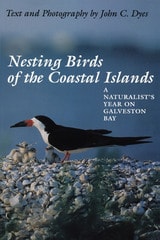
Nesting Birds of the Coastal Islands
A Naturalist's Year on Galveston BayBy John C. Dyes
University of Texas Press, 1993
Every year, more than twenty species of terns, gulls, and colonial wading birds raise their young on rookery islands all along the Gulf Coast. Their breeding and nesting activities go on in the wake of passing oil tankers, commercial fishing vessels, and pleasure boats of all kinds—human traffic that threatens their already circumscribed habitats.
John C. Dyes has spent more than ten years photographing and observing the birds in their rookeries on the Texas Coast, and, in Nesting Birds of the Coastal Islands, he presents a year in the birds' life through fine photographs and an evocative and informative text. In a month-by-month account, he follows the annual rituals and daily dramas of courtship, mating, and chick rearing among herons, egrets, spoonbills, cormorants, ibises, and other birds that migrate and gather in colonies ranging from half a dozen birds to tens of thousands.
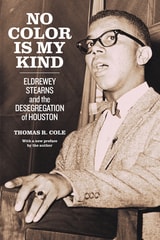
No Color Is My Kind
Eldrewey Stearns and the Desegregation of HoustonThomas R. Cole
University of Texas Press, 2021
In 1959, a Black man named Eldrewey Stearns was beaten by Houston police after being stopped for a traffic violation. He was not the first to suffer such brutality, but the incident sparked Stearns’s conscience and six months later he was leading the first sit-in west of the Mississippi River. No Color Is My Kind, first published in 1997, introduced readers to Stearns, including his work as a civil rights leader and lawyer in Houston’s desegregation movement between 1959 and 1963. This remarkable and important history, however, was nearly lost to bipolar affective disorder. Stearns was a fifty-two-year-old patient in a Galveston psychiatric hospital when Thomas Cole first met him in 1984. Over the course of a decade, Cole and Stearns slowly recovered the details of Stearns’s life before his slide into mental illness, writing a story that is more relevant today than ever.
In this new edition, Cole fills in the gaps between the late 1990s and now, providing an update on the progress of civil rights in Houston and Stearns himself. He also reflects on his tumultuous and often painful collaboration with Stearns, challenging readers to be part of his journey to understand the struggles of a Black man’s complex life. At once poignant, tragic, and emotionally charged, No Color Is My Kind is essential reading as the current movement for racial reconciliation gathers momentum.
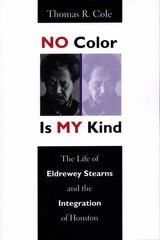
No Color Is My Kind
The Life of Eldrewey Stearns and the Integration of HoustonBy Thomas R. Cole
University of Texas Press, 1997

No Hope for Heaven, No Fear of Hell
The Stafford-Townsend Feud of Colorado County, Texas 1871-1911James Kearney
University of North Texas Press, 2016

No Mexicans, Women, or Dogs Allowed
The Rise of the Mexican American Civil Rights MovementBy Cynthia E. Orozco
University of Texas Press, 2009
Founded by Mexican American men in 1929, the League of United Latin-American Citizens (LULAC) has usually been judged according to Chicano nationalist standards of the late 1960s and 1970s. Drawing on extensive archival research, including the personal papers of Alonso S. Perales and Adela Sloss-Vento, No Mexicans, Women, or Dogs Allowed presents the history of LULAC in a new light, restoring its early twentieth-century context.
Cynthia Orozco also provides evidence that perceptions of LULAC as a petite bourgeoisie, assimilationist, conservative, anti-Mexican, anti-working class organization belie the realities of the group's early activism. Supplemented by oral history, this sweeping study probes LULAC's predecessors, such as the Order Sons of America, blending historiography and cultural studies. Against a backdrop of the Mexican Revolution, World War I, gender discrimination, and racial segregation, No Mexicans, Women, or Dogs Allowed recasts LULAC at the forefront of civil rights movements in America.
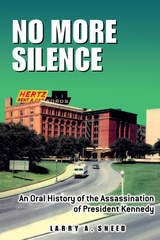
No More Silence
An Oral History of the Assassination of President KennedyLarry A. Sneed
University of North Texas Press, 2002
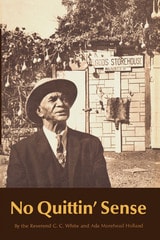
No Quittin' Sense
By the Reverend C. C. White and Ada Morehead Holland
University of Texas Press, 1994
This story, set in the Piney Woods country of East Texas, spans most of a century, from shortly after the close of the Civil War to the 1960's. It is the story of Charley White, who was born in the middle of those woods—in a decaying windowless log cabin a few years after his mother and father were freed from slavery. His childhood, lived in almost unbelievable poverty, was followed by financial stability achieved in middle age through years of struggle. And then, in order to obey God's will, he abandoned this secure life, and for forty years he waged a one-man war on poverty and intolerance.
Winner of the Carr P. Collins Award (best nonfiction book) of the Texas Institute of Letters, No Quittin' Sense presents the story of Rev. C. C. "Charley" White, whose life has inspired thousands of readers since the book was first published in 1969.
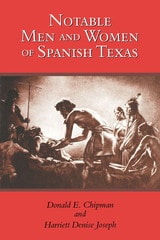
Notable Men and Women of Spanish Texas
By Donald E. Chipman and Harriett Denise Joseph
University of Texas Press, 1999
Winner, Presidio La Bahia Award, Sons of the Republic of Texas, 2000
Texas Old Missions and Forts Restoration Association Book Award, the Texas Old Missions and Fort Restoration Association and the Texas Catholic Historical Society, 2001
The Spanish colonial era in Texas (1528-1821) continues to emerge from the shadowy past with every new archaeological and historical discovery. In this book, years of archival sleuthing by Donald E. Chipman and Harriett Denise Joseph now reveal the real human beings behind the legendary figures who discovered, explored, and settled Spanish Texas.
By combining dramatic, real-life incidents, biographical sketches, and historical background, the authors bring to life these famous (and sometimes infamous) men of Spanish Texas:
- Alvar Núñez Cabeza de Vaca
- Alonso de León
- Francisco Hidalgo
- Louis Juchereau de St. Denis
- Antonio Margil
- The Marqués de Aguayo
- Pedro de Rivera
- Felipe de Rábago
- José de Escandón
- Athanase de Mézières
- The Marqués de Rubí
- Antonio Gil Ibarvo
- Domingo Cabello
- José Bernardo Gutiérrez de Lara
- Joaquín de Arredondo
The authors also devote a chapter to the women of Spanish Texas, drawing on scarce historical clues to tell the stories of both well-known and previously unknown Tejana, Indian, and African women.
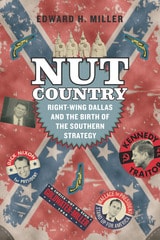
Nut Country
Right-Wing Dallas and the Birth of the Southern StrategyEdward H. Miller
University of Chicago Press, 2015
In Nut Country, Edward H. Miller tells the story of that transformation, showing how a group of influential far-right businessmen, religious leaders, and political operatives developed a potent mix of hardline anticommunism, biblical literalism, and racism to generate a violent populism—and widespread power. Though those figures were seen as extreme in Texas and elsewhere, mainstream Republicans nonetheless found themselves forced to make alliances, or tack to the right on topics like segregation. As racial resentment came to fuel the national Republican party’s divisive but effective “Southern Strategy,” the power of the extreme conservatives rooted in Texas only grew.
Drawing direct lines from Dallas to DC, Miller's captivating history offers a fresh understanding of the rise of the new Republican Party and the apocalyptic language, conspiracy theories, and ideological rigidity that remain potent features of our politics today.