Results by title
527 books match the query 'Translations into English' and 10 start with n

New Cathay
Contemporary Chinese PoetryEdited by Ming Di
Tupelo Press, 2013
The most up-to-date anthology of contemporary Chinese poetry, translated by American poets and edited by the executive editor of the bilingual literary journal Poetry East West. Showcasing the achievement of Chinese poetry in the last twenty years, a time of tremendous literary ferment, this collection focuses on a diversity of exciting poets from the mainland, highlighting Duo Duo (laureate of the 2010 Neustadt International Prize for Literature) and Liao Yiwu (recipient of 2012 Peace Prize of the German Book Trade organization) along with not yet well-known but brilliant poets such as Zang Di and Xiao Kaiyu and younger poets Jiang Tao and Lü Yue. The anthology includes interviews with the poets and a fascinating survey of their opinions on “Ten Favorite Chinese poets” and “Ten Best-Known Western poets in China.” Featured poets: Duo Duo, Wang Xiaoni, Bai Hua, Zhang Shuguang, Sun Wenbo, Wang Jiaxin, Liao Yiwu, Song Lin, Xiao Kaiyu, Lü De’an, Feng Yan, Yang Xiaobin, Zang Di, Ya Shi, Mai Mang, Lan Lan, Jiang Tao, Jiang Hao, Lü Yue, Hu Xudong, Yi Lai, Jiang Li, Zheng Xiaoqiong, Qiu Qixuan, and Li Shumin. With translations by Neil Aitken, Katie Farris, Ming Di, Christopher Lupke, Tony Barnstone, Afaa Weaver, Jonathan Stalling, Nick Admussen, Eleanor Goodman, Ao Wang, Dian Li, Kerry Shawn Keys, Jennifer Kronovet, Elizabeth Reitzell, and Cody Reese.
[more]
New Short Fiction from Cuba
Jacqueline Loss and Esther Whitfield
Northwestern University Press, 2007
With the disintegration of the Soviet bloc, the ongoing uncertainty surrounding Cuba’s political future, the onslaught of tourists, and the economic upheavals in their society, Cubans face an important, perhaps epochal, moment of cultural change. It is a moment amply and complexly reflected in the fiction collected here, twelve short stories written in Cuba during the past ten years and published in English for the first time with the collaboration of some of today’s finest translators.
An eclectic selection, the stories offer an exhilarating sense of a rich literary diversity and cultural history, an experience of Cuban literature that has rarely been available to an English audience. They differ widely, even wildly, in style and theme: from an impromptu encounter with Ernest Hemingway to an imagined romance mapped onto Cuba’s foundational nineteenth-century novel; from a witty, Borgesian satire on bureaucracy and officialist identity to a gothic adventure in homosexual voyeurism and mental illness; from an allegorical travelogue set in repressive China to a semi-surreal celebration of angels in Havana. These are the voices of Cuban fiction today, reflecting the past, anticipating the future, and composing in their infinite variety the stories of their culture.
An eclectic selection, the stories offer an exhilarating sense of a rich literary diversity and cultural history, an experience of Cuban literature that has rarely been available to an English audience. They differ widely, even wildly, in style and theme: from an impromptu encounter with Ernest Hemingway to an imagined romance mapped onto Cuba’s foundational nineteenth-century novel; from a witty, Borgesian satire on bureaucracy and officialist identity to a gothic adventure in homosexual voyeurism and mental illness; from an allegorical travelogue set in repressive China to a semi-surreal celebration of angels in Havana. These are the voices of Cuban fiction today, reflecting the past, anticipating the future, and composing in their infinite variety the stories of their culture.
[more]
New and Selected Poems
Yves Bonnefoy
University of Chicago Press, 1995
Yves Bonnefoy, celebrated translator and critic, is widely considered the most important and influential French poet since World War II. Named to the College de France in 1981 to fill the chair left vacant by the death of Roland Barthes, Bonnefoy was the first poet honored in this way since Paul Valery. Winner of many awards, including the Prix Goncourt in 1987 and the Hudson Review's Bennett Award in 1988, he is the author of six critically acclaimed books of poetry.
Spanning four decades and drawing on all of Bonnefoy's major collections, this selection provides a comprehensive overview of and an ideal introduction to his work. The elegant translations, many of them new, are presented in this dual-language edition alongside the original French. Several significant works appear here in English for the first time, among them, in its entirety, Bonnefoy's 1991 book of verse, The Beginning and the End of the Snow, the 1988 prose poem Where the Arrow Falls, and an important long poem from 1993, "Wind and Smoke." Together with poems from such classic volumes as "In the Lure of the Threshold", these new works shed light on the growth as well as the continuity of Bonnefoy's work.
John Naughton's detailed introduction looks at the evolution of Bonnefoy's poetry from the 1953 publication of "On the Motion and Immobility of Douve", which immediately established his reputation as one of France's leading poets, through the 1993 publication of The Wandering Life and its centerpiece "Wind and Smoke."
"This is a comprehensive selection that contains examples of work spanning [Bonnefoy's] full career of forty years, from the ground-breaking "Du Mouvement et de l'Immobilité de Douve" through the celebratory "Pierre Ecrite" to the magical winter landscapes of America's East Coast and an unsettling reworking of myth in the recent "La Vie Errante" . . . The translations, which are the work of a variety of hands, including Galway Kinnell, Emily Grosholz and Anthony Rudolf, nevertheless fit well together and all are sensitive to the register and subtleties of both languages, while the introductory essay by John Naughton expertly explains Bonnefoy's importance as a poet and the influences which have shaped him. This is definitely a volume worth having, for layman and French specialist alike."—Hilary Davies, Times Literary Supplement
"Anyone not familiar with Bonnefoy's work will benefit from the background information and explanations given by John Naughton in his excellent introduction . . . . The book as a whole provides an excellent introduction to Bonnefoy's poetry and to his concerns of a lifetime."—Don Rodgers, Poetry Wales
[more]

Night Patrol and Other Stories
Mikhail Kuraev
Duke University Press, 1994
"We live in a fantastic reality," Mikhail Kuraev writes. "Life itself, the turns of history, people’s fates are unlikely, amazing and fantastic." This is the strange reality, the fantastic world of Russia before glasnost, that comes to life in Kuraev’s remarkable short stories and novellas. Celebrated as one of the true innovators to emerge in recent years, Kuraev mines the rich literary tradition and the deep and not so distant past of his native Russia to produce tales that are both deeply moving and stylistically intriguing.
Though steeped in history, his stories pluck from obscurity the little people history ignores—and, in the Soviet Union of Stalin, often crushed. In the complex "Captain Dikshtein," a fictional account of an incident in the 1921 Kronstad, Kuraev evokes life within Soviet military culture and draws a vivid, difficult portrait of one particular life amid the ships and artillery. In "Night Patrol," a lowly member of the Soviet secret police narrates his evening rounds, interspersing the nightly arrests with reflections on his long career in the KGB. In "Petya on His Way to the Heavenly Kingdom," set in a construction site for a hydroelectric dam near Murmansk, a soldier’s murder of the village simpleton resonates through a small community committed to an enormous and enormously dubious technological project. Ranging over a broad landscape of historical foibles, Kuraev’s sympathetic wit and satiric brilliance have invited comparison to Gogol, but are finally unique. In this book, English-reading audiences will discover a new and challenging voice in a tradition that has given the world some of its greatest stories.
Though steeped in history, his stories pluck from obscurity the little people history ignores—and, in the Soviet Union of Stalin, often crushed. In the complex "Captain Dikshtein," a fictional account of an incident in the 1921 Kronstad, Kuraev evokes life within Soviet military culture and draws a vivid, difficult portrait of one particular life amid the ships and artillery. In "Night Patrol," a lowly member of the Soviet secret police narrates his evening rounds, interspersing the nightly arrests with reflections on his long career in the KGB. In "Petya on His Way to the Heavenly Kingdom," set in a construction site for a hydroelectric dam near Murmansk, a soldier’s murder of the village simpleton resonates through a small community committed to an enormous and enormously dubious technological project. Ranging over a broad landscape of historical foibles, Kuraev’s sympathetic wit and satiric brilliance have invited comparison to Gogol, but are finally unique. In this book, English-reading audiences will discover a new and challenging voice in a tradition that has given the world some of its greatest stories.
[more]
Night of Denial
Stories and NovellasIvan Bunin
Northwestern University Press, 2006
The first Russian to be awarded the Nobel Prize for literature, Ivan Bunin is often considered the last of the great Russian masters. Already renowned in Russia before the revolution, he fled the country in 1920 and lived the remainder of his life in France, where he continued to write for thirty years. Bunin made his name as a short-story writer with such masterpieces as "The Gentleman from San Francisco," the title piece in one of his collections and one of the stories in this volume. His last book of stories, Dark Avenues, was published in the 1940s. Among his longer works were a fictional autobiography, The Life of Arseniev (1930), and its sequel, Youth (1939), which were later collected into one volume, and two memoirs, The Accursed Days (1926), and Memories and Portraits (1950). He also wrote books on Tolstoy and Chekhov, both of whom he knew personally. Bunin, in fact, serves as a link-both personal and literary-between Tolstoy, whom he met as a young man, Chekhov, a close friend, and Vladimir Nabokov, who was influenced by Bunin early in his career and who moved in the same émigré literary circles in the twenties and thirties.
Bunin achieved his greatest mastery in the short story, and much of his finest work appears in this volume-the largest collection of his prose works ever published in English. In Robert Bowie's fine translation, with extensive annotations and a lengthy critical afterword, this work affords readers of English their first opportunity for a sustained encounter with a Russian classic, and one of the great writers of the twentieth century.
Bunin achieved his greatest mastery in the short story, and much of his finest work appears in this volume-the largest collection of his prose works ever published in English. In Robert Bowie's fine translation, with extensive annotations and a lengthy critical afterword, this work affords readers of English their first opportunity for a sustained encounter with a Russian classic, and one of the great writers of the twentieth century.
[more]
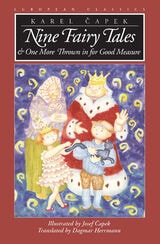
Nine Fairy Tales
and One More Thrown in for Good MeasureKarl Capek
Northwestern University Press, 1996
Karel Čapek, author of the acclaimed War with the Newts, is one of the great Czechoslovak writers of the twentieth century. These fairy tales bear Čapek's combination of the fantastic and the satirical, offering fairies, elves, and talking animals alongside references to detectives, secret police agents, luxury automobiles, and Hollywood starlets. Filled with the delight of language, dazzling wordplay, a sense of absurdity about the so-called adult world, and a deeply humane vision, these witty stories will appeal to readers of all ages.
[more]
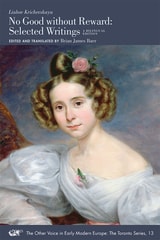
No Good without Reward
Selected Writings: A Bilingual EditionLiubov Krichevskaya
Iter Press, 2011
A female contemporary of Alexander Pushkin, Liubov Krichevskaya makes her Anglophone debut in an excellent translation of her fiction, drama, and poetry, which deftly capture women’s estate in the early nineteenth century. Krichevskaya intriguingly combines Sentimentalist preoccupations—sensibility, virtue, and men’s moral reformation through confrontation with exemplary women’s passive piety—with the uncontrollable passions and volatile hero popularized by the Byronic strain of Romanticism. Her gynocentric texts poignantly convey the stringent limitations imposed upon women’s agency by a society that paradoxically credited them with the seemingly limitless capacity to exert a civilizing influence as icons of probity. Readers acquainted with Rousseau, Richardson, and Goethe will discover familiar feminized turf, but cultivated in a Russian vein.
—Helena Goscilo
Chair and Professor of Slavic, The Ohio State University
—Helena Goscilo
Chair and Professor of Slavic, The Ohio State University
[more]
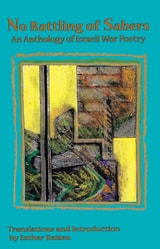
No Rattling of Sabers
An Anthology of Israeli War PoetryTranslation and introduction by Esther Raizen
University of Texas Press, 1995
<p>In this collection, Esther Raizen explores the significance and value of Hebrew poetry written in response to the wars in which Israel was involved during the last fifty years. The anthology includes the works of many poets, some as well known as Nathan Altherman and Yehudah Amichai and others less known. The poems, presented in both English and Hebrew, depict war as viewed by the soldier, as reflected upon by civilians, and as a force giving rise to the creation of poetry.</p>
<p>Raizen explores in an introductory essay the issue of whether poetry written with a defined political message and in the context of certain historical events can function adequately on the aesthetic level. She also tracks the changes in the characteristics of Israeli war poetry from 1948 to 1991, beginning with the glorified patriotism expected in the 1930s-1940s and progressing to the critical ideas in the later years, during which poetry is characterized by understatement and cynicism.</p>
<p>Raizen explores in an introductory essay the issue of whether poetry written with a defined political message and in the context of certain historical events can function adequately on the aesthetic level. She also tracks the changes in the characteristics of Israeli war poetry from 1948 to 1991, beginning with the glorified patriotism expected in the 1930s-1940s and progressing to the critical ideas in the later years, during which poetry is characterized by understatement and cynicism.</p>
[more]
Novas
Selected WritingsHaroldo de Campos
Northwestern University Press, 2007
The first full-scale English translation of one of Brazil's-and the world's-most influential avant-garde literary voices
A generous introduction to one of the key literary figures to emerge from Brazil in the second half of the twentieth century, this book offers English-speaking readers an ample selection of this prodigious writer's celebrated poetry and widely influential critical work. As a poet and as a cofounder of the renowned group Noigandres, Haroldo de Campos has made a unique and substantial contribution to the theory and practice of experimental writing, particularly the form known as concrete poetry, and to the Latin American avant-garde as a whole. These contributions, acclaimed worldwide by figures such as Umberto Eco, Jacques Derrida, Octavio Paz, and Guillermo Cabrera Infante, can be observed unfolding here, first in poetry selections ranging from de Campos' early work before concretism through his most recent production; then in theoretical texts that trace his evolution as a critic from an early interest in baroque and modernist writers to his development of an innovative model for reading, translating, and writing. This second, critical section of the book includes de Campos' encounters with the tasks of translating and reading some of the most important texts of Eastern and Western culture-from Ecclesiastes to the No play Hagoromo, from Dante to Paz-thus charting a genealogy of modern literature.
Together, these poems and critical writings afford English-speaking readers their first sustained exposure to a unique personality within the international avant-garde, a writer described by Brazilian poet João Cabral de Melo Neto as "that wonderful thing: / a poet and a translator who came to literature armed with an enviable / knowledge of the literary phenomenon."
[more]
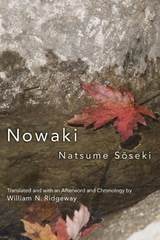
Nowaki
Natsume Soseki; Translated and with an Afterword and Chronology by William N. Ridgeway
University of Michigan Press, 2011
Shirai Dōya is a man of letters, a man of principles. His principles sometimes stand in the way of his teaching career, but his writing allows him to openly address “today’s youth” with stern conviction—although he is still unable to make a comfortable living from his writing. Two youths in particular show interest in his ideas: the tubercular impoverished Takayanagi, an aspiring writer himself (and former student of Dōya’s, as it turns out), and his rich friend, the dandy Nakano. The lives and minds of the three men come together in ways that are both commonplace and surprising. The setting—mainly Tokyo of one hundred years ago—and the preoccupations of these characters will appear distinctly familiar, even today.
[more]