Results by title
60 books match the query 'Ukraine' and 4 start with n
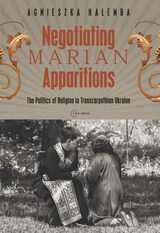
Negotiating Marian Apparitions
The Politics of Religion in Transcarpathian UkraineAgnieszka Halemba
Central European University Press, 2015
This book concerns the politics of religion as expressed through apparitions of the Virgin Mary in Dzhublyk in Transcarpathian Ukraine. On the one hand, the analysis provides insights into the present position of Transcarpathia in regional, Ukraine-wide, and European struggles for identity and political belonging. The way in which the apparitions site has been conceived and managed raises questions concerning the fate of religious communities during and after socialism, the significance of national projects for religious organizations, and the politics of religious management in a situation in which local religious commitments are relatively strong and religious organizations are relatively weak. The analysis contributes to the ethnography and history of this particular region and of the post-socialist world in general. On the other hand, the changing status of the apparition site over the years allows investigation of the questions concerning authority, legitimacy, and power in religious organizations, especially in relation to management of religious experiences. The analysis aims at clarification of such concepts as religious institutions, organizations but also religious experiences and is relevant to anthropology, sociology and religious studies. It is argued that the important question in analyses of religious apparitions should not be how an individual experience becomes institutionalized and instrumentalized, but how experience becomes a tool for negotiation and transformation in the religious field. Key word: 1. Mary, Blessed Virgin, Saint-–Apparitions and miracles–Ukraine–Zakarpats'kaoblast'. 2. Zakarpats'ka oblast' (Ukraine)–Church history.
[more]
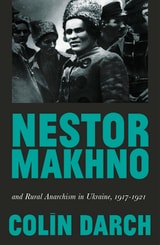
Nestor Makhno and Rural Anarchism in Ukraine, 1917-1921
Colin Darch
Pluto Press, 2020
Histories of the Russian Revolution often present the Bolshevik seizure of power in 1917 as the central event, neglecting the diverse struggles of urban and rural revolutionaries across the heartlands of the Russian Empire. This book takes as its subject one such struggle, the anarcho-communist peasant revolt led by Nestor Makhno in left-bank Ukraine, locating it in the context of the final collapse of the Empire that began in 1914.
Between 1917 and 1921, the Makhnovists fought German and Austrian invaders, reactionary monarchist forces, Ukrainian nationalists and sometimes the Bolsheviks themselves. Drawing upon anarchist ideology, the Makhnovists gathered widespread support amongst the Ukrainian peasantry, taking up arms when under attack and playing a significant role - in temporary alliance with the Red Army - in the defeats of the White Generals Denikin and Wrangel. Often dismissed as a kulak revolt, or a manifestation of Ukrainian nationalism, Colin Darch analyses the successes and failures of the Makhnovist movement, emphasising its revolutionary character.
Over 100 years after the revolutions, this book reveals a lesser known side of 1917, contributing both to histories of the period and broadening the narrative of 1917, whilst enriching the lineage of anarchist history.
[more]

Nestor Makhno and Rural Anarchism in Ukraine, 1917-1921
Colin Darch
Pluto Press, 2020
Histories of the Russian Revolution often present the Bolshevik seizure of power in 1917 as the central event, neglecting the diverse struggles of urban and rural revolutionaries across the heartlands of the Russian Empire. This book takes as its subject one such struggle, the anarcho-communist peasant revolt led by Nestor Makhno in left-bank Ukraine, locating it in the context of the final collapse of the Empire that began in 1914.
Between 1917 and 1921, the Makhnovists fought German and Austrian invaders, reactionary monarchist forces, Ukrainian nationalists and sometimes the Bolsheviks themselves. Drawing upon anarchist ideology, the Makhnovists gathered widespread support amongst the Ukrainian peasantry, taking up arms when under attack and playing a significant role - in temporary alliance with the Red Army - in the defeats of the White Generals Denikin and Wrangel. Often dismissed as a kulak revolt, or a manifestation of Ukrainian nationalism, Colin Darch analyzes the successes and failures of the Makhnovist movement, emphasizing its revolutionary character.
Over 100 years after the revolutions, this book reveals a lesser known side of 1917, contributing both to histories of the period and broadening the narrative of 1917, whilst enriching the lineage of anarchist history.
[more]
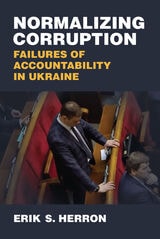
Normalizing Corruption
Failures of Accountability in UkraineErik S. Herron
University of Michigan Press, 2020
Accountability is crucial to every successful democratic system. The failure to develop functioning mechanisms of accountability has undermined democratic consolidation worldwide. Reliable tools that hold officials accountable are essential for democratic governance; one of the key threats to accountability comes from corrupt practices, especially when they are integrated—or normalized—in the day-to-day activities of institutions. This book focuses on the experiences of contemporary Ukraine to evaluate the successes and failures of institutions, politicians, political parties, bureaucracies, and civil society. Yet, the topic is directly relevant to countries that have experienced democratic backsliding, and especially those countries that are at risk.
Normalizing Corruption addresses several interconnected questions: Under what circumstances do incumbents lose elections? How well do party organizations encourage cohesive behavior? Is executive authority responsive to inquiries from public organizations and other government institutions? How can citizens influence government actions? Do civil servants conduct their duties as impartial professionals, or are they beholden to other interests? The research builds upon extensive fieldwork, data collection, and data analysis that Erik S. Herron has conducted since 1999.
Normalizing Corruption addresses several interconnected questions: Under what circumstances do incumbents lose elections? How well do party organizations encourage cohesive behavior? Is executive authority responsive to inquiries from public organizations and other government institutions? How can citizens influence government actions? Do civil servants conduct their duties as impartial professionals, or are they beholden to other interests? The research builds upon extensive fieldwork, data collection, and data analysis that Erik S. Herron has conducted since 1999.
[more]