Results by title
18284 books match the query 'United States' and 397 start with n

NATIONALIST FERMENT
ORIGINS OF U.S. FOREIGN POLICY, 1789-1812MARIE-JEANNE ROSSIGNOL
The Ohio State University Press, 2003
This book was published in June 1994 by a French publisher and became the winner of the Organization of American Historians foreign language book prize.
The Nationalist Ferment contributes significantly to the renewal of early U.S. diplomatic history. Since the 1980s, a number of diplomatic historians have turned aside from traditional diplomatic issues and sources. They have instead focused on gender, ethnic relationships, culture, and the connections between foreign and domestic policy.
Rossignol argues that in the years 1789–1812 the new nation needed to assert its independence and autonomous character in the face of an unconvinced world. After overcoming initial divisions caused by foreign policy, Americans met this challenge by defining common foreign policy objectives and attitudes, which both legitimized the United States abroad and reinforced national unity at home. This book establishes the constant connections between domestic and international issues during the early national period.
NATO and the UN
A Peculiar RelationshipLawrence S. Kaplan
University of Missouri Press, 2010
In NATO and the UN, Lawrence Kaplan, one of the leading experts on NATO, examines the intimate and often contentious relations between the two and describes how this relationship has changed over the course of two generations. Kaplan documents the many interactions between them throughout their interconnected history, focusing on the major flashpoints where either NATO clashed with UN leadership, the United States and the Soviet Union confronted each other directly, or fissures within the Atlantic alliance were dramatized in UN sessions. He draws on the organizations’ records as well as unpublished files from the National Archives and its counterparts in Britain, France, and Germany to provide the best account yet of working relations between the two organizations. By examining their complex connection with regard to such conflicts as the Balkan wars, Kaplan enhances our understanding of both institutions.
Crisis management has been a source of conflict between the two in the past but has also served as an incentive for collaboration, and Kaplan shows how this peculiar but persistent relationship has functioned. Although the Cold War years are gone, the UN remains the setting where NATO problems have played out, as they have in Iraq during recent decades. And it is to NATO that the UN has turned for military power to face crises in the Balkans, Middle East, and South Asia.
Kaplan stresses the importance of both organizations in the twenty-first century, recognizing their potential to advance global peace and security while showing how their tangled history explains the obstacles that stand in the way. His work offers significant findings that will especially impact our understanding of NATO while filling a sizable gap in our understanding of post-World War II diplomacy.

NEWER IDEALS OF PEACE
Jane Addams
University of Illinois Press, 2006
In this her second book, Jane Addams moves beyond humanitarian appeals to sensibility and prudence, advancing a more aggressive, positive idea of peace as a dynamic social process emerging out of the poorer quarters of cosmopolitan cities. Her deep analysis of relations among diverse groups in U.S. society, exemplified by inter-ethnic and labor relations in Chicago, draws widely useful lessons for both domestic and global peace, in an early formulation of today’s "globalization from below."
In an unprecedented, revolutionary critique of the pervasive militarization of society, Addams applies her scathing pen to traditional advocates and philosophers of “negative” peace, founders of the U.S. constitution, militarists, bigots, imperialists, and theories of “democratic peace” and liberal capitalism. Instead she sees a slow, powerful emergence of forces from below--the poor, the despised, workers, women, ethnic and racial communities, oppressed groups at home and abroad--that would invent moral substitutes for war and gradually shape a just, peaceful, and varied social order. An extensive, in-depth introduction by Berenice Carroll and Clinton Fink provides historical context, analysis, and a reassessment of the theoretical and practical significance of Newer Ideals of Peace today.
NFL Football
A History of America's New National PastimeRichard C. Crepeau
University of Illinois Press, 2014
Probing and learned, NFL Football tells an epic American success story peopled by larger-than-life figures and driven by ambition, money, sweat, and dizzying social and technological changes.
NFL Football
A History of America's New National PastimeRichard C. Crepeau
University of Illinois Press, 2020
A multi-billion-dollar entertainment empire, the National Football League is a coast-to-coast obsession that borders on religion and dominates our sports-mad culture. But today's NFL also provides a stage for playing out important issues roiling American society.
The updated and expanded edition of NFL Football observes the league's centennial by following the NFL into the twenty-first century, where off-the-field concerns compete with touchdowns and goal line stands for headlines. Richard Crepeau delves into the history of the league and breaks down the new era with an in-depth look at the controversies and dramas swirling around pro football today:
- Tensions between players and Commissioner Roger Goodell over collusion, drug policies, and revenue;
- The firestorm surrounding Colin Kaepernick and protests of police violence and inequality;
- Andrew Luck and others choosing early retirement over the threat to their long-term health;
- Paul Tagliabue's role in covering up information on concussions;
- The Super Bowl's evolution into a national holiday.
NURSE-MIDWIFERY
THE BIRTH OF A NEW AMERICAN PROFESSIONLaura E. Ettinger
The Ohio State University Press, 2006
Today, nurse-midwives have assumed a larger role in mainstream health care than before, yet they are still marginalized. As in the past, nurse-midwives’ futures will depend on continuing changes in American attitudes about childbirth, health care, and women professionals as well as on their own ability to adapt to the changes. The history of the profession suggests that nurse-midwives will continue to navigate in difficult waters in a middle space between the mainstream and the margins of medicine and between the nursing profession and midwifery traditions.
NURSING AND THE PRIVILEGE OF PRESCRIPTION
1893-2000Arlene W. Keeling
The Ohio State University Press, 2007
Naked Barbies, Warrior Joes, and Other Forms of Visible Gender
Jeannie Banks Thomas
University of Illinois Press, 2003
Images of females are often emphasized or sexualized, frequently through nudity or partial nudity, whereas those of the male body are not only clothed but also armored in the trappings of action and aggression. Thomas locates these various objects of folk art within a discussion of the post–women's movement discourse on gender.
In addition to the items themselves, Thomas explores the stories and behaviors they generate, including legends of the supernatural about cemetery statues, oral narratives of yard artists and accounts of pranks involving yard art, narratives about children's play with Barbie, Ken, and G.I. Joe, and the electronic folklore (or "e-lore") about Barbie that circulates on the Internet.

Naked Truth
Strip Clubs, Democracy, and a Christian RightBy Judith Lynne Hanna
University of Texas Press, 2012
Across America, strip clubs have come under attack by a politically aggressive segment of the Christian Right. Using plausible-sounding but factually untrue arguments about the harmful effects of strip clubs on their communities, the Christian Right has stoked public outrage and incited local and state governments to impose onerous restrictions on the clubs with the intent of dismantling the exotic dance industry. But an even larger agenda is at work, according to Judith Lynne Hanna. In Naked Truth, she builds a convincing case that the attack on exotic dance is part of the activist Christian Right’s “grand design” to supplant constitutional democracy in America with a Bible-based theocracy.
Hanna takes readers onstage, backstage, and into the community and courts to reveal the conflicts, charges, and realities that are playing out at the intersection of erotic fantasy, religion, politics, and law. She explains why exotic dance is a legitimate form of artistic communication and debunks the many myths and untruths that the Christian Right uses to fight strip clubs. Hanna also demonstrates that while the fight happens at the local level, it is part of a national campaign to regulate sexuality and punish those who do not adhere to Scripture-based moral values. Ultimately, she argues, the naked truth is that the separation of church and state is under siege and our civil liberties—free speech, women’s rights, and free enterprise—are at stake.

Naked in the Woods
My Unexpected Years in a Hippie CommuneMargaret Grundstein
Oregon State University Press, 2015
Naked in the Woods chronicles Grundstein’s shift from reluctant hippie to committed utopian—sacrificing phones, electricity, and running water to live on 160 acres of remote forest with nothing but a drafty cabin and each other. Grundstein, (whose husband left, seduced by “freer love”) faced tough choices. Could she make it as a single woman in man’s country? Did she still want to? How committed was she to her new life? Although she reveled in the shared transcendence of communal life deep in the natural world, disillusionment slowly eroded the dream. Brotherhood frayed when food became scarce. Rifts formed over land ownership. Dogma and reality clashed.
Many people, baby boomers and millennials alike, have romantic notions about the 1960s and 70s. Grundstein’s vivid account offers an unflinching, authentic portrait of this iconic and often misreported time in American history. Accompanied by a collection of distinctive photographs she took at the time, Naked in the Woods draws readers into a period of convulsive social change and raises timeless questions: how far must we venture to find the meaning we seek, and is it ever far out enough to escape our ingrained human nature?
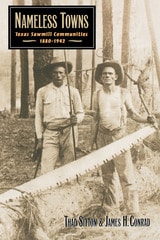
Nameless Towns
Texas Sawmill Communities, 1880-1942By Thad Sitton and James H. Conrad
University of Texas Press, 1998
Winner, T. H. Fehrenbach Award, Texas Historical Commission
Sawmill communities were once the thriving centers of East Texas life. Many sprang up almost overnight in a pine forest clearing, and many disappeared just as quickly after the company "cut out" its last trees. But during their heyday, these company towns made Texas the nation's third-largest lumber producer and created a colorful way of life that lingers in the memories of the remaining former residents and their children and grandchildren.
Drawing on oral history, company records, and other archival sources, Sitton and Conrad recreate the lifeways of the sawmill communities. They describe the companies that ran the mills and the different kinds of jobs involved in logging and milling. They depict the usually rough-hewn towns, with their central mill, unpainted houses, company store, and schools, churches, and community centers. And they characterize the lives of the people, from the hard, awesomely dangerous mill work to the dances, picnics, and other recreations that offered welcome diversions.
Naming What We Know, Classroom Edition
Threshold Concepts of Writing StudiesLinda Adler-Kassner
Utah State University Press, 2016
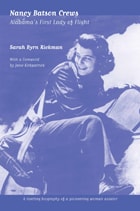
Nancy Batson Crews
Alabama's First Lady of FlightSarah Byrn Rickman
University of Alabama Press, 2009
This is the story of an uncommon woman--high school cheerleader, campus queen, airplane pilot, wife, mother, politician, business-woman--who epitomizes the struggles and freedoms of women in 20th-century America, as they first began to believe they could live full lives and demanded to do so. World War II offered women the opportunity to contribute to the work of the country, and Nancy Batson Crews was one woman who made the most of her privileged beginnings and youthful talents and opportunities.
In love with flying from the time she first saw Charles Lindbergh in Birmingham, (October 1927), Crews began her aviation career in 1939 as one of only five young women chosen for Civilian Pilot Training at the University of Alabama. Later, Crews became the 20th woman of 28 to qualify as an "Original" Women's Auxiliary Ferrying Squadron (WAFS) pilot, employed during World War II shuttling P-38, P-47, and P-51 high-performance aircrafts from factory to staging areas and to and from maintenance and training sites. Before the war was over, 1,102 American women would qualify to fly Army airplanes. Many of these female pilots were forced out of aviation after the war as males returning from combat theater assignments took over their roles. But Crews continued to fly, from gliders to turbojets to J-3 Cubs, in a postwar career that began in California and then resumed in Alabama.
The author was a freelance journalist looking to write about the WASP (Women Airforce Service Pilots) when she met an elderly, but still vital, Nancy Batson Crews. The former aviatrix held a reunion of the surviving nine WAFS for an interview with them and Crews, recording hours of her own testimony and remembrance before Crews's death from cancer in 2001. After helping lead the fight in the '70s for WASP to win veteran status, it was fitting that Nancy Batson Crews was buried with full military honors.
Nancy Drew and Company
Culture, Gender, and Girls’ SeriesEdited by Sherrie A. Inness
University of Wisconsin Press, 1997

Nancy Hanks, An Intimate Portrait
The Creation of a National Commitment to the ArtsMichael Straight
Duke University Press, 1988
This biography captures the spirit and the flavor of Ms. Hanks's remarkable life, above all during the eight years in which she led the Endowment. Tracing her childhood in Florida and North Carolina through her achievements as a student leader at Duke University, Straight makes clear her conscious effort to find a path with more scope than the usual marriage-and-a-family when expected of Southern women. Nancy Hanks went to Washington and found a job with the Office of War Mobilization. She later worked with Nelson Rockefeller, who became governor of New York, a Republican party luminary, and vice president under Gerald Ford, in addition to being an heir to one of America's greatest fortunes. Her relationship with Rockefeller was crucial to her personal life, and his conception of government and its role and a lasting influence on her career.
Straight examines Nancy Hanks's leadership of the NEA and takes particular note of the intense debate over the role of government in fostering American artistic expression, an issue with roots running back through the New Deal to the early history of the United States. Nancy Hanks took a strong and activist role in the formulation and administration of a national arts policy, and her accomplishments have left an indelible mark on public support for arts in the United States. Straight, who worked closely with Ms. Hanks and admired her despite frequent policy disagreements, deals honestly with both the successes and failures of her efforts. His biography imparts a sense of the reasons why her many friends felt such loyalty to this complex and gifted woman.

Nancy Love and the WASP Ferry Pilots of World War II
Sarah Byrn Rickman
University of North Texas Press, 2008
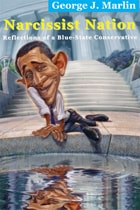
Narcissist Nation
Reflections of a Blue-State ConservativeGeorge J. Marlin
St. Augustine's Press, 2011
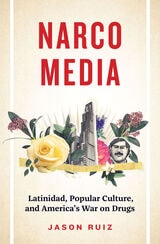
Narcomedia
Latinidad, Popular Culture, and America's War on DrugsJason Ruiz
University of Texas Press, 2023
2024 Honorable Mention — The Victor Villaseñor Best Latino Focused Nonfiction Book Award – English, Empowering Latino Futures’ International Latino Book Awards
Exploring representations of Latinx people from Scarface to Narcos, this book examines how pop culture has framed Latin America as the villain in America’s long and ineffectual War on Drugs.
If there is an enemy in the War on Drugs, it is people of color. That is the lesson of forty years of cultural production in the United States. Popular culture, from Scarface and Miami Vice to Narcos and Better Call Saul, has continually positioned Latinos as an alien people who threaten the US body politic with drugs. Jason Ruiz explores the creation and endurance of this trope, its effects on Latin Americans and Latinx people, and its role in the cultural politics of the War on Drugs.
Even as the focus of drug anxiety has shifted over the years from cocaine to crack and from methamphetamines to opioids, and even as significant strides have been made in representational politics in many areas of pop culture, Latinx people remain an unshakeable fixture in stories narrating the production, distribution, and sale of narcotics. Narcomedia argues that such representations of Latinx people, regardless of the intentions of their creators, are best understood as a cultural front in the War on Drugs. Latinos and Latin Americans are not actually America’s drug problem, yet many Americans think otherwise—and that is in no small part because popular culture has largely refused to imagine the drug trade any other way.
Narrating Jane
Telling the Story of an Early African American Mormon WomanQuincy D. Newell
Utah State University Press, 2016
In volume 21 of the Arrington Lecture Series, Quincy Newell studies the life of Jane Elizabeth Manning James, an African American, born in 1822, who converted to Mormonism in 1843. The narrative of Jane's life has to date been told in versions that favored official LDS positions on race and gender at the time of their telling. Newell's study here brings contemporary historical scholarship and critical distance to bear on the facts and the meanings of Jane M. James's experience.
The Arrington Lecture series, established by one of the twentieth-century West's most distinguished historians, Leonard Arrington, has become a leading forum for prominent historians to address topics related to Mormon history. Utah State University hosts the Leonard J. Arrington Mormon History Lecture Series through the Merrill-Cazier Library Special Collections and Archives department.
Narrative, Race, and Ethnicity in the United States
Edited by James J. Donahue, Jennifer Ann Ho, and Shaun Morgan
The Ohio State University Press, 2017
Recognizing that racial/ethnic issues and tensions are often contextualized geographically, this volume focuses on narratives associated with various racial and ethnic communities in the United States. By engaging with new developments in narrative theory and critical race studies, this volume demonstrates the vitality of using the tools of narratology and critical race theory together to understand how race influences narrative and how narratology illuminates a reading of race in ethnic American literature.
Narrative, Violence, and the Law
The Essays of Robert CoverMartha Minow, Michael Ryan, and Austin Sarat, Editors
University of Michigan Press, 1993
"Bob Cover was and remains the dominant voice of his generation among legal scholars. These essays, each one magnificent in itself, are, when taken together, even more important. The wisdom they impart is forever." --Guido Calabresi, Dean and Sterling Professor of Law, Yale University "Robert Cover drew his sources for the authority of law--for its violence, but also for its paideic potential--from the structuring stories that spark our communal imaginations. Literally until the day of his untimely death, his irreplaceably restless spirit was binding itself with the pages of the Midrash, of The Brothers Karamazov, of Billy Budd, Sailor. It is for us now to work also with these--Bob Cover's stories."--Richard Weisberg, Benjamin N. Cardozo Law School, Yeshiva University "The writings of Robert Cover were usually provocative, sometimes exasperating, but always relevant. In his last years, he concentrated on Jewish sources as well as mystical and Messianic thought. This collection of his articles is a thesaurus of some of his finest writings."--Robert F. Drinan, S.J., Georgetown University Law Center. The late Robert Cover was Professor of Law, Yale Law School.
Narratives of (Dis)Enfranchisement
Reckoning with the History of Libraries and the Black and African American ExperienceTracey Overbey and Amanda L. Folk
American Library Association, 2022
Still a predominantly white profession, librarianship has a legacy of racial discrimination, and it is essential that we face the ways that race impacts how we meet the needs of diverse user communities. Identifying and acknowledging implicit and learned bias is a necessary step toward transforming not only our professional practice but also our scholarship, assessment, and evaluation practices. From this Special Report, readers will
- learn the hidden history of Africa’s contributions to libraries and educational institutions, which are often omitted from K-12, higher education, and library school curricula;
- engage with the racist legacies of libraries as well as contemporary scholarship related to Black and African American users’ experiences with libraries;
- be introduced to frameworks and theories that can help to identify and unpack the role of race in librarianship and in library users’ experiences; and
- garner practical takeaways to bring to their own views and practice of librarianship.

Narratives of (Dis)Engagement
Exploring Black and African American Students’ Experiences in LibrariesAmanda L. Folk and Tracey Overbey
American Library Association, 2022
- learn details about the study, which focused on the potential role of race in the students’ interactions with library staff, including white staff and staff of color;
- gain insight into Black and African American users’ perceptions of libraries and library staff, attitudes towards reading, frequency of library usage, and the importance of family;
- understand the implications of the study’s findings for our practice and for librarianship more broadly, including our ongoing commitment to diversifying the profession; and
- walk away with recommendations that can be applied to every library and educational context, such as guidance for developing an antiracist organization and more equitable service provision.
Narratives of Joy and Failure in Antiracist Assessment
Exploring Collaborative Writing AssessmentsAsao B. Inoue
University Press of Colorado, 2024
Narratives of the American West
Literature and HistoryRichard W. Etulain
University of Nevada Press, 2027
Narratives of the American West: Literature and History brings together Richard W. Etulain’s most resonant work—along with newly written essays—to reveal how history and storytelling have continually shaped each other in the making of the West. Part historiographical memoir, part wide‑ranging critical survey, the collection moves from Etulain’s Basque upbringing in eastern Washington to his lifetime of teaching, editing, and writing, showing how personal experience and intellectual inquiry converge on the page.
In the tradition of Elliott West’s The Essential West, Etulain maps the field’s major interpretive turns, from Frederick Jackson Turner to Earl Pomeroy to West’s“Greater Reconstruction,” and demonstrates how literary craft and historical method inform each other. Along the way, he demythologizes the stories of iconic figures, such as Billy the Kid, Calamity Jane, Chief Joseph, and Sacagawea, tracing how cultural memory evolves across novels, films, and archives.
Featuring new essays on Wallace Stegner and Elliott West, alongside revised classics on western myths, genres, regions, and peoples, this accessible yet rigorous volume invites readers to embrace narratives that are complex and morally engaged. Essential for scholars, students, and curious general readers alike, Narratives of the American West is a compelling guide to how the West has been written and remembered—and why those stories still matter.
Nashville Metro
The Politics of City-County ConsolidationBrett W. Hawkins
Vanderbilt University Press, 2024
This is a valuable artifact in itself, but the new foreword by Judge David Briley—former Nashville mayor and grandson of the first metro Nashville mayor, Beverly Briley—offers a firsthand account of the realities of metropolitan government sixty years on.
Nashville in the 1890s
William Waller
Vanderbilt University Press, 1970
It is, however, not a complete insight into Nashville in the 1890s. Readers should take note that the book focuses almost exclusively on the experiences and worldviews of white Nashvillians. These stories have incredible value for local historians and anyone interested in Nashville history, but the book’s failure to deal with race—as evidenced by Waller’s belief that “the social order was thought to be providential,” which was clearly not true for Nashville’s Black residents who struggled against the unjust systems designed to oppress them—is a grave shortcoming.
Nashville's New Americans
Tracing the Journeys of Our Immigrant NeighborsSheri Lea Sellmeyer
Vanderbilt University Press, 2026
Whether it’s building skyscrapers, running successful restaurants, researching diseases, performing music, cleaning hotel rooms, or holding public office, immigrants are changing Nashville from a mid‑sized city known for its country music industry to an increasingly diverse, multicultural destination. In Metro Nashville schools today, students speak more than 120 languages. The city is bigger, more congested, and more expensive than it’s ever been, drawing criticism from both longtime residents and newcomers. But growth has also brought top‑notch scientists and educators, a world‑class symphony, major league sports teams, investment from major corporations—and a wide range of immigrants whose talent and hard work have helped make all of that happen.
Through its profiles of thirty-nine immigrants from thirty-eight countries in Asia, the Middle East, Africa, Europe, Latin America, and Australia, Nashville’s New Americans provides a case study from one of the fastest-growing cities in the country on the contributions immigrants are making to its culture and economy.

Nashville, 1900 to 1910
William Waller
Vanderbilt University Press, 1972
Nathan B. Young and the Struggle over Black Higher Education
Antonio F. Holland
University of Missouri Press, 2006
Born in slavery in Alabama, Young followed a love of learning to degrees from Talladega and Oberlin Colleges and a career in higher education. Employed by Booker T. Washington in 1892, he served at Tuskegee Institute until conflict with Washington’s vocational orientation led him to move on. During a brief tenure at Georgia State Industrial College under Richard R. Wright, Sr., he became disillusioned by efforts of whites to limit black education to agriculture and the trades. Hired as president of Florida A&M in 1901, he fought for twenty years to balance agricultural/vocational education with the liberal arts, only to meet with opposition from state officials that led to his ouster.
This principled educator finally found his place as president of Lincoln University in Missouri in 1923. Here Young made a determined effort to establish the school as a standard institution of higher learning. Holland describes how he campaigned successfully to raise academic standards and gain accreditation for Lincoln’s programs—successes made possible by the political and economic support of farsighted members of Missouri’s black community.
Holland shows that the great debate over black higher education was carried on not only in the rhetoric of Washington and Du Bois but also on the campuses, as Young and others sought to prepare African American students to become thinkers and creators. In tracing Young’s career, Holland presents a wealth of information on the nature of the education provided for former slaves and their descendents in four states—shedding new light on the educational environment at Oberlin and Tuskegee—and on the actions of racist white government officials to limit the curriculum of public education for blacks.
Although Young’s efforts to improve the schools he served were often thwarted, Holland shows that he kept his vision alive in the black community. Holland’s meticulous reconstruction of an eventful career provides an important look at the forces that shaped and confounded the development of black higher education during traumatic times.
Nathan Boone and the American Frontier
R. Douglas Hurt
University of Missouri Press, 2000
Celebrated as one of America's frontier heroes, Daniel Boone left a legacy that made the Boone name almost synonymous with frontier settlement. Nathan Boone, the youngest of Daniel's sons, played a vital role in American pioneering, following in much the same steps as his famous father. In Nathan Boone and the American Frontier, R. Douglas Hurt presents for the first time the life of this important frontiersman.
Based on primary collections, newspaper articles, government documents, and secondary sources, this well-crafted biography begins with Nathan's childhood in present-day Kentucky and Virginia and then follows his family's move to Missouri. Hurt traces Boone's early activities as a hunter, trapper, and surveyor, as well as his leadership of a company of rangers during the War of 1812. After the war, Boone returned to survey work. In 1831, he organized another company of rangers for the Black Hawk War and returned to military life, making it his career. The remainder of the book recounts Boone's activities with the army in Iowa and the Indian Territory, where he was the first Boone to gain notice outside Missouri or Kentucky. Even today his work is recognized in the form of state parks, buildings, and place-names.
Although Nathan Boone was an important figure, he lived much of his life in the shadow of his father. R. Douglas Hurt, however, makes a strong case for Nathan's contribution to the larger context of life in the American backcountry, especially the execution of military and Indian policy and the settlement of the frontier.
By recognizing the significant role that Nathan Boone played, Nathan Boone and the American Frontier also provides the recognition due the many unheralded frontiersmen who helped settle the West. Anyone with an interest in the history of Missouri, the frontier, or the Boone name will find this book informative and compelling.
Nathan Hale
The Life and Death of America's First SpyM. William Phelps
University Press of New England, 2015
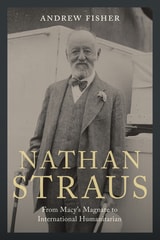
Nathan Straus
From Macy's Magnate to International HumanitarianAndrew Fisher
Rutgers University Press, 2026
Nathan Straus (1848–1931) encompassed worlds. He rose from his Jewish German immigrant family’s ruin in Civil War Georgia to become co-owner of Macy’s and Abraham & Straus department stores. He helped build American Zionism and cofounded the American Jewish Congress movement. His public service led to a nomination for New York City mayor.
This, the first comprehensive biography of Straus, details each of these lives but argues that his most historic achievements lay elsewhere—in philanthropy. Inspired by both his Jewish values and no-nonsense pragmatism, Straus designed, funded, and oversaw four Progressive philanthropic initiatives. The greatest—his demonstration and advocacy campaigns for milk pasteurization—saved the lives of countless thousands of infants in New York City and, ultimately, across much of America and western Europe. Straus also founded America’s first TB preventorium for at-risk children: a model for the forty-five more that followed. Partnering with Hadassah, he brought American public health innovations to Mandate Palestine. He provided vast relief for New York City’s jobless in the severe 1890s depression. In all, Straus’s humanitarianism won the acclaim of American presidents and world leaders and the gratitude of millions. We can learn from him today.

Nathaniel Southgate Shaler and the Culture of American Science
David N. Livingstone
University of Alabama Press, 1987
An influential American scientist and educator.
Nathaniel Southgate Shaler and the Culture of American Science is the first book-length study of the man who served a Harvard’s Professor of Geology and Paleontology during the Darwinian era. Shaler was a student of Louis Agassiz and went on to a successful, multifaceted career as a geologist, geographer, educator, humanist, and poet. Livingstone employs a thematic approach to chart Shaler’s career against the broader intellectual currents of America’s Gilded Age. After tracing Shaler’s life story from his boyhood in Kentucky through his student years at Harvard, his service with the Geological Survey, and eventually his years as Dean of Harvard’s Lawrence Scientific School, the author examines Shaler’s evolutionary vision and portrays his strategic efforts to reconcile the nineteenth century’s scientific and religious world views.
Livingstone assesses Shaler’s prolific writings, including those on race, which demonstrate a typical concern to provide a “scientific” perspective on the political questions of immigration restriction and eugenic control. IN addition, the book explores his efforts to interweave geography and history, particularly in relation to the American frontier; and his contributions to geology and geomorphology. The portrait of Shaler is completed with a review of his educational thinking and his role in establishing the American Summer School and in furthering scientific and technological education.
Nathaniel Southgate Shaler emerges from Livingstone’s work as a distinctive figure in the development of the new scientific culture, a figure who provides a focal point for assessing the impact of evolutionary naturalism on late-nineteenth-century American thought.
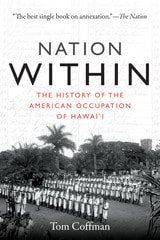
Nation Within
The History of the American Occupation of Hawai'iTom Coffman
Duke University Press, 2009

Nation and World, Church and God
The Legacy of Garry WillsEdited by Kenneth L. Vaux and Melanie Baffes
Northwestern University Press, 2014
Garry Wills is the polymathic public intellectual bemoaned as missing from American letters. A professor emeritus at Northwestern University, he has built upon his early studies in classics and patristics, while bringing his considerable intellect to bear on American culture, politics, and religion, notably through provocative articles and books on wars, past and present presidents, and the Catholic Church Wills has distinguished himself in the crowded field of Civil War history; fearlessly taken on the legacies of Richard Nixon and Ronald Reagan, among other presidents; and offered a critical voice in many fraught ethical discussions, especially in the areas of war and peace.
Nation and World, Church and God gathers original critical reflections by leading writers and scholars on Garry Wills’s life work. Organized around the themes of “Classics,” “Civil War,” “War and Peace,” and “Theology, Church, and the Arts,” the book reflects the cultural acumen, fine-grained political analysis, ethical candor, and theological wisdom of one of America’s most prolific writers.
National Abjection
The Asian American Body OnstageKaren Shimakawa
Duke University Press, 2002
Shimakawa looks at the origins of Asian American theater, particularly through the memories of some of its pioneers. Her examination of the emergence of Asian American theater companies illuminates their strategies for countering the stereotypes of Asian Americans and the lack of visibility of Asian American performers within the theater world. She shows how some plays—Wakako Yamauchi’s 12-1-A, Frank Chin’s Chickencoop Chinaman, and The Year of the Dragon—have both directly and indirectly addressed the displacement of Asian Americans. She analyzes works attempting to negate the process of abjection—such as the 1988 Broadway production of M. Butterfly as well as Miss Saigon, a mainstream production that enacted the process of cultural displacement both onstage and off. Finally, Shimakawa considers Asian Americanness in the context of globalization by meditating on the work of Ping Chong, particularly his East-West Quartet.
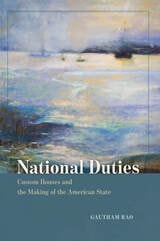
National Duties
Custom Houses and the Making of the American StateGautham Rao
University of Chicago Press, 2016
In the wake of the American Revolution, if you had asked a citizen whether his fledgling state would survive more than two centuries, the answer would have been far from confident. The problem, as is so often the case, was money. Left millions of dollars of debt by the war, the nascent federal government created a system of taxes on imported goods and installed custom houses at the nation’s ports, which were charged with collecting these fees. Gradually, the houses amassed enough revenue from import merchants to stabilize the new government. But, as the fragile United States was dependent on this same revenue, the merchants at the same time gained outsized influence over the daily affairs of customs houses. As the United States tried to police this commerce in the early nineteenth century, the merchants’ stranglehold on custom house governance proved to be formidable.
In National Duties, Gautham Rao makes the case that the origins of the federal government and the modern American state lie in these conflicts at government custom houses between the American Revolution and the presidency of Andrew Jackson. He argues that the contours of the government emerged from the push-and-pull between these groups, with commercial interests gradually losing power to the administrative state, which only continued to grow and lives on today.
National Healing
Race, State, and the Teaching of CompositionClaude Hurlbert
Utah State University Press, 2013
In National Healing, author Claude Hurlbert persuasively relates nationalism to institutional racism and contends that these are both symptoms of a national ill health afflicting American higher education and found even in the field of writing studies. Teachers and scholars, even in progressive fields like composition, are unwittingly at odds with their own most liberatory purposes, he says, and he advocates consciously broadening our understanding of rhetoric and writing instruction to include rhetorical traditions of non-Western cultures.
Threading a personal narrative of his own experiences as a student, professor, and citizen through a wide ranging discussion of theory, pedagogy, and philosophy in the writing classroom, Hurlbert weaves a vision that moves beyond simple polemic and simplistic multiculturalism. National Healing offers a compelling new aesthetic, epistemological, and rhetorical configuration.
National Health Care
Lessons for the United States and CanadaJonathan Lemco, Editor
University of Michigan Press, 1994
National History and the World of Nations
Capital, State, and the Rhetoric of History in Japan, France, and the United StatesChristopher L. Hill
Duke University Press, 2008
Delving into narrative histories, prose fiction, and social philosophy, Hill analyzes the rhetoric, narrative form, and intellectual genealogy of late-nineteenth-century texts that contributed to the creation of national history in each of the three countries. He discusses the global political economy of the era, the positions of the three countries in it, and the reasons that arguments about history loomed large in debates on political, economic, and social problems. Examining how the writing of national histories in the three countries addressed political transformations and the place of the nation in the world, Hill illuminates the ideological labor national history performed. Its production not only naturalized the division of the world by systems of states and markets, but also asserted the inevitability of the nationalization of human community; displaced dissent to pre-modern, pre-national pasts; and presented the subject’s acceptance of a national identity as an unavoidable part of the passage from youth to adulthood.
National Identities and Post-Americanist Narratives
Donald E. Pease
Duke University Press, 1994
This volume, originally published as a special issue of bounrary 2, focuses on the process of assembling and dismantling the American national narrative(s), sketching its inception and demolition. The contributors examine various cultural, political, and historical sources--colonial literature, mass movements, epidemics of disease, mass spectacle, transnational corporations, super-weapons, popular magazines, literary texts--out of which this narrative was constructed, and propose different understandings of nationality and identity following in its wake.
Contributors. Jonathan Arac, Lauren Berlant, Robert J. Corber, Elizabeth Freeman, Kathryn V. Lingberg, Jack Matthews, Alan Nadel, Patrick O'Donnell, Daniel O'Hara, Donald E. Pease, Ross Posnock, John Carlos Rowe, Rob Wilson

National Insecurity
U.S. Intelligence After the Cold Waredited by Craig Eisendrath, foreword by Tom Harkin
Temple University Press, 2000
In National Insecurity ten prominent experts describe, from an insider perspective, what went wrong with U.S. intelligence and what will be necessary to fix it. Drawing on their experience in government administration, research, and the foreign service, they propose a radical rethinking of the United States' intelligence needs in the post-Cold War world. In addition, they offer a coherent and unified plan for reform that can simultaneously protect U. S. security and uphold the values of our democratic system.
As we now know, even during the Cold War, when intelligence was seen as a matter of life and death, our system served us badly. It provided unreliable information, which led to a grossly inflated military budget, as it wreaked havoc around the world, supporting corrupt regimes, promoting the drug trade, and repeatedly violating foreign and domestic laws. Protected by a shroud of secrecy, it paid no price for its mistakes. Instead it grew larger and more insulated every year.
Taking into consideration our strategic interests abroad as well as the price of covert operations in dollars, in reliability, and in good will, every American taxpayer can be informed by and will want to read this book. National Insecurity is essential for readers interested in contemporary political issues, international relations, U.S. history, public policy issues, foreign policy, intelligence reform, and political science.
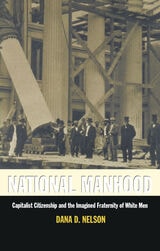
National Manhood
Capitalist Citizenship and the Imagined Fraternity of White MenDana D. Nelson
Duke University Press, 1998
Using political, scientific, medical, personal, and literary texts ranging from the Federalist papers to the ethnographic work associated with the Lewis and Clark expedition to the medical lectures of early gynecologists, Nelson explores the referential power of white manhood, how and under what conditions it came to stand for the nation, and how it came to be a fraternal articulation of a representative and civic identity in the United States. In examining early exemplary models of national manhood and by tracing its cultural generalization, National Manhood reveals not only how an impossible ideal has helped to form racist and sexist practices, but also how this ideal has simultaneously privileged and oppressed white men, who, in measuring themselves against it, are able to disavow their part in those oppressions.
Historically broad and theoretically informed, National Manhood reaches across disciplines to engage those studying early national culture, race and gender issues, and American history, literature, and culture.

National Parks Forever
Fifty Years of Fighting and a Case for IndependenceJonathan B. Jarvis and T. Destry Jarvis
University of Chicago Press, 2022
The US National Parks, what environmentalist and historian Wallace Stegner called America’s “best idea,” are under siege. Since 1972, partisan political appointees in the Department of the Interior have offered two conflicting views of the National Park Service (NPS): one vision emphasizes preservation and science-based decision-making, and another prioritizes economic benefits and privatization. These politically driven shifts represent a pernicious, existential threat to the very future of our parks.
For the past fifty years, brothers Jonathan B. and T. Destry Jarvis have worked both within and outside NPS as leaders and advocates. National Parks Forever interweaves their two voices to show how our parks must be protected from those who would open them to economic exploitation, while still allowing generations to explore and learn in them. Their history also details how Congress and administration appointees have used budget and staffing cuts to sabotage NPS’s ability to manage the parks and even threatened their existence. Drawing on their experience, Jarvis and Jarvis make a bold and compelling proposal: that it is time for NPS to be removed from the Department of the Interior and made an independent agency, similar to the Smithsonian Institution, giving NPS leaders the ability to manage park resources and plan our parks’ protection, priorities, and future.

National Parks Forever
Fifty Years of Fighting and a Case for IndependenceJonathan B. Jarvis and T. Destry Jarvis
University of Chicago Press, 2022
This is an auto-narrated audiobook edition of this book.
Two leaders of the National Park Service provide a front-row seat to the disastrous impact of partisan politics over the past fifty years—and offer a bold vision for the parks’ future.
The US National Parks, what environmentalist and historian Wallace Stegner called America’s “best idea,” are under siege. Since 1972, partisan political appointees in the Department of the Interior have offered two conflicting views of the National Park Service (NPS): one vision emphasizes preservation and science-based decision-making, and another prioritizes economic benefits and privatization. These politically driven shifts represent a pernicious, existential threat to the very future of our parks.
For the past fifty years, brothers Jonathan B. and T. Destry Jarvis have worked both within and outside NPS as leaders and advocates. National Parks Forever interweaves their two voices to show how our parks must be protected from those who would open them to economic exploitation, while still allowing generations to explore and learn in them. Their history also details how Congress and administration appointees have used budget and staffing cuts to sabotage NPS’s ability to manage the parks and even threatened their existence. Drawing on their experience, Jarvis and Jarvis make a bold and compelling proposal: that it is time for NPS to be removed from the Department of the Interior and made an independent agency, similar to the Smithsonian Institution, giving NPS leaders the ability to manage park resources and plan our parks’ protection, priorities, and future.
Nationally Competitive Scholarships
Serving Students and the Public GoodSuzanne McCray
University of Arkansas Press, 2007
Native Acts
Law, Recognition, and Cultural AuthenticityJoanne Barker
Duke University Press, 2011
Native American Catholic Studies Reader
History and TheologyDavid J. Endres
Catholic University of America Press, 2022
Native American Communities in Wisconsin, 1600–1960
A Study of Tradition and ChangeRobert E. Bieder
University of Wisconsin Press, 1995
The first comprehensive history of Native American tribes in Wisconsin, this thorough and thoroughly readable account follows Wisconsin’s Indian communities—Ojibwa, Potawatomie, Menominee, Winnebago, Oneida, Stockbridge-Munsee, and Ottawa—from the 1600s through 1960. Written for students and general readers, it covers in detail the ways that native communities have striven to shape and maintain their traditions in the face of enormous external pressures.
The author, Robert E. Bieder, begins by describing the Wisconsin region in the 1600s—both the natural environment, with its profound significance for Native American peoples, and the territories of the many tribal cultures throughout the region—and then surveys experiences with French, British, and, finally, American contact. Using native legends and historical and ethnological sources, Bieder describes how the Wisconsin communities adapted first to the influx of Indian groups fleeing the expanding Iroquois Confederacy in eastern America and then to the arrival of fur traders, lumber men, and farmers. Economic shifts and general social forces, he shows, brought about massive adjustments in diet, settlement patterns, politics, and religion, leading to a redefinition of native tradition.
Historical photographs and maps illustrate the text, and an extensive bibliography has many suggestions for further reading.