Results by title
91 books match the query 'West Virginia' and 3 start with n
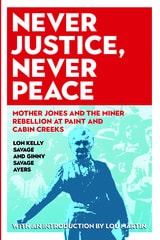
Never Justice, Never Peace
Mother Jones and the Miner Rebellion at Paint and Cabin CreeksGinny Savage Ayers
West Virginia University Press, 2018
In 1986 Lon Savage published Thunder in the Mountains: The West Virginia Mine War, 1920–21, a popular history now considered a classic. Among those the book influenced are Denise Giardina, author of Storming Heaven, and John Sayles, writer and director of Matewan. When Savage passed away, he left behind an incomplete book manuscript about a lesser-known Mother Jones crusade in Kanawha County, West Virginia. His daughter Ginny Savage Ayers drew on his notes and files, as well as her own original research, to complete Never Justice, Never Peace—the first book-length account of the Paint Creek–Cabin Creek Strike of 1912–13.
Savage and Ayers offer a narrative history of the strike that weaves together threads about organizer Mother Jones, the United Mine Workers union, politicians, coal companies, and Baldwin-Felts Detective Agency guards with the experiences of everyday men and women. The result is a compelling and in-depth treatment that brings to light an unjustly neglected—and notably violent—chapter of labor history. Introduced by historian Lou Martin, Never Justice, Never Peace provides an accessible glimpse into the lives and personalities of many participants in this critical struggle.

New Deal Photographs of West Virginia, 1934-1943
Betty Rivard
West Virginia University Press, 2012
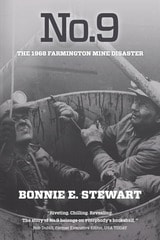
No.9
The 1968 Farmington Mine DisasterBonnie E. Stewart
West Virginia University Press, 2011
Ninety-nine men entered the cold, dark tunnels of the Consolidation Coal Company’s No.9 Mine in Farmington, West Virginia, on November 20, 1968. Some were worried about the condition of the mine. It had too much coal dust, too much methane gas. They knew that either one could cause an explosion. What they did not know was that someone had intentionally disabled a safety alarm on one of the mine’s ventilation fans. That was a death sentence for most of the crew. The fan failed that morning, but the alarm did not sound. The lack of fresh air allowed methane gas to build up in the tunnels. A few moments before 5:30 a.m., the No.9 blew up. Some men died where they stood. Others lived but suffocated in the toxic fumes that filled the mine. Only 21 men escaped from the mountain.