Results by title
272 books match the query 'Work' and 3 start with n

Nobody Grew but the Business
On the Life and Work of William GaddisJoseph Tabbi
Northwestern University Press, 2015
Finalist, 2016 Society for Midland Authors Award for Biography & Memoir
During his lifetime, William Gaddis (1922–1998) evaded biographical questions, never read from his work publicly, and didn’t allow his photograph to appear on his books. Before his novel J R (1975) won Gaddis the National Book Award and some measure of renown, he had given up the bohemian world of 1950s Greenwich Village for a series of corporate jobs that both paid the bills and provided an inside view of the encroachment of market values into every corner of American culture.
By illustrating the interconnectedness of Gaddis’s life and work, Tabbi, among his foremost interpreters, demystifies the “difficult author” and shows a writer who was as attuned as any to the way Americans talk, and who sensitively chronicled the gradual commodification of artistic endeavor. Illuminating, heartbreaking, and masterful, Tabbi’s book gives us the most subtly drawn portrait to date of one of the twentieth century’s seminal novelists.
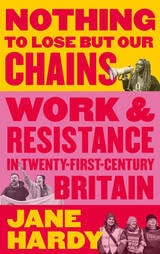
Nothing to Lose But Our Chains
Work and Resistance in Twenty-First-Century BritainJane Hardy
Pluto Press, 2021
Capitalism is a dynamic system, continually adapting itself to exploit workers in new ways. In Britain today, the gig economy is its newest form, expressed through precarious contracts and the supposed atomization of workers. In this book, Jane Hardy argues that despite capitalism’s best efforts to stop us, we can always find ways to fight it.
Through a range of case studies, from cleaners to university lecturers, Hardy looks at how workers are challenging employers’ assaults in the neoliberal workplace, comparing these new actions to a long history of British working class struggle. She explores the historic role of migrants in the British workforce, from the Windrush generation to more recent arrivals from the European Union, as well as placing womens’ collective action center stage. Analysing the rise of robotics and artificial intelligence, she refutes claims that we are entering a post-capitalist society.
Nothing to Lose But Our Chains is an optimistic exploration into the power of the working class, showing that no matter what tools capitalism uses, it can always be resisted.