Results by title
211 books match the query 'Working class' and 2 start with n

NEWER IDEALS OF PEACE
Jane Addams
University of Illinois Press, 2006
In this her second book, Jane Addams moves beyond humanitarian appeals to sensibility and prudence, advancing a more aggressive, positive idea of peace as a dynamic social process emerging out of the poorer quarters of cosmopolitan cities. Her deep analysis of relations among diverse groups in U.S. society, exemplified by inter-ethnic and labor relations in Chicago, draws widely useful lessons for both domestic and global peace, in an early formulation of today’s "globalization from below."
In an unprecedented, revolutionary critique of the pervasive militarization of society, Addams applies her scathing pen to traditional advocates and philosophers of “negative” peace, founders of the U.S. constitution, militarists, bigots, imperialists, and theories of “democratic peace” and liberal capitalism. Instead she sees a slow, powerful emergence of forces from below--the poor, the despised, workers, women, ethnic and racial communities, oppressed groups at home and abroad--that would invent moral substitutes for war and gradually shape a just, peaceful, and varied social order. An extensive, in-depth introduction by Berenice Carroll and Clinton Fink provides historical context, analysis, and a reassessment of the theoretical and practical significance of Newer Ideals of Peace today.
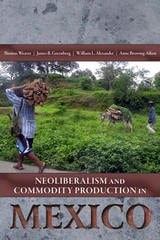
Neoliberalism and Commodity Production in Mexico
Thomas Weaver
University Press of Colorado, 2012
Detailed ethnographic fieldwork shows how foreign investment, privatization, deregulation, and elimination of welfare benefits have devastated national industries and natural resources and threatened agriculture, driving the campesinos and working class deeper into poverty. Focusing on specific commodity chains and the changes to production and marketing under neoliberalism, the contributors highlight the detrimental impacts of policies by telling the stories of those most affected by these changes. They detail the complex interplay of local and global forces, from the politically mediated systems of demand found at the local level to the increasingly powerful municipal and state governments and the global trade and banking institutions.
Sharing a common theoretical perspective and method throughout the chapters, Neoliberalism and Commodity Production in Mexico is a multi-sited ethnography that makes a significant contribution to studies of neoliberal ideology in practice.