Results by title
127 books match the query 'World politics' and 10 start with n

NATO and Germany
A Study in the Sociology of Supranational RelationsStanford Lyman
University of Arkansas Press, 1995
Focusing on the Cold War years, thismonograph examines the processes, problems, and policies through which the Federal Republic of Germany was formed and admitted into the North Atlantic Treaty Organization (NATO). The author compares the situation of Weimar Germany during its short-lived postwar decade with that of the Federal Republic by applying geopolitical concepts and theory, illustrating Germany’s territorial uniqueness and how that special aspect of its place on the European continent in?uenced the nation’s diplomacy in both eras.
During the late 1940s and the 1950s, the problem presented by Germany to the other NATO allies was how to secure and maintain the Federal Republic’s allegiance to the anticommunist alliance without eliminating the country’s desire to be reunited with its Soviet-dominated eastern section. How both NATO and Germany managed to maintain themselves in a state of dynamic equilibrium throughout the era of the Cold War illustrates the concept of international organization called “cooptation,” which Lyman helped to de?ne and expand.
The epilogue explores the larger issues that the case study illuminates: global space, national territorialization, collective identity, and ethnocentrism. Considering the current con?ict in the Balkans as it relates to the new Germany and the role of NATO, this far-reaching book is especially relevant with its suggestions for a basic supranational sociology.
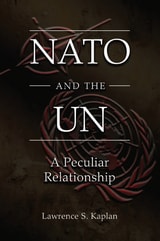
NATO and the UN
A Peculiar RelationshipLawrence S. Kaplan
University of Missouri Press, 2010
In NATO and the UN, Lawrence Kaplan, one of the leading experts on NATO, examines the intimate and often contentious relations between the two and describes how this relationship has changed over the course of two generations. Kaplan documents the many interactions between them throughout their interconnected history, focusing on the major flashpoints where either NATO clashed with UN leadership, the United States and the Soviet Union confronted each other directly, or fissures within the Atlantic alliance were dramatized in UN sessions. He draws on the organizations’ records as well as unpublished files from the National Archives and its counterparts in Britain, France, and Germany to provide the best account yet of working relations between the two organizations. By examining their complex connection with regard to such conflicts as the Balkan wars, Kaplan enhances our understanding of both institutions.
Crisis management has been a source of conflict between the two in the past but has also served as an incentive for collaboration, and Kaplan shows how this peculiar but persistent relationship has functioned. Although the Cold War years are gone, the UN remains the setting where NATO problems have played out, as they have in Iraq during recent decades. And it is to NATO that the UN has turned for military power to face crises in the Balkans, Middle East, and South Asia.
Kaplan stresses the importance of both organizations in the twenty-first century, recognizing their potential to advance global peace and security while showing how their tangled history explains the obstacles that stand in the way. His work offers significant findings that will especially impact our understanding of NATO while filling a sizable gap in our understanding of post-World War II diplomacy.

NGOs and Transnational Networks
Wild Cards in World PoliticsWilliam E. DeMars
Pluto Press, 2005

National Identity
Anthony D. Smith
University of Nevada Press, 1993
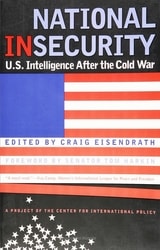
National Insecurity
U.S. Intelligence After the Cold Waredited by Craig Eisendrath, foreword by Tom Harkin
Temple University Press, 2000
In National Insecurity ten prominent experts describe, from an insider perspective, what went wrong with U.S. intelligence and what will be necessary to fix it. Drawing on their experience in government administration, research, and the foreign service, they propose a radical rethinking of the United States' intelligence needs in the post-Cold War world. In addition, they offer a coherent and unified plan for reform that can simultaneously protect U. S. security and uphold the values of our democratic system.
As we now know, even during the Cold War, when intelligence was seen as a matter of life and death, our system served us badly. It provided unreliable information, which led to a grossly inflated military budget, as it wreaked havoc around the world, supporting corrupt regimes, promoting the drug trade, and repeatedly violating foreign and domestic laws. Protected by a shroud of secrecy, it paid no price for its mistakes. Instead it grew larger and more insulated every year.
Taking into consideration our strategic interests abroad as well as the price of covert operations in dollars, in reliability, and in good will, every American taxpayer can be informed by and will want to read this book. National Insecurity is essential for readers interested in contemporary political issues, international relations, U.S. history, public policy issues, foreign policy, intelligence reform, and political science.
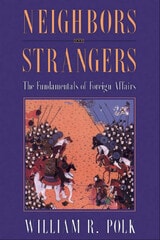
Neighbors and Strangers
The Fundamentals of Foreign AffairsWilliam R. Polk
University of Chicago Press, 1997
Indeed, going deeper into the human experience, Polk documents "fear of the foreigner" as a visceral response so deep-seated and so pervasive that it transcends human memory, individual experience and even logical analysis. More generally, he shows that the tension created by having to live as neighbors with those who, in the definition of contemporaries, were irredeemably alien has been one of the major causes of the rise of civilizations.
Accessible and engaging, Neighbors and Strangers is a revelatory look at how foreign affairs are a profound reflection of human nature.

Neoliberalism and Unlawful Governance
The Crisis of Democratic RightsGuillermina Seri
University of Michigan Press, 2026
In looking at the ways in which people resist, the book honors the perspective of the excluded and the voices of those most immediately affected by neoliberal austerity—from activists defending land and rights to communities subjected to various forms of exploitation, extractivism, and displacement. Bringing in these voices and theoretical perspectives, including from beyond the English-speaking world, this book highlights alternative ways of thinking about democracy and rights, drawing from the tradition of the commons. Through its deep analysis of history, theory, and world events, Neoliberalism and Unlawful Governance offers fresh insights into how various forms of emergency measures, policing, and security are used to privilege markets over people and the planet, while also emphasizing the crucial role of popular movements in defending and expanding democratic rights and to rebuilding commons.

Nietzsche's Earth
Great Events, Great PoliticsGary Shapiro
University of Chicago Press, 2016
Shapiro explores Nietzsche’s rejection of historical inevitability and its idea of the end of history. He highlights Nietzsche’s prescient vision of today’s massive human mobility and his criticism of the nation state’s desperate efforts to sustain its exclusive rule by declaring emergencies and states of exception. Shapiro then explores Nietzsche’s vision of a transformed garden earth and the ways it sketches an aesthetic of the Anthropocene. He concludes with an explanation of the deep political structure of Nietzsche’s “philosophy of the Antichrist,” by relating it to traditional political theology. By triangulating Nietzsche between his time and ours, between Bismarck’s Germany and post-9/11 America, Nietzsche’s Earth invites readers to rethink not just the philosopher himself but the very direction of human history.
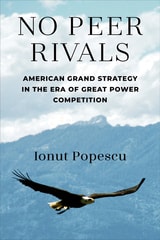
No Peer Rivals
American Grand Strategy in the Era of Great Power CompetitionIonut Popescu
University of Michigan Press, 2025
No Peer Rivals takes a major staple of International Relations scholarship—the offensive realist paradigm—and develops a comprehensive and practical grand strategy for the United States in this new era of Great Power Competition. The No Peer Rival framework is grounded in a realistic assessment of the most likely courses of action adopted by China, Russia, and other important regional powers. It prioritizes great power rivalry over other strategic goals, and identifies China as the biggest threat to America’s unique position in the international system. This grand strategic approach carefully aligns the domestic sources of national power (economic strength, energy security, and technological prowess) to America’s foreign policy and national security objectives. In addition to recommending necessary changes to America’s military and diplomatic strategies, No Peer Rivals also demonstrates that a realistic approach to industrial policy, international trade, energy production, and technological superiority offers the best chance for developing the sinews of power needed to outcompete Beijing in the long run.
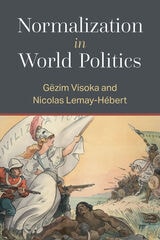
Normalization in World Politics
Gëzim Visoka and Nicolas Lemay-Hébert
University of Michigan Press, 2022
This book traces main discourses and practices associated with normalcy in world politics. Visoka and Lemay-Hébert mostly focus on how dominant states and international organizations try to manage global affairs through imposing normalcy over fragile states, restoring normalcy over disaster-affected states, and accepting normalcy over suppressive states. They show how discourses and practices come together in constituting normalization interventions and how in turn they play in shaping the dynamics of continuity and change in world politics.