Results by title
991 books match the query 'Writing' and 21 start with n
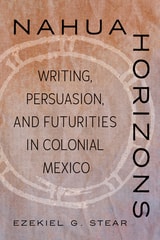
Nahua Horizons
Writing, Persuasion, and Futurities in Colonial MexicoEzekiel G. Stear
University of Arizona Press, 2025
Nahua Horizons: Writing, Persuasion, and Futurities in Colonial Mexico investigates how Nahuas conceptualized their futures in the early colonial period. Scholar Ezekiel G. Stear delves deeply into canonical texts such as the Florentine Codex and the Crónica mexicayotl as well as understudied texts such as the Lienzo de Quauhquechollan, the Tira de Tepechpan, and the Anales de Juan Bautista. The study does more than describe how Nahuas conceived of their own futures: it also shows their specific plans for moving into the coming years.
The book examines how Nahua writers in Central Mexico and other Mesoamerican voices in colonial Spanish America played an active, decisive role in shaping culture, using writing to persuade their communities to mold their own destinies, even amid colonial upheaval. This work opens up new directions for research and teaching, shifting inquiry from how Nahuas preserved cultural continuity to how they envisioned their roles as pathfinders toward times to come.
Nahua Horizons challenges the notion that the Spanish erased Nahua culture. The book emphasizes the ways people kept sovereignty over the futures they envisioned for themselves and their communities. Stear’s bold new approach follows the paths that Nahuas forged ahead into unknown times.
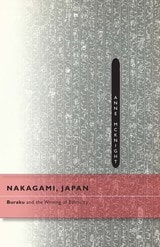
Nakagami, Japan
Buraku and the Writing of EthnicityAnne McKnight
University of Minnesota Press, 2010
In Nakagami, Japan, Anne McKnight shows how the writer’s exploration of buraku led to a unique blend of fiction and ethnography—which amounted to nothing less than a reimagining of modern Japanese literature. McKnight develops a parallax view of Nakagami’s achievement, allowing us to see him much as he saw himself, as a writer whose accomplishments traversed both buraku literary arts and high literary culture in Japan.
As she considers the ways in which Nakagami and other twentieth-century writers used ethnography to shape Japanese literature, McKnight reveals how ideas about language also imagined a transfigured relation to mainstream culture and politics. Her analysis of the resulting “rhetorical activism” lays bare Nakagami’s unique blending of literature and ethnography within the context of twentieth-century ideas about race, ethnicity, and citizenship—in Japan, but also on an international scale.
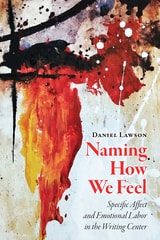
Naming How We Feel
Specific Affect and Emotional Labor In the Writing CenterDaniel Lawson
Utah State University Press, 2026
Writing centers are the locus for a wide range of emotional labor on campus, often serving students beyond the typical educational purpose. Naming How We Feel grapples with the question of how writing center administrators account for, train for, and theorize emotion and affect in the writing center to facilitate better and more ethical practices and considers how writing center administrators might ameliorate the costs of such emotional labor to faculty, tutors, and students.
Beginning with a discussion of how writing center scholars might identify and understand emotional labor, the book then expands to examine richly varied case studies and anecdotes to showcase how tutors tend to experience such labor and consider its relationship and association with emotional intelligence and burnout. Lawson considers how the field might better prepare and train tutors for affect and emotional labor, ultimately advocating for more equitable conditions for emotional labor within writing centers.
Naming How We Feel examines the critical role feelings play in writing and writing center work, offering advice on training tutors for emotional labor and literacy and suggestions for how administrators might engage institutional stakeholders to create and support more equitable conditions for emotional labor within their writing centers.
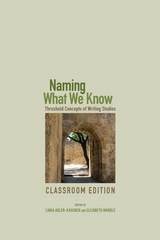
Naming What We Know, Classroom Edition
Threshold Concepts of Writing StudiesLinda Adler-Kassner
Utah State University Press, 2016
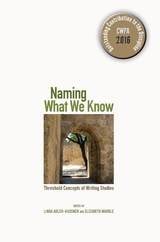
Naming What We Know
Threshold Concepts of Writing StudiesLinda Adler-Kassner
Utah State University Press, 2015
Naming What We Know examines the core principles of knowledge in the discipline of writing studies using the lens of “threshold concepts”—concepts that are critical for epistemological participation in a discipline. The first part of the book defines and describes thirty-seven threshold concepts of the discipline in entries written by some of the field’s most active researchers and teachers, all of whom participated in a collaborative wiki discussion guided by the editors. These entries are clear and accessible, written for an audience of writing scholars, students, and colleagues in other disciplines and policy makers outside the academy. Contributors describe the conceptual background of the field and the principles that run throughout practice, whether in research, teaching, assessment, or public work around writing. Chapters in the second part of the book describe the benefits and challenges of using threshold concepts in specific sites—first-year writing programs, WAC/WID programs, writing centers, writing majors—and for professional development to present this framework in action.
Naming What We Know opens a dialogue about the concepts that writing scholars and teachers agree are critical and about why those concepts should and do matter to people outside the field.
Narratives of Joy and Failure in Antiracist Assessment
Exploring Collaborative Writing AssessmentsAsao B. Inoue
University Press of Colorado, 2024
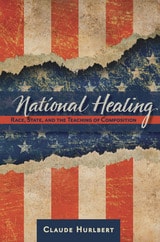
National Healing
Race, State, and the Teaching of CompositionClaude Hurlbert
Utah State University Press, 2013
In National Healing, author Claude Hurlbert persuasively relates nationalism to institutional racism and contends that these are both symptoms of a national ill health afflicting American higher education and found even in the field of writing studies. Teachers and scholars, even in progressive fields like composition, are unwittingly at odds with their own most liberatory purposes, he says, and he advocates consciously broadening our understanding of rhetoric and writing instruction to include rhetorical traditions of non-Western cultures.
Threading a personal narrative of his own experiences as a student, professor, and citizen through a wide ranging discussion of theory, pedagogy, and philosophy in the writing classroom, Hurlbert weaves a vision that moves beyond simple polemic and simplistic multiculturalism. National Healing offers a compelling new aesthetic, epistemological, and rhetorical configuration.
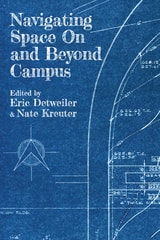
Navigating Space On and Beyond Campus
Eric Detweiler
Utah State University Press, 2026
Offering practical applications of scholarship in spatial theory and rhetorics of space and place, Navigating Space On and Beyond Campus profiles how writing and rhetoric programs across the United States have responded to the spatial challenges and possibilities facing higher education. Exploring how instructors creatively and critically navigate actual, virtual, and inaccessible spaces in the pursuit of effective, ethically informed rhetoric and writing education, this book also reveals how the use of space contributes to the creation and/or denial of equity among students, faculty, and programs.
Contributors document how they have secured and repurposed campus real estate, literally and metaphorically navigated relationships with other campus resources, and responded to austerity measures that have threatened the spaces they have historically called their own. Individual sections focus on the historical pressures that have shaped programs’ locations and resources, developments in the work and design of writing centers, the creation of new labs and centers, and the relationship between writing programs and the broader places and communities with which they are intertwined.
How spaces are allocated, structured, and regulated is a key determinant of access and equity in higher education. Navigating Space On and Beyond Campus offers timely strategies for and reflections on the place of rhetoric and writing on college and university campuses.
Neatness Counts
Essays on the Writer’s DeskKevin Kopelson Kopelson
University of Minnesota Press, 2006
Negotiating the Intersections of Writing and Writing Instruction
Proceedings from the 2019 Conference of the European Association for the Teaching of Academic Writingedited by Magnus Gustafsson and Andreas Eriksson
University Press of Colorado, 2022
Network Sense
Methods for Visualizing a DisciplineDerek N. Mueller
University Press of Colorado, 2018
New Orleans Style and the Writing of American Jazz History
Bruce Boyd Raeburn
University of Michigan Press, 2009
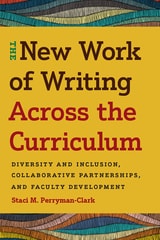
New Work of Writing Across the Curriculum
Diversity and Inclusion, Collaborative Partnerships, and Faculty DevelopmentStaci M. Perryman-Clark
Utah State University Press, 2023
Many of these initiatives are created in isolation, reinforcing institutional silos that are not used strategically to gain the attention of senior administrators, particularly those working at state-supported public institutions who must manage shrinking institutional budgets. Yet teaching and learning centers and WAC programs gain tremendously from one another by building explicit partnerships on campus-wide diversity initiatives that emphasize cultural competence. In addition, both cultural competence and written proficiency enhance the transferable skills necessary for completing undergraduate education requirements, and this work can be leveraged to draw the attention of senior administrative leadership.
Faculty development and WAC need to make diversity and inclusion initiatives a priority for professional development. The New Work of Writing Across the Curriculum reviews initiatives that point to increased understanding of diversity and inclusion that will be of significance to administrators, WAC specialists, faculty developers, and diversity officers across the spectrum of institutions of higher learning.
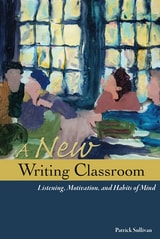
New Writing Classroom
Listening, Motivation, and Habits of MindPatrick Sullivan
Utah State University Press, 2014
In A New Writing Classroom, Patrick Sullivan provides a new generation of teachers a means and a rationale to reconceive their approach to teaching writing, calling into question the discipline's dependence on argument.
Including secondary writing teachers within his purview, Sullivan advocates a more diverse, exploratory, and flexible approach to writing activities in grades six through thirteen. A New Writing Classroom encourages teachers to pay more attention to research in learning theory, transfer of learning, international models for nurturing excellence in the classroom, and recent work in listening to teach students the sort of dialogic stance that leads to higher-order thinking and more sophisticated communication.
The conventional argumentative essay is often a simplistic form of argument, widely believed to be the most appropriate type of writing in English classes, but other kinds of writing may be more valuable to students and offer more important kinds of cognitive challenges. Focusing on listening and dispositions or "habits of mind” as central elements of this new composition pedagogy, A New Writing Classroom draws not just on composition studies but also on cognitive psychology, philosophy, learning theory, literature, and history, making an exciting and significant contribution to the field.
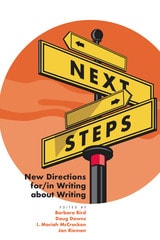
Next Steps
New Directions for/in Writing about WritingBarbara Bird
Utah State University Press, 2019
For more than ten years, WAW approaches have been emerging in all these sites and scenes of college writing instruction, and Next Steps offers an original look at the breadth of ways WAW pedagogy has been taken up by writing instructors and into an array of writing courses. Organized by some of the key foci of WAW instruction—writerly identity, process, and engagement—the book takes readers into thick classroom descriptions as well as vignettes offering shorter takes on particular strategies. The classroom descriptions are fleshed out in more personal ways by student vignettes, reflections on encountering writing about writing in college writing classes. As its theoretical basis, Next Steps includes chapters on threshold concepts, transfer of writing-related learning, and the history of WAW pedagogies.
As the first extensive look into WAW pedagogies across courses and institutions, Next Steps is ideal for writing instructors looking for new approaches to college composition instruction or curious about what “writing about writing” pedagogy actually is, for graduate students in composition pedagogy and their faculty, and for those researching composition pedagogy, threshold concepts, and learning transfer.
Contributors:
Linda Adler-Kassner, Olga Aksakalova, Joy Arbor, Matthew Bryan, Shawn Casey, Gabriel Cutrufello, Jennifer deWinter, Kristen di Gennaro, Emma Gaier, Christina Grant, Gwen Hart, Kimberly Hoover, Rebecca Jackson, Frances Johnson, Elizabeth Kleinfeld, Katie Jo LaRiviere, Andrew Lucchesi, Cat Mahaffey, Michael Michaud, Rebecca S. Nowacek, Andrew Ogilvie, Sarah Read, Rebecca Robinson, Kevin Roozen, Mysti Rudd, Christian Smith, Nichole Stack, Samuel Stinson, Hiroki Sugimoto, Lisa Tremain, Valerie Vera, Megan Wallace, Elizabeth Wardle, Christy I. Wenger, Nancy Wilson, Dominique Zino
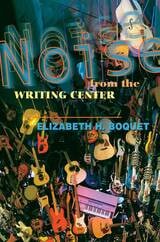
Noise From The Writing Center
Elizabeth H. Boquet
Utah State University Press, 2002
In Noise from the Writing Center, Boquet develops a theory of "noise" and excess as an important element of difference between the pedagogy of writing centers and the academy in general. Addressing administrative issues, Boquet strains against the bean-counting anxiety that seems to drive so much of writing center administration. Pedagogically, she urges a more courageous practice, developed via metaphors of music and improvisation, and argues for "noise," excess, and performance as uniquely appropriate to the education of writers and tutors in the center.
Personal, even irreverent in style, Boquet is also theoretically sophisticated, and she draws from an eclectic range of work in academic and popular culture-from Foucault to Attali to Jimi Hendrix. She includes, as well, the voices of writing center tutors with whom she conducted research, and she finds some of her most inspiring moments in the words and work of those tutors.
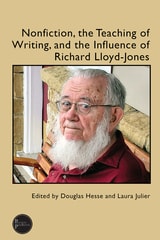
Nonfiction, the Teaching of Writing, and the Influence of Richard Lloyd-Jones
Doug Hesse
University Press of Colorado, 2023
Nonnative English-Speaking Teachers of U.S. College Composition
Exploring Identities and Negotiating DifferenceMariya Tseptsura
University Press of Colorado, 2024
Nothing Begins with N
New Investigations of FreewritingEdited by Pat Belanoff, Peter Elbow, and Sheryl I. Fontaine
Southern Illinois University Press, 1991
The 16 essays in this book provide a theoretical underpinning for freewriting.
Sheryl I. Fontaine opens the book with a description of the organization, purpose, and content of students’ 10-minute unfocused freewriting.
Pat Belanoff discusses the relationship between skilled and unskilled student writers.
Richard H. Haswell analyzes forms of freewriting.
Lynn Hammond describes the focused freewriting strategies used in legal writing and in the analysis of poetry.
Joy Marsella and Thomas L. Hilgers suggest ways of teaching freewriting as a heuristic.
Diana George and Art Young show what teachers learned about the writing abilities of three engineering students through freewriting journals.
Anne E. Mullin seeks to determine whether freewriting lives up to claims made for it.
Barbara W. Cheshire assesses the efficacy of freewriting.
James W. Pennebaker checks the short- and long-term effects of freewriting on students’ emotional lives.
Ken Macrorie notes that freewriting means being freed to use certain powers.
Peter Elbow shows how authors use freewriting.
Robert Whitney tells "why I hate to freewrite."
Karen Ferro considers her own freewriting, showing how it leads to a deeper self-understanding.
Chris Anderson discusses the qualities in freewriting that we should maintain in revision.
Burton Hatlen shows the parallels between writing projective verse and freewriting.
Sheridan Blau describes the results of experiments with invisible writing.
Nothingism
Poetry at the End of Print CultureJason Schneiderman
University of Michigan Press, 2025
In this collection, the essays range from blistering manifesto to deep historical dives to gentle classroom guidance to considerations of the poems of James Merrill and Agha Shahid Ali, moving between the theoretical and the practical. Nothingism is both deeply personal and highly erudite, providing an engaging and scholarly account of reading, writing, and teaching poetry as our world continues its unsupervised lurch toward digital culture.
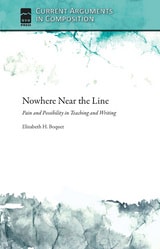
Nowhere Near the Line
Pain and Possibility in Teaching and WritingElizabeth H. Boquet
Utah State University Press, 2016
In this short work, Elizabeth Boquet explores the line Lawrence Schall describes above, tracing the overlaps and intersections of a lifelong education around guns and violence, as a student, a teacher, a feminist, a daughter, a wife, a citizen and across the dislocations and relocations that are part of a life lived in and around school. Weaving narratives of family, the university classroom and administration, her husband’s work as a police officer, and her work with students and the Poetry for Peace effort that her writing center sponsors in the local schools, she recounts her efforts to respond to moments of violence with a pedagogy of peace. “Can we not acknowledge that our experiences with pain anywhere should render us more, not less, capable of responding to it everywhere?” she asks. “Compassion, it seems to me, is an infinitely renewable resource.”