8642 books match the query '20th century' and 219 start with n

cover of Ne me quitte pas: A Song by Jacques Brel and Interpreted by Nina Simone and Others

Ne me quitte pas

A Song by Jacques Brel and Interpreted by Nina Simone and Others

Maya Angela Smith

Duke University Press, 2025

In 1959, Belgian singer-songwriter Jacques Brel wrote and performed “Ne me quitte pas” (Don’t leave me), a visceral and haunting plea for his lover to come back. As a teenager, Maya Angela Smith was so captivated by Nina Simone’s powerful 1965 cover of the song that it inspired her to be a French professor. In Ne me quitte pas, Smith follows the classic song’s long and varied journey, from Brel’s iconic 1966 performance on French television to Simone’s cover to Shirley Bassey’s English-language version (“If You Go Away”) to its contemporary manifestations in popular culture. Throughout, Smith shows that as the song travels across languages, geographies, genres, and generations, it accumulates shifting artistic and cultural significance as each listener creates their own meaning.
[more]
cover of Nearly Nuclear: A Mismanaged Energy Transition

Nearly Nuclear

A Mismanaged Energy Transition

leroy smith

Michigan State University Press, 2021

When Consumers Power’s plan to build a nuclear power plant in Midland, Michigan, was announced in 1967, it promised to free Michigan residents from expensive, dirty, coal-fired electricity and to keep Dow Chemical operating in the state. But before the plan could be completed, the facility was called an engineering nightmare, a financial disaster, a construction boondoggle, a political headache, and a regulatory muddle. Most locals had welcomed nuclear power eagerly. Why, after almost twenty years and billions of dollars, did this promise of a high-tech, coal-free, prosperous future fail? And what lessons does its failure offer today as Americans try to develop a clean energy  economy based on renewable power? To answer these questions, energy consultant and author LeRoy Smith carefully traces the design and construction decisions made by Consumers Power, including its choice of reactor and its hiring of the Bechtel Corporation to manage the project. He also details the rapidly changing regulatory requirements and growing public concern about the environmental risks of nuclear power generation. An examination of both the challenges and importance of renewable energy, this book will be of value to anyone interested in grappling with the complexities of our ongoing efforts to eliminate fossil fuels in favor of clean renewable energy.
[more]
cover of Neatness Counts: Essays on the Writer’s Desk

Neatness Counts

Essays on the Writer’s Desk

Kevin Kopelson Kopelson

University of Minnesota Press, 2006

In Neatness Counts, Kevin Kopelson reflects on the poetics of the desk—rolltop or bureau-plat, cluttered or bare, the nestlike desk, the schematic desk, the dramatic desk, the dramatic lack of any such furniture. Exploring the topography of literary creation by way of the topography of work space, Kopelson, one of today’s most important critics, offers a series of meditations on how orderliness, chaos, and other physical states correspond with both the exhilaration of production and the desperation of writer's block.Focusing on the poet Elizabeth Bishop, the novelist Marcel Proust, the critic Roland Barthes, the playwright Tom Stoppard, and the travel writer Bruce Chatwin, Neatness Counts is at once critical and creative, examining how various writers' work habits relate to their published work. Kopelson also considers desks of his own—one that had belonged to an older brother, one he borrowed from a messy friend, one now shared with a partner. And by pursuing these two lines of inquiry to their unlikely but enlightening conclusions, Kopelson both fabricates a virtual library of literary insight and commemorates an era in which the term “desktop” didn’t denote one’s computer screen.Kevin Kopelson is professor of English at the University of Iowa. His books include, most recently, The Queer Afterlife of Vaslav Nijinsky.
[more]
cover of Necessary American Fictions: Popular Literature of the 1950s

Necessary American Fictions

Popular Literature of the 1950s

William Darby

University of Wisconsin Press, 1987

William Darby gives us a comprehensive and (mostly) sympathetic reading of over fifty novels and a few movies from the 1950s. He examines titles such as Mandingo, The Invisible Man, I the Jury, Catcher in the Rye, Battle Cry, The Caine Mutiny, The Revolt of Mamie Stover, The Manchurian Candidate, Hawaii, The Bramble Bush, Peyton Place, Ten North Frederick, A Stone for Danny Fisher, The Bad Seed, Not as a Stranger, The Blackboard Jungle, From Here to Eternity, and Compulsion.
[more]
cover of Necropolitics

Necropolitics

Achille Mbembe

Duke University Press, 2019

In Necropolitics Achille Mbembe, a leader in the new wave of francophone critical theory, theorizes the genealogy of the contemporary world, a world plagued by ever-increasing inequality, militarization, enmity, and terror as well as by a resurgence of racist, fascist, and nationalist forces determined to exclude and kill. He outlines how democracy has begun to embrace its dark side---what he calls its “nocturnal body”---which is based on the desires, fears, affects, relations, and violence that drove colonialism. This shift has hollowed out democracy, thereby eroding the very values, rights, and freedoms liberal democracy routinely celebrates. As a result, war has become the sacrament of our times in a conception of sovereignty that operates by annihilating all those considered enemies of the state. Despite his dire diagnosis, Mbembe draws on post-Foucauldian debates on biopolitics, war, and race as well as Fanon's notion of care as a shared vulnerability to explore how new conceptions of the human that transcend humanism might come to pass. These new conceptions would allow us to encounter the Other not as a thing to exclude but as a person with whom to build a more just world.
[more]
cover of Negative Exposures: Knowing What Not to Know in Contemporary China

Negative Exposures

Knowing What Not to Know in Contemporary China

Margaret Hillenbrand

Duke University Press, 2020
When nations decide to disown their troubled pasts, how does this strategic disavowal harden into social fact? In Negative Exposures, Margaret Hillenbrand investigates the erasure of key aspects of such momentous events as the Nanjing Massacre, the Cultural Revolution, and the Tiananmen Square protests from the Chinese historical consciousness, not due to amnesia or censorship but through the operations of public secrecy. Knowing what not to know, she argues, has many stakeholders, willing and otherwise, who keep quiet to protect themselves or their families out of shame, pragmatism, or the palliative effects of silence. Hillenbrand shows how secrecy works as a powerful structuring force in Chinese society, one hiding in plain sight, and identifies aesthetic artifacts that serve as modes of reckoning against this phenomenon. She analyses the proliferation of photo-forms—remediations of well-known photographs of troubling historical events rendered in such media as paint, celluloid, fabric, digital imagery, and tattoos—as imaginative spaces in which the shadows of secrecy are provocatively outlined.
[more]
cover of Negative Liberties: Morrison, Pynchon, and the Problem of Liberal Ideology

Negative Liberties

Morrison, Pynchon, and the Problem of Liberal Ideology

Cyrus R. K. Patell

Duke University Press, 2001

Since the nineteenth century, ideas centered on the individual, on Emersonian self-reliance, and on the right of the individual to the pursuit of happiness have had a tremendous presence in the United States—and even more so after the Reagan era. But has this presence been for the good of all? In Negative Liberties Cyrus R. K. Patell revises important ideas in the debate about individualism and the political theory of liberalism. He does so by adding two new voices to the current discussion—Toni Morrison and Thomas Pynchon—to examine the different ways in which their writings embody, engage, and critique the official narrative generated by U.S. liberal ideology.
Pynchon and Morrison reveal the official narrative of individualism as encompassing a complex structure of contradiction held in abeyance. This narrative imagines that the goals of the individual are not at odds with the goals of the family or society and in fact obscures the existence of an unholy truce between individual liberty and forms of oppression. By bringing these two fiction writers into a discourse dominated by Ralph Waldo Emerson, Isaiah Berlin, John Rawls, George Kateb, Robert Bellah, and Michael Sandel, Patell unmasks the ways in which contemporary U.S. culture has not fully shed the oppressive patterns of reasoning handed down by the slaveholding culture from which American individualism emerged.
With its interdisciplinary approach, Negative Liberties will appeal to students and scholars of American literature, culture, sociology, and politics.
[more]
cover of Negative Originals: Race and Early Photography in Colombia

Negative Originals

Race and Early Photography in Colombia

Juanita Solano Roa

Duke University Press, 2025
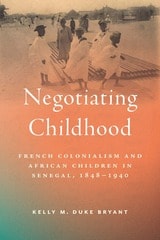
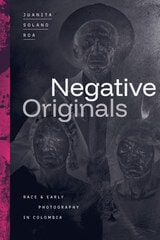
In Negative Originals, Juanita Solano Roa explores race and identity through photographic practices in late nineteenth-century Medellín, Colombia. Focusing on the photographic studios of Fotografía Rodríguez and Benjamín de la Calle, Solano Roa examines the visual construction and dissemination of racial ideologies and the linkage of race to progress. She studies both positive and negative prints to highlight the juxtaposition of traditional portraiture, which reinforced prevailing racial ideologies, and subversive depictions of often excluded individuals such as cross-dressers, peasants, the poor, and Afro-Colombians. In redefining photography’s role, Solano Roa shifts the critic’s eye from traditional positive prints to negatives, exposing the form’s material, symbolic, and spatial significance. In doing so, she simultaneously uncovers new perspectives on the medium and challenges hegemonic histories. Engaging one of Latin America’s most important photographic archives, Solano Roa addresses urgent gaps in the history of Colombian and Latin American photography, particularly at the intersection of race, gender, and the construction of whiteness.
[more]
cover of Negotiating Childhood: French Colonialism and African Children in Senegal, 1848–1940

Negotiating Childhood

French Colonialism and African Children in Senegal, 1848–1940

Kelly M. Duke Bryant

University of Massachusetts Press, 2026

A groundbreaking study of the meaning of childhood in French colonial Senegal

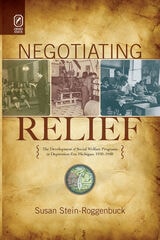
Negotiating Childhood explores how colonial child protection policies and African children’s responses to them produced new ways of defining, measuring, documenting, and experiencing childhood in the French colony of Senegal from 1848 to 1940. In this groundbreaking book, Kelly M. Duke Bryant takes the scholarship in new directions, offering to a literature dominated by studies of British colonies in the twentieth century a study of childhood in a French colony from the immediate post-emancipation period through the 1930s. This focus allows her to complicate the generally accepted timeline of child protection in colonial Africa and question other assumptions about children’s history on the continent.

This deeply researched work uses a wide range of sources to examine children’s experiences in spaces where they encountered French discipline and surveillance, such as wardship courts, public streets, schools, juvenile reformatories, and vaccine clinics. The book shows not only how these spaces re-ordered African childhood, but also how children themselves shaped and limited French efforts to impose order, especially when the state depended on African children’s cooperation to make good on rhetoric about child “protection.” It also charts the rise of documentation in children’s lives, as colonial representatives recorded names, ages, and other details about the African children with whom they interacted. Tracing the “documented” child back to the early colonial period, Negotiating Childhood historicizes the emergence of identity documentation—so crucial to our contemporary world—and questions the naturalness of the very idea of the “child.”
[more]
cover of Negotiating Relief: The Development of Social Welfare Programs in Depression-Era Michigan, 1930–1940

Negotiating Relief

The Development of Social Welfare Programs in Depression-Era Michigan, 1930–1940

Susan Stein-Roggenbuck

The Ohio State University Press, 2008

In Negotiating Relief, Susan Stein-Roggenbuck examines Michigan’s implementation of the New Deal relief programs and the state’s reorganization of welfare in 1939. Local officials, social workers, and recipients were key players in the Michigan debates over how best to administer relief. The book sheds important light on the profession of social work and public welfare, and the development of nonfederal relief at the state and local levels after 1935.
 
Guided by fiscal localism and a firm belief in home rule, local officials fought to retain control of relief. Stein-Roggenbuck argues that while significant changes occurred in welfare policy as a result of the New Deal, many continuities remained. Among those was the responsibility of families to provide financial support. Often forgotten were those on general relief—individuals who did not fit the federal programs such as Aid to Dependent Children (ADC) and Old Age Assistance (OAA). General relief became a third track of welfare.

Drawing on newspaper records, county and city board minutes, social welfare agency records, federal records, and case file records, Negotiating Relief gives voice to the numerous groups involved in welfare debates, particularly the recipients of relief. This book adds to our understanding of the local implementation of welfare policy in both rural and urban areas.

 
[more]
cover of Negotiating With ETA: Obstacles To Peace In The Basque Country, 1975-1988

Negotiating With ETA

Obstacles To Peace In The Basque Country, 1975-1988

Robert P. Clark

University of Nevada Press, 1990

Since the late 1960s, the Basque insurgent organization ETA (Euzkadi ta Askatasuna, or Basque Homeland and Freedom) has been engaged in a violent struggle against the Spanish state in an effort to gain the independence of the Basque Country. ETA violence has led to the death of hundreds of people, making the organization the most violent insurgent group in Europe. Between 1975 and 1988, nearly thirty attempts to negotiate an end to violence, with a few limited exceptions, all ended in failure. This important book examines why the efforts to negotiate have failed and makes suggestions on how to improve the chances for successful discussion in the future. Although Clark does not disprove the conventional wisdom that negotiation with terrorists is a bad idea, he does begin from the opposing point of view that there may be some positive values to be realized from such negotiation.Negotiating with ETA describes the various factions that are interested in the outcome of such negotiations and the Spanish antiterrorist policy throughout the period under examination. The book also recounts the early attempts to negotiate, the first attempt at "social reintegration," various attempts by the Basque Government to get negotiations started, negotiation efforts under the Spanish socialist government of Felipe González, and the lengthy negotiations that took place in Algeria. A wide range of scholars and specialists will find this book valuable, including those interested in contemporary Spanish politics, ethnic nationalism, Basque affairs, the problem of terrorism, and conflict resolution.
[more]
cover of Negro Thought in America, 1880-1915: Racial Ideologies in the Age of Booker T. Washington

Negro Thought in America, 1880-1915

Racial Ideologies in the Age of Booker T. Washington

August Meier

University of Michigan Press, 1963

An analysis of the ideas of Booker T. Washington, Frederick Douglass, W. E. B. DuBois, and other black leaders from the turn of the century
[more]
cover of Neither Donkey nor Horse: Medicine in the Struggle over China's Modernity

Neither Donkey nor Horse

Medicine in the Struggle over China's Modernity

Sean Hsiang-lin Lei

University of Chicago Press, 2014

Neither Donkey nor Horse tells the story of how Chinese medicine was transformed from the antithesis of modernity in the early twentieth century into a potent symbol of and vehicle for China’s exploration of its own modernity half a century later. Instead of viewing this transition as derivative of the political history of modern China, Sean Hsiang-lin Lei argues that China’s medical history had a life of its own, one that at times directly influenced the ideological struggle over the meaning of China’s modernity and the Chinese state.
           
Far from being a remnant of China’s premodern past, Chinese medicine in the twentieth century coevolved with Western medicine and the Nationalist state, undergoing a profound transformation—institutionally, epistemologically, and materially—that resulted in the creation of a modern Chinese medicine. This new medicine was derided as “neither donkey nor horse” because it necessarily betrayed both of the parental traditions and therefore was doomed to fail. Yet this hybrid medicine survived, through self-innovation and negotiation, thus challenging the conception of modernity that rejected the possibility of productive crossbreeding between the modern and the traditional.
           
By exploring the production of modern Chinese medicine and China’s modernity in tandem, Lei offers both a political history of medicine and a medical history of the Chinese state.
[more]
cover of Neocolonial Fictions of the Global Cold War

Neocolonial Fictions of the Global Cold War

Steven Belletto and Joseph Keith

University of Iowa Press, 2019

Bringing together noted scholars in the fields of literary, cultural, gender, and race studies, this edited volume challenges us to reconsider our understanding of the Cold War, revealing it to be a global phenomenon rather than just a binary conflict between U.S. and Soviet forces. Shining a spotlight on writers from the war’s numerous fronts and applying lenses of race, gender, and decolonization, the essayists present several new angles from which to view the tense global showdown that lasted roughly a half-century. Ultimately, they reframe the Cold War not merely as a divide between the Soviet Union and the United States, but between nations rich and poor, and mostly white and mostly not. By emphasizing the global dimensions of the Cold War, this innovative collection reveals emergent forms of post-WWII empire that continue to shape our world today, thereby raising the question of whether the Cold War has ever fully ended.
[more]
cover of Neodomestic American Fiction

Neodomestic American Fiction

Kristin J. Jacobson

The Ohio State University Press, 2010
In American literature, domestic fictions—that is, novels focused on the home and homemaking—are linked with white, middle-class women’s fiction and culture. Employing a spatial lens, Neodomestic American Fiction joins and extends other studies in redefining domestic fiction’s literary history and definition. Unlike previous redefinitions and reevaluations, Neodomestic American Fiction reads domestic novels alongside feminist geography and architectural history to map the links and disjunctions among a range of authors writing during the same period as well as across centuries and cultures. Kristin Jacobson’s attention to domestic geographies reveals a new space and subgenre emerge in the 1980s: neodomestic fiction.
 
In this innovative study, Kristin Jacobson identifies over thirty novels that renovate traditional forms, therefore challenging model domesticity’s conservative gender, racial, and sexual politics. Rather than produce stable single-family homes, neodomestic fictions advance a politics of instability characterized by mobility, renovation and redesign, and relational space. These “alternative” domesticities—when read in the context of neodomestic fiction—are not marginal but rather central to domesticity’s configurations. Such resistance, as Iris Marion Young argues, “is integral to modern political theory and is not an alternative to it.”
 
Thus, this spatial analysis of post-1980 domestic novels does not indicate a post-feminist or post-gender world. Rather, neodomestic fiction’s heterogeneous, unstable spaces offer opportunities to examine contemporary hierarchies and experiment with more egalitarian homemaking. These fictions include Toni Morrison’s Paradise, Barbara Kingsolver’s The Poisonwood Bible, Leslie Marmon Silko’s Gardens in the Dunes, and Chang-rae Lee’s A Gesture Life.
[more]
cover of Neoliberal Bonds: Undoing Memory in Chilean Art and Literature

Neoliberal Bonds

Undoing Memory in Chilean Art and Literature

Fernando A. Blanco

The Ohio State University Press, 2015

Fernando A. Blanco’s Neoliberal Bonds: Undoing Memory in Chilean Art and Literature analyzes the sociocultural processes that have reshaped subjectivities in post-Pinochet Chile. By creatively exploring the intersections among memory, gender, post-trauma, sociology, psychoanalysis, and neoliberalism, Neoliberal Bonds draws on Lacan’s notion of perversion to critique the subjective fantasies that people create to compensate for the loss of the social bond in the wake of a dictatorship founded on individualism, competition, and privatization.
 
Neoliberal Bonds vehemently criticizes how Chile’s transition governments, through a series of political and legal maneuvers, created the state’s official memory narratives. Blanco argues that the state, the media, academia, and the neoliberal market colluded to colonize and mediatize the “memory scene.” In contrast to these official narratives, Neoliberal Bonds analyzes alternative memory accounts within the visual arts and literature that push back against the state, its institutions, and its economic allies. These alternative memory narratives highlight the ontological fracture of the new neoliberal subjects; they also bring into sharp relief the urgent need for democratization that still poses a challenge to Chile a quarter century after its “transition to democracy” began.
[more]
cover of Neoliberal Chicago

Neoliberal Chicago

Edited by Larry Bennett, Roberta Garner, and Euan Hague

University of Illinois Press, 2017

The neoliberal philosophy of fiscal austerity aligned with reduced regulation has transformed Chicago. As pursued by mayor Rahm Emanuel and his predecessor Richard M. Daley, neoliberalism led officials to privatize everything from parking meters to schools, gut regulations and social services, and promote gentrification wherever possible. The essayists in Neoliberal Chicago explore an essential question: how does neoliberalism work on the ground in today's Chicago? Contextual chapters explore race relations, physical development, and why Chicago embraced neoliberalism. Other contributors delve into aspects of the neoliberal vision, neoliberalism's impact on three iconic city spaces, and how events like the 2008 foreclosure crisis and the bid to attract the Olympic Games reveal the workings of neoliberalism. Contributors: Stephen Alexander, Larry Bennett, Michael Bennett, Carrie Breitbach, Sean Dinces, Kenneth Fidel, Roberta Garner, Euan Hague, Black Hawk Hancock, Christopher Lamberti, Michael J. Lorr, Martha Martinez, Brendan McQuade, Alex G. Papadopoulos, Rajiv Shah, Costas Spirou, Carolina Sternberg, and Yue Zhang.
[more]
cover of Neruda: An Intimate Biography

Neruda

An Intimate Biography

By Volodia Teitelboim

University of Texas Press, 1992

Like a rain-swollen river sweeping everything into its current, Pablo Neruda channeled all his life experiences into impassioned poetry that ultimately brought him the 1971 Nobel Prize for literature. His close friend and fellow writer-activist Volodia Teitelboim shared that exciting process for forty years, uniquely qualifying him to offer this intimate portrait of the poet. Originally published in Spain in 1984, Neruda is a biography that reads like a novel.

Teitelboim captures the whole sweep of Neruda's eventful life (1904-1973), from his motherless childhood in Chile's rainy southern forest to his unquiet death just twelve days after the violent overthrow of the Allende government he had served. He follows him through his bohemian youth as an impoverished university student in Santiago, his lonely existence in Southeast Asia consular outposts, his joyous discovery of Spain, and his lifelong devotion to poetry, love, Chile, and politics.

[more]
cover of Nervous Systems: Art, Systems, and Politics since the 1960s

Nervous Systems

Art, Systems, and Politics since the 1960s

Johanna Gosse and Timothy Stott, editors

Duke University Press, 2021

The contributors to Nervous Systems reassess contemporary artists' and critics' engagement with social, political, biological, and other systems as a set of complex and relational parts: an approach commonly known as systems thinking. Demonstrating the continuing relevance of systems aesthetics within contemporary art, the contributors highlight the ways that artists adopt systems thinking to address political, social, and ecological anxieties. They cover a wide range of artists and topics, from the performances of the Argentinian collective the Rosario Group and the grid drawings of Charles Gaines to the video art of Singaporean artist Charles Lim and the mapping of global logistics infrastructures by contemporary artists like Hito Steyerl and Christoph Büchel. Together, the essays offer an expanded understanding of systems aesthetics in ways that affirm its importance beyond technological applications detached from cultural contexts.

Contributors. Cristina Albu, Amanda Boetzkes, Brianne Cohen, Kris Cohen, Jaimey Hamilton Faris, Christine Filippone, Johanna Gosse, Francis Halsall, Judith Rodenbeck, Dawna Schuld, Luke Skrebowski, Timothy Stott, John Tyson
[more]
cover of Networked: Business and Politics in Decentralizing Indonesia, 1998-2004

Networked

Business and Politics in Decentralizing Indonesia, 1998-2004

Wahyu Prasetyawan

National University of Singapore Press, 2018

B. J. Habibie may have served the shortest term of any of Indonesia’s presidents, but his push for decentralization would affect the country for decades. Habibie came to power in 1998 and immediately set to work restructuring the government. He gave local districts more power, allowing them to elect their own leaders and create their own bylaws. After years of authoritarian rule, these reforms were meant to return power to the people. But that led to local governments engaging in bureaucratic and political conflict with the central government over control of valuable natural resources and the distribution of the revenue they generated. Decentralization became the most important political economic development in Indonesia of the past thirty years.
Networked Business and Politics in Decentralizing Indonesia evaluates three cases of deep-seated political conflict and intrigue including central government, local governments, and multinational companies. It looks at how the structure of the national political economy has changed as the result of local politicians becoming involved in disputes with the national government over control of natural resources. It also analyzes how these changes will affect the distribution of wealth in the country as well as Indonesia’s evolving democratic politics and modes of governance.
[more]
cover of Networks of Modernism: Reorganizing American Narrative

Networks of Modernism

Reorganizing American Narrative

Wesley Beal

University of Iowa Press, 2015

Networks of Modernism offers a new understanding of American modernist aesthetics and introduces the idea that networks were central to how American moderns thought about their culture in their dramatically changing milieu. While conventional wisdom holds that the network rose to prominence in the 1980s and 1990s in the context of information technologies, digitization is only the most recent manifestation of networks in intellectual history. Crucial developments in modern America provide another archive of network discourses well before the advent of the digital age. The rise of the railroad recast the American landscape as an assortment of interconnected hubs. The advent of broadcast radio created a decentralized audience that was at once the medium’s strength and its weakness. The steady and intertwined advances of urbanization and immigration demanded the reconceptualization of community and ethnic identity to replace the failing “melting pot” metaphor for the nation. Indeed, the signal developments of the modern era eroded social stratification and reorganized American society in a nodal, decentralized, and interpenetrating form—what today we would label a “distributed” network that is fully flattened and holds no clustered centers of power.

In this ferment of social upheaval and technological change, the moderns found what we would today term “the network,” though they did not have the vocabulary for it that we do now, to be a versatile model for their aesthetic experiments in representing social space and social relations. Whether they used the figuration of the network as a kind of formal experiment to negotiate the tensions between dispersal and unity, fragment and totality, or took the network as a subject in itself, as seen when dealing with crowds or public spaces, the network was a way for writers and artists to conceptualize and explore their rapidly changing society. Through readings of the works of Randolph Bourne, Jean Toomer, Anita Loos, John Dos Passos, and Nathanael West, Networks of Modernism positions the network as the defining figure of American modernist aesthetics and explores its use as a conceptual tool used to think through the rapid changes in American society.
[more]
cover of Neurasthenic Nation: America's Search for Health, Happiness, and Comfort, 1869-1920

Neurasthenic Nation

America's Search for Health, Happiness, and Comfort, 1869-1920

Schuster, David G

Rutgers University Press, 2011

As the United States rushed toward industrial and technological modernization in the late nineteenth century, people worried that the workplace had become too competitive, the economy too turbulent, domestic chores too taxing, while new machines had created a fast-paced environment that sickened the nation. Physicians testified that, without a doubt, modern civilization was causing a host of ills—everything from irritability to insomnia, lethargy to weight loss, anxiety to lack of ambition, and indigestion to impotence. They called this condition neurasthenia.

Neurasthenic Nation investigates how the concept of neurasthenia helped doctors and patients, men and women, and advertisers and consumers negotiate changes commonly associated with “modernity.” Combining a survey of medical and popular literature on neurasthenia with original research into rare archives of personal letters, patient records, and corporate files, David Schuster charts the emergence of a “neurasthenic nation”—a place where people saw their personal health as inextricably tied to the pitfalls and possibilities of a changing world.
[more]
cover of Neuromatic: Or, A Particular History of Religion and the Brain

Neuromatic

Or, A Particular History of Religion and the Brain

John Lardas Modern

University of Chicago Press, 2021

John Modern offers a powerful and original critique of neurology’s pivotal role in religious history.

In Neuromatic, religious studies scholar John Lardas Modern offers a sprawling examination of the history of the cognitive revolution and current attempts to locate all that is human in the brain, including spirituality itself. Neuromatic is a wildly original take on the entangled histories of science and religion that lie behind our brain-laden present: from eighteenth-century revivals to the origins of neurology and mystic visions of mental piety in the nineteenth century; from cyberneticians, Scientologists, and parapsychologists in the twentieth century to contemporary claims to have discovered the neural correlates of religion.

What Modern reveals via this grand tour is that our ostensibly secular turn to the brain is bound up at every turn with the religion it discounts, ignores, or actively dismisses. In foregrounding the myths, ritual schemes, and cosmic concerns that have accompanied idealizations of neural networks and inquiries into their structure, Neuromatic takes the reader on a dazzling and disturbing ride through the history of our strange subservience to the brain.
[more]
cover of Nevada's Twentieth-Century Mining Boom: Tonopah, Goldfield, Ely

Nevada's Twentieth-Century Mining Boom

Tonopah, Goldfield, Ely

Russell R. Elliott

University of Nevada Press, 1966
Twenty years after the decline of the magnificent Comstock Lode, Nevada’s prosperity and population had diminished to such a degree that some popular articles questioned whether to deprive Nevada of her statehood. Then in the spring of 1900, a miner discovered silver in south-central Nevada. This casual find precipitated a spectacular latter-day mining boom that, among other things, helped to restore prosperity.
With its wealth of little-known historical data, Nevada's Twentieth-Century Mining Boom chronicles the classic pattern of gold and silver rushes and emphasizes the differences between Nevada's two boom periods, pointing to the stability of the second bonanza. The author also details the entrance of radical labor into the new camps and the violent strikes that followed at Goldfield, McGill, and Tonopah. This labor strife had a significant impact on Nevada mining for many years.  
The first in-depth study of Nevada’s latter-day boom period, this informative book gives balance to the history of mining in Nevada. Foreword by Jerome Edwards.
[more]
cover of Never Done: A History of Women’s Work in Media Production

Never Done

A History of Women’s Work in Media Production

Hill, Erin

Rutgers University Press, 2016

Winner of the 2018 Best First Book Award from the Society for Cinema and Media Studies (SCMS)​

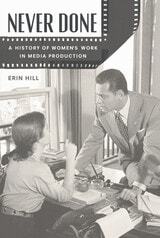
Histories of women in Hollywood usually recount the contributions of female directors, screenwriters, designers, actresses, and other creative personnel whose names loom large in the credits. Yet, from its inception, the American film industry relied on the labor of thousands more women, workers whose vital contributions often went unrecognized. 
 
Never Done introduces generations of women who worked behind the scenes in the film industry—from the employees’ wives who hand-colored the Edison Company’s films frame-by-frame, to the female immigrants who toiled in MGM’s backrooms to produce beautifully beaded and embroidered costumes. Challenging the dismissive characterization of these women as merely menial workers, media historian Erin Hill shows how their labor was essential to the industry and required considerable technical and interpersonal skills. Sketching a history of how Hollywood came to define certain occupations as lower-paid “women’s work,” or “feminized labor,” Hill also reveals how enterprising women eventually gained a foothold in more prestigious divisions like casting and publicity.   
 
 
[more]
cover of Never Say I: Sexuality and the First Person in Colette, Gide, and Proust

Never Say I

Sexuality and the First Person in Colette, Gide, and Proust

Michael Lucey

Duke University Press, 2006

Never Say I reveals the centrality of representations of sexuality, and particularly same-sex sexual relations, to the evolution of literary prose forms in twentieth-century France. Rethinking the social and literary innovation of works by Marcel Proust, André Gide, and Colette, Michael Lucey considers these writers’ production of a first-person voice in which matters related to same-sex sexuality could be spoken of. He shows how their writings and careers took on political and social import in part through the contribution they made to the representation of social groups that were only slowly coming to be publicly recognized. Proust, Gide, and Colette helped create persons and characters, points of view, and narrative practices from which to speak and write about, for, or as people attracted to those of the same sex.

Considering novels along with journalism, theatrical performances, correspondences, and face-to-face encounters, Lucey focuses on the interlocking social and formal dimensions of using the first person. He argues for understanding the first person not just as a grammatical category but also as a collectively produced social artifact, demonstrating that Proust’s, Gide’s, and Colette’s use of the first person involved a social process of assuming the authority to speak about certain issues, or on behalf of certain people. Lucey reveals these three writers as both practitioners and theorists of the first person; he traces how, when they figured themselves or other first persons in certain statements regarding same-sex identity, they self-consciously called attention to the creative effort involved in doing so.

[more]
cover of Never a City So Real: A Walk in Chicago

Never a City So Real

A Walk in Chicago

Alex Kotlowitz

University of Chicago Press, 2019

“Chicago is a tale of two cities,” headlines declare. This narrative has been gaining steam alongside reports of growing economic divisions and diverging outlooks on the future of the city. Yet to keen observers of the Second City, this is nothing new. Those who truly know Chicago know that for decades—even centuries—the city has been defined by duality, possibly since the Great Fire scorched a visible line between the rubble and the saved. For writers like Alex Kotlowitz, the contradictions are what make Chicago. And it is these contradictions that form the heart of Never a City So Real.

The book is a tour of the people of Chicago, those who have been Kotlowitz’s guide into this city’s – and by inference, this country’s – heart.  Chicago, after all, is America’s city. Kotlowitz introduces us to the owner of a West Side soul food restaurant who believes in second chances,  a steelworker turned history teacher, the “Diego Rivera of the projects,” and the lawyers and defendants who populate Chicago’s Criminal Courts Building.  These empathic, intimate stories chronicle the city’s soul, its lifeblood.

This new edition features a new afterword from the author, which examines the state of the city today as seen from the double-paned windows of a pawnshop. Ultimately, Never a City So Real is a love letter to Chicago, a place that Kotlowitz describes as “a place that can tie me up in knots but a place that has been my muse, my friend, my joy.”

[more]
cover of New Cathay: Contemporary Chinese Poetry

New Cathay

Contemporary Chinese Poetry

Edited by Ming Di

Tupelo Press, 2013

The most up-to-date anthology of contemporary Chinese poetry, translated by American poets and edited by the executive editor of the bilingual literary journal Poetry East West. Showcasing the achievement of Chinese poetry in the last twenty years, a time of tremendous literary ferment, this collection focuses on a diversity of exciting poets from the mainland, highlighting Duo Duo (laureate of the 2010 Neustadt International Prize for Literature) and Liao Yiwu (recipient of 2012 Peace Prize of the German Book Trade organization) along with not yet well-known but brilliant poets such as Zang Di and Xiao Kaiyu and younger poets Jiang Tao and Lü Yue. The anthology includes interviews with the poets and a fascinating survey of their opinions on “Ten Favorite Chinese poets” and “Ten Best-Known Western poets in China.” Featured poets: Duo Duo, Wang Xiaoni, Bai Hua, Zhang Shuguang, Sun Wenbo, Wang Jiaxin, Liao Yiwu, Song Lin, Xiao Kaiyu, Lü De’an, Feng Yan, Yang Xiaobin, Zang Di, Ya Shi, Mai Mang, Lan Lan, Jiang Tao, Jiang Hao, Lü Yue, Hu Xudong, Yi Lai, Jiang Li, Zheng Xiaoqiong, Qiu Qixuan, and Li Shumin. With translations by Neil Aitken, Katie Farris, Ming Di, Christopher Lupke, Tony Barnstone, Afaa Weaver, Jonathan Stalling, Nick Admussen, Eleanor Goodman, Ao Wang, Dian Li, Kerry Shawn Keys, Jennifer Kronovet, Elizabeth Reitzell, and Cody Reese.
[more]
cover of New Day Begun: African American Churches and Civic Culture in Post-Civil Rights America

New Day Begun

African American Churches and Civic Culture in Post-Civil Rights America

R. Drew Smith, ed.

Duke University Press, 2003

New Day Begun presents the findings of the first major research project on black churches’ civic involvement since C. Eric Lincoln and Lawrence H. Mamiya’s landmark study The Black Church in the African American Experience. Since the passage of the 1964 Civil Rights Act and the 1965 Voting Rights Act, the scale and scope of African American churches’ civic involvement have changed significantly: the number of African American clergy serving in elective and appointive offices has noticeably increased, as have joint efforts by black churches and government agencies to implement policies and programs. Filling a vacuum in knowledge about these important developments, New Day Begun assesses the social, political, and ecclesiastical factors that have shaped black church responses to American civic and political life since the Civil Rights movement.

This collection of essays analyzes the results of an unprecedented survey of nearly 2,000 African American churches across the country conducted by The Public Influences of African-American Churches Project, which is based at Morehouse College in Atlanta. These essays—by political scientists, theologians, ethicists, and others—draw on the survey findings to analyze the social, historical, and institutional contexts of black church activism and to consider the theological and moral imperatives that have shaped black church approaches to civic life—including black civil religion and womanist and afrocentric critiques. They also look at a host of faith-based initiatives addressing economic development and the provision of social services. New Day Begun presents necessary new interpretations of how black churches have changed—and been changed by—contemporary American political culture.

Contributors.
Lewis Baldwin, Allison Calhoun-Brown, David D. Daniels III, Walter Earl Fluker, C.R.D. Halisi, David Howard-Pitney, Michael Leo Owens, Samuel Roberts, David Ryden, Corwin Smidt, R. Drew Smith
[more]
cover of New Day in Babylon: The Black Power Movement and American Culture, 1965-1975

New Day in Babylon

The Black Power Movement and American Culture, 1965-1975

William L. Van Deburg

University of Chicago Press, 1992

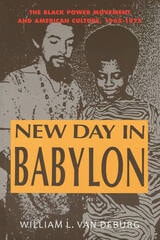
The most comprehensive account available of the rise and fall of the Black Power Movement and of its dramatic transformation of both African-American and larger American culture. With a gift for storytelling and an ear for street talk, William Van Deburg chronicles a decade of deep change, from the armed struggles of the Black Panther party to the cultural nationalism of artists and writers creating a new aesthetic. Van Deburg contends that although its tactical gains were sometimes short-lived, the Black Power movement did succeed in making a revolution—one in culture and consciousness—that has changed the context of race in America.

"New Day in Babylon is an extremely intelligent synthesis, a densely textured evocation of one of American history's most revolutionary transformations in ethnic group consciousness."—Bob Blauner, New York Times

Winner of the Gustavus Myers Center Outstanding Book Award, 1993
[more]
cover of New Deal / New South: An Anthony J. Badger Reader

New Deal / New South

An Anthony J. Badger Reader

Anthony J. Badger

University of Arkansas Press, 2007
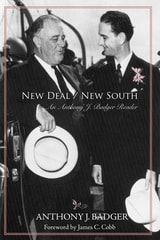
The twelve essays in this book, several published here for the first time, represent some of Tony Badger’s best work in his ongoing examination of how white liberal southern politicians who came to prominence in the New Deal and World War II handled the race issue when it became central to politics in the 1950s and 1960s. Franklin Roosevelt in the 1930s thought a new generation of southerners would wrestle Congress back from the conservatives. The Supreme Court thought that responsible southern leaders would lead their communities to general school desegregation after the Brown decision. John F. Kennedy believed that moderate southern leaders would, with government support, facilitate peaceful racial change. Badger’s writings demonstrate how all of these hopes were misplaced. Badger shows time and time again that moderates did not control southern politics. Southern liberal politicians for the most part were paralyzed by their fear that ordinary southerners were all-too-aroused by the threat of integration and were reluctant to offer a coherent alternative to the conservative strategy of resistance.
[more]
cover of New Deal Archaeology in Tennessee: Intellectual, Methodological, and Theoretical Contributions

New Deal Archaeology in Tennessee

Intellectual, Methodological, and Theoretical Contributions

Edited by David H. Dye

University of Alabama Press, 2016

Exploring how New Deal innovation transformed archaeology in the American South.

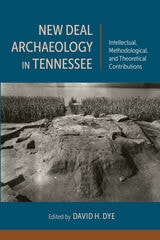
New Deal Archaeology in Tennessee tells the engrossing story of Southeastern archaeology in the 1930s. The Tennessee Valley Authority Act of May 1933 initiated an ambitious program of flood control and power generation by way of a chain of hydroelectric dams on the Tennessee River. The construction of these dams flooded hundreds of thousands of square miles of river bottoms, campsites, villages, and towns that had been homes to Native Americans for centuries. This triggered an urgent need to undertake extensive archaeological fieldwork throughout the region. Those studies continue to influence contemporary archaeology.

The state of Tennessee and the Tennessee Valley were especially well suited research targets thanks to their mild climate and long field seasons. A third benefit in the 1930s was the abundance of labor supplied by Tennesseans unemployed during the Great Depression. Within months of the passage of the Tennessee Valley Authority Act, teams of archaeologists fanned out across the state and region under the farsighted direction of Smithsonian Institution curators Neil M. Judd, Frank H. H. Roberts, and Frank M. Setzler. The early months of 1934 would become the busiest period of archaeological fieldwork in US history.

The twelve insightful essays in New Deal Archaeology in Tennessee document and explore this unique peak in archaeological study. Chapters highlight then-new techniques such as mound “peeling” and stratigraphic excavation adapted from the University of Chicago; the four specific New Deal sites of Watts Bar Reservoir, Mound Bottom, Pack, and Chickamauga Basin; bioarchaeology in the New Deal; and the enduring impact of the New Deal on contemporary fieldwork.

The challenges of the 1930s in recruiting skilled labor, training unskilled ancillary labor, developing and improvising new field methods, and many aspects of archaeological policies, procedures, and best-practices laid much of the foundation of contemporary archaeological practice. New Deal Archaeology in Tennessee offers an invaluable record of that pivotal time for professional, student, and amateur archaeologists.
[more]
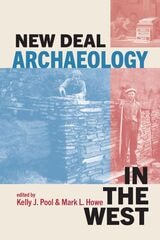
cover of New Deal Archaeology in the West

New Deal Archaeology in the West

Edited by Kelly J. Pool and Mark L. Howe

University of Utah Press, 2023

From 1933 to 1944, a wide range of archaeological and cultural heritage projects were funded across this country as part of Franklin D. Roosevelt’s New Deal. The results of work east of the Mississippi River are amply documented in other publications. However, little has been reported or synthesized regarding western archaeological work, its role in economic recovery, or its impact on the direction and knowledge of the discipline. This volume shares previously untold stories of New Deal archaeology from across the American West and explores insights into the past revealed by these projects.
 
Descriptions of New Deal projects and their contributions to our understanding of the past, as well as the stories of those involved—archaeologists, avocationalists, and others—are woven together across the chapters. Also documented are lost or scattered artifacts, records, and ancestors’ remains; incomplete analyses; unpublished reports; inconsistent application of scientific methodology; and the loss of Native sacred sites and traditional lands and lifeways. Authors highlight characteristics that distinguished the American West from the East during the Depression and affected the nature of New Deal projects, including the extent of federal land available in the West, the reliance of sparsely populated areas upon tourism, the presence of large resident Native populations with deep histories, and the wide-ranging degree of existing archaeology infrastructure in each state. This volume demonstrates that despite regional differences, New Deal-funded archaeological and cultural heritage projects created a legacy of knowledge and practice across the nation.
[more]
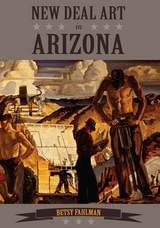
cover of New Deal Art in Arizona

New Deal Art in Arizona

Betsy Fahlman

University of Arizona Press, 2009

Arizona’s art history is emblematic of the story of the modern West, and few periods in that history were more significant than the era of the New Deal. From Dorothea Lange and Ansel Adams to painters and muralists including Native American Gerald Nailor, the artists working in Arizona under New Deal programs were a notable group whose art served a distinctly public purpose. Their photography, paintings, and sculptures remain significant exemplars of federal art patronage and offer telling lessons positioned at the intersection of community history and culture.

Art is a powerful instrument of historical record and cultural construction, and many of the issues captured by the Farm Security Administration photographers remain significant issues today: migratory labor, the economic volatility of the mining industry, tourism, and water usage. Art tells important stories, too, including the work of Japanese American photographer Toyo Miyatake in Arizona’s internment camps, murals by Native American artist Gerald Nailor for the Navajo Nation Council Chamber in Window Rock, and African American themes at Fort Huachuca. Illustrated with 100 black-andwhite photographs and covering a wide range of both media and themes, this fascinating and accessible volume reclaims a richly textured story of Arizona history with potent lessons for today.
[more]
cover of New Deal Modernism: American Literature and the Invention of the Welfare State

New Deal Modernism

American Literature and the Invention of the Welfare State

Michael Szalay

Duke University Press, 2000

In New Deal Modernism Michael Szalay examines the effect that the rise of the welfare state had on American modernism during the 1930s and 1940s, and, conversely, what difference this revised modernism made to the New Deal’s famed invention of “Big Government.”
Szalay situates his study within a liberal culture bent on security, a culture galvanized by its imagined need for private and public insurance.
Taking up prominent exponents of social and economic security—such as Franklin Delano Roosevelt, John Maynard Keynes, and John Dewey—Szalay demonstrates how the New Deal’s revision of free-market culture required rethinking the political function of aesthetics. Focusing in particular on the modernist fascination with the relation between form and audience, Szalay offers innovative accounts of Busby Berkeley, Jack London, James M. Cain, Robert Frost, Ayn Rand, Betty Smith, and Gertrude Stein, as well as extended analyses of the works of Ernest Hemingway, John Steinbeck, and Richard Wright.

[more]
cover of New Deal Photographs of West Virginia, 1934-1943

New Deal Photographs of West Virginia, 1934-1943

Betty Rivard

West Virginia University Press, 2012
Upon entering the White House in 1933, President Franklin D. Roosevelt faced an ailing economy in the throes of the Great Depression and rushed to transform the country through recovery programs and legislative reform. By 1934, he began to send professional photographers to the state of West Virginia to document living conditions and the effects of his New Deal programs. The photographs from the Farm Security Administration Project not only introduced “America to Americans,” exposing a continued need for government intervention, but also captured powerful images of life in rural and small town America.
New Deal Photographs of West Virginia, 1934-1943 presents images of the state’s northern and southern coalfields, the subsistence homestead projects of Arthurdale, Eleanor, and Tygart Valley, and various communities from Charleston to Clarksburg and Parkersburg to Elkins. With over one hundred and fifty images by ten FSA photographers, including Walker Evans, Marion Post Wolcott, Arthur Rothstein, and Ben Shahn, this collection is a remarkable proclamation of hardship, hope, endurance, and, above all, community. These photographs provide a glimpse into the everyday lives of West Virginians during the Great Depression and beyond.
[more]
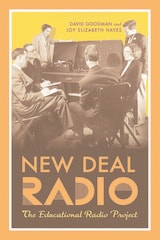
cover of New Deal Radio: The Educational Radio Project

New Deal Radio

The Educational Radio Project

David Goodman

Rutgers University Press, 2022

New Deal Radio examines the federal government's involvement in broadcasting during the New Deal period, looking at the U.S. Office of Education's Educational Radio Project. The fact that the United States never developed a national public broadcaster, has remained a central problem of US broadcasting history. Rather than ponder what might have been, authors Joy Hayes and David Goodman look at what did happen. There was in fact a great deal of government involvement in broadcasting in the US before 1945 at local, state, and federal levels. Among the federal agencies on the air were the Department of Agriculture, the National Park Service, the Works Progress Administration (WPA) and the Federal Theatre Project.

Contextualizing the different series aired by the Educational Radio Project as part of a unified project about radio and citizenship is crucial to understanding them. New Deal Radio argues that this distinctive government commercial partnership amounted to a critical intervention in US broadcasting and an important chapter in the evolution of public radio in America.
 
[more]
cover of New Downtown Now: An Anthology Of New Theater From Downtown New York

New Downtown Now

An Anthology Of New Theater From Downtown New York

Mac Wellman

University of Minnesota Press, 2006

At a time when most serious drama being written and produced for the American stage aspires only to mainstream acceptance and high-toned mediocrity, an innovative new generation of playwrights based in New York City has emerged, crafting works that challenge and undermine the conventional structure, language, and characterization of commercial theater while rejecting outdated notions of the avant-garde. New Downtown Now brings together ten new works that exemplify the playfulness, excitement, and possibilities of the theater. Characterized by fragmenting structure, hypnotic rhythms, kaleido-scopic imagery, unpredictable characters, and lyrical language, these plays resemble puzzles from which the writers are teasing revelations. Though disparate in subject matter and style, with characters ranging from a sushi chef to a soldier and settings from a taxicab to a live television broadcast, these highly original plays share a commitment to formal experimentation that places them beyond the psychological clichés of the majority and the cold condescension of postmodernism. The anthology includes Interim by Barbara Cassidy; Tragedy: a tragedy by Will Eno; Nine Come by Elana Greenfield; Shufu-Sachiko and Enoshima Island by Madelyn Kent; The Appeal by Young Jean Lee; The Vomit Talk of Ghosts by Kevin Oakes; Ajax (por nobody) by Alice Tuan; Apparition, an uneasy play of the underknown by Anne Washburn; Demon Baby by Erin Courtney.Mac Wellman is the author of numerous plays and the recipient of three Obie awards, most recently in 2003 for lifetime achievement. He is professor of playwriting at Brooklyn College. Young Jean Lee is a playwright and director, and member of the Obie award-winning company 13P. Jeffrey M. Jones is a playwright and curator of the Obie award-winning Little Theater at Tonic in New York.
[more]
cover of New Hard-Boiled Writers: 1970s–1990s

New Hard-Boiled Writers

1970s–1990s

LeRoy Lad Panek

University of Wisconsin Press, 2000

Beginning in the 1970s, a new generation of writers took over the hard-boiled story (created by Raymond Chandler and Dashiell Hammett) and transformed it to fit the realities of their world—a universe infected by violence, greed, racism, sexism, war, and commercialism. Their protagonists, too, are far different from Sam Spade and Philip Marlowe.
    The author comments both on the way the hard-boiled story has changed over the past three decades and examines the work of ten significant contemporary hard-boiled writers. Chapters on Robert B. Parker, James Crumley, Loren Estleman, Sara Paretsky, Sue Grafton, Carl Hiaasen, Earl Emerson, Robert Crais, James Lee Burke, and Walter Mosley demonstrate how these writers have used the hard-boiled hero to make powerful statements about life in the last quarter of the twentieth century.

[more]
cover of New Italian Migrations to the United States: Vol. 1: Politics and History since 1945

New Italian Migrations to the United States

Vol. 1: Politics and History since 1945

Edited by Laura E. Ruberto and Joseph Sciorra: Afterword by Donna Gabaccia

University of Illinois Press, 2017

Italian immigration from 1945 to the present is an American phenomenon too little explored in our historical studies. Until now. In this new collection, Laura E. Ruberto and Joseph Sciorra edit essays by an elite roster of scholars in Italian American studies. These interdisciplinary works focus on leading edge topics that range from politics of the McCarren-Walter Act and its effects on women to the ways Italian Americans mobilized against immigration restrictions. Other essays unwrap the inner workings of multi-ethnic power brokers in a Queens community, portray the complex transformation of identity in Boston’s North End, and trace the development of Italian American youth culture and how new arrivals fit into it. Finally, Donna Gabaccia pens an afterword on the importance of this seventy-year period in U.S. migration history.

Contributors: Ottorino Cappelli, Donna Gabaccia, Stefano Luconi, Maddalena Marinari, James S. Pasto, Rodrigo Praino, Laura E. Ruberto, Joseph Sciorra, Donald Tricarico, and Elizabeth Zanoni.
[more]
cover of New Italian Migrations to the United States: Vol. 2: Art and Culture since 1945

New Italian Migrations to the United States

Vol. 2: Art and Culture since 1945

Laura Ruberto, Joseph Sciorra

University of Illinois Press, 2017

This second volume of <i>New Italian Migrations to the United States</i> explores the evolution of art and cultural expressions created by and about Italian immigrants and their descendants since 1945. The essays range from an Italian-language radio program that broadcast intimate messages from family members in Italy to the role of immigrant cookbook writers in crafting a fashionable Italian food culture. Other works look at how exoticized actresses like Sophia Loren and Pier Angeli helped shape a glamorous Italian style out of images of desperate postwar poverty; overlooked forms of brain drain; the connections between countries old and new in the works of Michigan self-taught artist Silvio Barile; and folk revival performer Alessandra Belloni's reinterpretation of tarantella dance and music for Italian American women. In the afterword, Anthony Julian Tamburri discusses the nomenclature ascribed to Italian American creative writers living in Italy and the United States.

Contributors: John Allan Cicala, Simone Cinotto, Teresa Fiore, Incoronata (Nadia) Inserra, Laura E. Ruberto, Joseph Sciorra, and Anthony Julian Tamburri.
[more]
cover of New Jewish Identities

New Jewish Identities

András Kovács

Central European University Press, 2003
A unique collection of essays that deal with the intriguing and complex problems connected to the question of Jewish identity in the contemporary world. Based on a conference held in Budapest, Hungary in July 2001, it analyzes and compares how Jews conceive of their Jewishness. Do they see it in mostly religious, cultural or ethnic terms? What are the policy implications of these views and how have they been evolving? What do they portend for the future of world Jewry? The authors present new data from west European and post-Communist countries (Hungary, Moldova, Poland, Russia, Ukraine) and re-interpret data from other European countries as well as from Israel and the United States, making this a truly comprehensive, comparative and contemporary work.
[more]
cover of New Latina Narrative: The Feminine Space of Postmodern Ethnicity

New Latina Narrative

The Feminine Space of Postmodern Ethnicity

Ellen McCracken

University of Arizona Press, 1999
During the last two decades of the twentieth century, U.S. Latina writers have made a profound impact on American letters with fiction in both mainstream and regional venues. Following on the heels of this vibrant and growing body of work, New Latina Narrative offers the first in-depth synthesis and literary analysis of this transethnic genre. Focusing on the dynamic writing published in the 1980s and 1990s by Mexican American, Puerto Rican, Cuban American, and Domincan American women, New Latina Narrative illustrates how these writers have redefined the concepts of multiculturalism and diversity in American society. As participants in both mainstream and grassroots forms of multiculturalism, these new Latina narrativists have created a feminine space within postmodern ethnicity, disrupting the idealistic veneer of diversity with which publishers often market this fiction. In this groundbreaking study, author Ellen McCracken opens the conventional boundaries of Latino/a literary criticism, incorporating elements of cultural studies theory and contemporary feminism. Emphasizing the diversity within new Latina narrative, McCracken discusses the works of more than two dozen writers, including Julia Alvarez, Denise Chávez, Sandra Cisneros, Cristina Garcia, Graciela Limón, Demetria Martínez, Pat Mora, Cherríe Moraga, Mary Helen Ponce, and Helena María Viramontes. She stresses such themes as the resignification of master narrative, the autobiographical self and collective identity, popular religiosity, subculture and transgression, and narrative harmony and dissonance. New Latina Narrative provides readers an enriched basis for reconceiving the overall Latino/a literary field and its relation to other contemporary literary and cultural trends. McCracken's original approach extends the Latina literary canon—both the works to be studied and the issues to be examined—resulting in a valuable work for all readers of women's studies, contemporary American literature, ethnic studies, communications, and sociology.
[more]
cover of New Media Futures: The Rise of Women in the Digital Arts

New Media Futures

The Rise of Women in the Digital Arts

Edited by Donna J. Cox, Ellen Sandor, and Janine Fron

University of Illinois Press, 2018
Trailblazing women working in digital arts media and education established the Midwest as an international center for the artistic and digital revolution in the 1980s and beyond. Foundational events at the University of Illinois and the School of the Art Institute of Chicago created an authentic, community-driven atmosphere of creative expression, innovation, and interdisciplinary collaboration that crossed gender lines and introduced artistically informed approaches to advanced research. Interweaving historical research with interviews and full-color illustrations, New Media Futures captures the spirit and contributions of twenty-two women working within emergent media as diverse as digital games, virtual reality, medicine, supercomputing visualization, and browser-based art. The editors and contributors give voice as creators integral to the development of these new media and place their works at the forefront of social change and artistic inquiry. What emerges is the dramatic story of how these Midwestern explorations in the digital arts produced a web of fascinating relationships. These fruitful collaborations helped usher in the digital age that propelled social media. Contributors: Carolina Cruz-Niera, Colleen Bushell, Nan Goggin, Mary Rasmussen, Dana Plepys, Maxine Brown, Martyl Langsdorf, Joan Truckenbrod, Barbara Sykes, Abina Manning, Annette Barbier, Margaret Dolinsky, Tiffany Holmes, Claudia Hart, Brenda Laurel, Copper Giloth, Jane Veeder, Sally Rosenthal, Lucy Petrovic, Donna J. Cox, Ellen Sandor, and Janine Fron.
 
[more]
cover of New Negro Artists in Paris: African American Painters and Sculptors in the City of Light, 1922-1934

New Negro Artists in Paris

African American Painters and Sculptors in the City of Light, 1922-1934

Leininger-Miller, Theresa

Rutgers University Press, 2001

The New Negro Artist in Paris analyzes the experiences and works of six African American artists who lived and worked in Paris during the Jazz Age sculptors Elizabeth Prophet and Augusta Savage, and painters Palmer Hayden, Hale Woodruff, Archibald J. Motley, Jr., and Albert Alexander Smith. More than 120 works of art are analyzed, many never before published.

These artists exhibited the works they created in Paris at prestigious salons in France and in the United States, winning fellowships, grants, and awards. Leininger-Miller argues that it was study abroad that won these artists critical acclaim, establishing their reputations as some of the most significant leaders of the New Negro movement in the visual arts. She begins her study with a history of the debut of African American artists in Paris, 1830–1914, then provides readers with rarely seen profiles of each of the six artists from their birth through the end of their time abroad. Finally, Leininger-Miller examines patterns and differences in these individuals’ backgrounds and development, their patronage in the United States and France, their shared experiences abroad, and the impact their study in Paris had on the rest of their careers.

[more]
cover of New Orleans Style and the Writing of American Jazz History

New Orleans Style and the Writing of American Jazz History

Bruce Boyd Raeburn

University of Michigan Press, 2009
New Orleans Style tells the tale of the recognition of New Orleans jazz as a discrete style and how that recognition affected the writing of American jazz history. The men and women who participated in the awakening of American jazz scholarship were partisans of a community of "hot" record collectors, whose interest in the origins of jazz was a foregone conclusion. As an international network of these collectors took shape between the 1920s and 1934, they provided a mechanism for the circulation of historical information on jazz, which then became the basis for the emergence of a jazz literati writing for magazines such as Down Beat, Esquire, the New Republic, and Jazz Information. It was not until later that writers like Charles Edward Smith and William Russell, inspired by their love for the music and emphasizing "New Orleans style," explained in works such as Jazzmen (1939) and The Jazz Record Book (1942) that jazz was "born in New Orleans." Raeburn traces the conceptualization of jazz history derived from Jazzmen to jazz's ultimate refuge in New Orleans and its integration into the cultures which it celebrated. The result is an essential work of jazz criticism that will fill a major gap in the field's literature.
[more]
cover of New People in Old Neighborhoods: The Role of Immigrants in Rejuvenating New York's Communities

New People in Old Neighborhoods

The Role of Immigrants in Rejuvenating New York's Communities

Louis Winnick

Russell Sage Foundation, 1990
The recent wave of immigration into this country has given rise to myriad concerns—from the worries about the impact of immigration on the nation's economy to questions about whether multilingual education should be used in public schools. The resulting debates have overshadowed some very good news: this influx of New Immigrants has resulted in an astonishing rebirth of many of our older, decaying cities. Nowhere has this demographic renewal been more apparent than in New York City, as Louis Winnick demonstrates in New People in Old Neighborhoods, a timely and perceptive study of the effects of immigration in Brooklyn's Sunset Park. Sunset Park was born of the late nineteenth century flood of immigrants who developed a prosperous waterfront commerce; by the end of World War I the community had achieved a thriving maturity. Yet the decades following World War II brought about a period of urban decay lifted only by the post-1965 influx of more than 20,000 immigrants, most notably from Asia and the Caribbean Basin. These New Immigrants not only revived the dying community but enriched it with greater ethnic diversity than it had ever known. Winnick combines data on ethnic change and living patterns with data on employment, housing, school enrollment, and subway ridership to study the revitalization of Sunset Park. He discusses the ethnic composition and characteristics of the new immigrants; trends in self-employment and entrepreneurship ("microcapitalism"); immigrant impact upon retailing, manufacturing, and the lower echelons of the service industries; skill and education levels; and presence in the professions. Winnick also discusses the immigrants' positive effect on faltering New York systems, such as the subways and public schools, and places immigrant renewal within the larger context of overall housing and economic regeneration in New York City. New People in Old Neighborhoods views today's immigrants as the historic heirs to the community builders of the last century, and offers important insights into the often-troubled yet transforming relationship between the nation and its foreign-born population. The future of these immigrants will be a yardstick to measure the quality and performance of our cities and their neighborhoods in the years ahead.
[more]
cover of New Spain, New Literatures

New Spain, New Literatures

Luis Martín-Estudillo

Vanderbilt University Press, 2010

This volume, which includes essays on Catalonia, the Basque country, Galicia, and literature written by African immigrants, focuses on issues of "difference" that are at the center of current debates in Spain and elsewhere--the emergence of minoritized literatures, multilingualism and identity, new relationships between culture and institutions, the negotiation of historical memories, the connections between migrations and the redefinition of nationhood, and the impact of global trends on local symbolic systems.
[more]
cover of New Studies in Philosophy, Politics, Economics, and the History of Ideas

New Studies in Philosophy, Politics, Economics, and the History of Ideas

F. A. Hayek

University of Chicago Press, 1978

Following on F. A. Hayek's previous work Studies in Philosophy, Politics, and Economics (1967), New Studies in Philosophy, Politics, Economics and the History of Ideas collects some of Hayek's most notable essays and lectures dealing with problems of philosophy, politics and economics, with many of the essays falling into more than one of these categories. Expanding upon the previous volume the present work also includes a fourth part collecting a series of Hayek's writings under the heading 'History of Ideas.'

Of the articles contained in this volume the lectures on 'The Errors of Constructivism' (chapter 1) and 'Competition as a Discovery Procedure' (chapter 12) have been published before only in German, while the article on 'Liberalism' (chapter 9) was written in English to be published in an Italian translation in the Enciclopedia del Novicento by the Istituto della Enciclopedia Italiana at Rome.
[more]
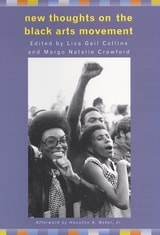
cover of New Thoughts on the Black Arts Movement

New Thoughts on the Black Arts Movement

Edited by Lisa Gail Collins and Margo Natalie Crawford

Rutgers University Press, 2006

During the 1960s and 1970s, a cadre of poets, playwrights, visual artists, musicians, and other visionaries came together to create a renaissance in African American literature and art. This charged chapter in the history of African American culture—which came to be known as the Black Arts Movement—has remained largely neglected by subsequent generations of critics. New Thoughts on the Black Arts Movement includes essays that reexamine well-known figures such as Amiri Baraka, Larry Neal, Gwendolyn Brooks, Sonia Sanchez, Betye Saar, Jeff Donaldson, and Haki Madhubuti. In addition, the anthology expands the scope of the movement by offering essays that explore the racial and sexual politics of the era, links with other period cultural movements, the arts in prison, the role of Black colleges and universities, gender politics and the rise of feminism, color fetishism, photography, music, and more. An invigorating look at a movement that has long begged for reexamination, this collection lucidly interprets the complex debates that surround this tumultuous era and demonstrates that the celebration of this movement need not be separated from its critique.
[more]