Results by title
2916 books match the query 'Politics and government' and 66 start with n
No Middle Ground
How Informal Party Organizations Control Nominations and Polarize LegislaturesSeth E. Masket
University of Michigan Press, 2011
"This is a fascinating book. It is one of the best studies of the ways that parties and politics get conducted in any American state. Masket shows that legislators can be perfectly content without parties that control agendas and does a terrific job of explaining the transition from free-wheeling legislators to rigidly partisan voting blocs."
---Sam Popkin, University of California at San Diego
"No Middle Ground makes a significant contribution to the study of American parties and legislative politics."
---Matthew Green, Catholic University of America
Despite concerns about the debilitating effects of partisanship on democratic government, in recent years political parties have gained strength in state governments as well as in Washington. Whereas political machines of the past manipulated votes, today's machines determine which candidates can credibly compete in a primary.
Focusing on the history and politics of California, Seth E. Masket reveals how these machines evolved and how they stay in power by directing money, endorsements, and expertise to favored candidates, who often tend toward the ideological extreme. Masket argues that politicians are not inherently partisan. Instead, partisanship is thrust upon them by actors outside the government with the power to manipulate primary elections.
Seth E. Masket is Associate Professor of Political Science at the University of Denver.
No One Was Killed
The Democratic National Convention, August 1968John Schultz
University of Chicago Press, 2009
While other writers contemplated the events of the 1968 Chicago riots from the safety of their hotel rooms, John Schultz was in the city streets, being threatened by police, choking on tear gas, and listening to all the rage, fear, and confusion around him. The result, No One Was Killed, is his account of the contradictions and chaos of convention week, the adrenalin, the sense of drama and history, and how the mainstream press was getting it all wrong.
"A more valuable factual record of events than the city’s white paper, the Walker Report, and Theodore B. White’s Making of a President combined."—Book Week
"As a reporter making distinctions between Yippie, hippie, New Leftist, McCarthyite, police, and National Guard, Schultz is perceptive; he excels in describing such diverse personalities as Julian Bond and Eugene McCarthy."—Library Journal
"High on my short list of true, lasting, inspired evocations of those whacked-out days when the country was fighting a phantasmagorical war (with real corpses), and police under orders were beating up demonstrators who looked at them funny."—Todd Gitlin, from the foreword
No Votes for Women
The New York State Anti-Suffrage MovementSusan Goodier
University of Illinois Press, 2013

No. 10
The Geography of Power at Downing StreetJack Brown
Haus Publishing, 2019
Written by Number 10’s first ever ‘Researcher in Residence,’ with unprecedented access to people and papers, No. 10: The Geography of Power at Downing Street sheds new light on unexplored aspects of Prime Ministers’ lives. Jack Brown tells the story of the intimately entwined relationships between the house and its post-war residents, telling how each occupant’s use and modification of the building reveals their own values and approaches to the office of Prime Minister. The book reveals how and why Prime Ministers have stamped their personalities and philosophies upon Number 10 and how the building has directly affected the ability of some Prime Ministers to perform the role. Both fascinating and extremely revealing, No. 10 offers an intimate account of British political power and the building at its core. It is essential reading for anyone interested in the nature and history of British politics.

Nobody Calls Just to Say Hello
Reflections on Twenty-Two Years in the Illinois SenatePhilip J. Rock, with Ed Wojcicki
Southern Illinois University Press, 2011
A native of Chicago's West Side, Rock became one of the most influential politicians in Illinois during the 1970s and 1980s. As a senator in the 1970s and senate president from 1979 to 1993, he sponsored historic legislation to assist abused and neglected children and victims of domestic violence, ushered the state through difficult income tax increases and economic development decisions, shepherded an unruly and fragmented Democratic senate caucus, and always was fair to his Republican counterparts. Covering in great detail a critical period in Illinois political history for the first time, Rock explains how making life better for others drove his decisions in office, while also espousing the seven principles he advocates for effective leadership and providing context for how he applied those principles to the legislative battles of the era.
Unlike many Illinois politicians, Rock, a former seminarian, was known for having a greater interest in issues than in partisan politics. Considered a true statesman, he also was known as a skilled orator who could silence a busy floor of legislators with his commentary on important issues and as a devoted public servant who handled tens of thousands of bills and sponsored nearly five hundred of them himself.
Nobody Calls Just to Say Hello, which takes its title from the volume of calls and visits to elected officials from constituents in need of help, perfectly captures Rock's profound reverence for the institutions of government, his respect for other government offices, and his reputation as a problem solver who, despite his ardent Democratic beliefs, disavowed political self-preservation to cross party lines and make government work for the people. Taking readers through his legislative successes, bipartisan efforts, and political defeats-including a heartbreaking loss in the U.S. Senate primary to Paul Simon in 1984-Rock passionately articulates his belief that government's primary role is to help people, offering an antidote to the current political climate with the simple legislative advice, "Just try to be fair, give everyone a chance, and everything else comes after that."
Nomodeiktes
Greek Studies in Honor of Martin OstwaldRalph M. Rosen and Joseph Farrell, Editors
University of Michigan Press, 1994
Nomodeiktes: Greek Studies in Honor of Martin Ostwald offers fascinating discussions of many of these areas, and it helps illuminate ways in which modern perceptions of this complex period are right and are wrong. Important observations are made on Greek historians and historiography, on politics and society, and on Greek philosophy and literature. The analyses of these major areas of investigation will be very useful for all interested in this centrally important period and for those who know the lure of that vivid and compelling city, Athens.
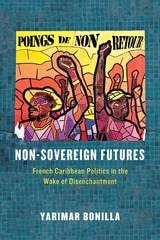
Non-Sovereign Futures
French Caribbean Politics in the Wake of DisenchantmentYarimar Bonilla
University of Chicago Press, 2015
Through a deep ethnography of Guadeloupean labor activism, Bonilla examines how Caribbean political actors navigate the conflicting norms and desires produced by the modernist project of postcolonial sovereignty. Exploring the political and historical imaginaries of activist communities, she examines their attempts to forge new visions for the future by reconfiguring narratives of the past, especially the histories of colonialism and slavery. Drawing from nearly a decade of ethnographic research, she shows that political participation—even in failed movements—has social impacts beyond simple material or economic gains. Ultimately, she uses the cases of Guadeloupe and the Caribbean at large to offer a more sophisticated conception of the possibilities of sovereignty in the postcolonial era.
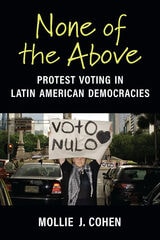
None of the Above
Protest Voting in Latin American DemocraciesMollie J. Cohen
University of Michigan Press, 2024
Winner of the 2025 International Society of Political Psychology David O. Sears Best Book on Mass Politics Award
Around the world each year, millions of citizens turn out to vote but leave their ballots empty or spoil them. Increasingly, campaigns have emerged that promote “invalid” votes like these. Why do citizens choose to cast blank and spoiled votes? And how do campaigns mobilizing the invalid vote influence this decision? None of the Above answers these questions using evidence from presidential and gubernatorial elections in eighteen Latin American democracies. Author Mollie J. Cohen draws on a broad range of methods and sources, incorporating data from electoral management bodies, nationally representative surveys, survey experiments, focus groups, semi-structured interviews, and news sources.
Contrary to received wisdom, this book shows that most citizens cast blank or spoiled votes in presidential elections on purpose. By participating in invalid vote campaigns, citizens can voice their concerns about low-quality candidates while also expressing a preference for high-quality democracy. Campaigns promoting blank and spoiled votes come about more often, and succeed at higher rates, when incumbent politicians undermine the quality of elections. Surprisingly, invalid vote campaigns can shore up the quality of democracy in the short term. None of the Above shows that swings in blank and spoiled vote rates can serve as a warning about the trajectory of a country’s democracy.

Normal Aging I
Reports from the Duke Longitudinal Studies, 1955–1969Erdman Palmore
Duke University Press, 1970
Normalizing Corruption
Failures of Accountability in UkraineErik S. Herron
University of Michigan Press, 2020
Normalizing Corruption addresses several interconnected questions: Under what circumstances do incumbents lose elections? How well do party organizations encourage cohesive behavior? Is executive authority responsive to inquiries from public organizations and other government institutions? How can citizens influence government actions? Do civil servants conduct their duties as impartial professionals, or are they beholden to other interests? The research builds upon extensive fieldwork, data collection, and data analysis that Erik S. Herron has conducted since 1999.
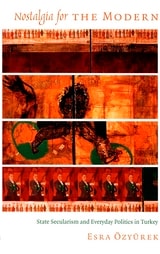
Nostalgia for the Modern
State Secularism and Everyday Politics in TurkeyEsra Özyürek
Duke University Press, 2006
Drawing on her ethnographic research in Istanbul and Ankara during the late 1990s, Özyürek describes how ordinary Turkish citizens demonstrated their affinity for Kemalism in the ways they organized their domestic space, decorated their walls, told their life stories, and interpreted political developments. She examines the recent interest in the private lives of the founding generation of the Republic, reflects on several privately organized museum exhibits about the early Republic, and considers the proliferation in homes and businesses of pictures of Atatürk, the most potent symbol of the secular Turkish state. She also explores the organization of the 1998 celebrations marking the Republic’s seventy-fifth anniversary. Özyürek’s insights into how state ideologies spread through private and personal realms of life have implications for all societies confronting the simultaneous rise of neoliberalism and politicized religion.
Not in Our Lifetimes
The Future of Black PoliticsMichael C. Dawson
University of Chicago Press, 2011
For all the talk about a new postracial America, the fundamental realities of American racism—and the problems facing black political movements—have not changed. Michael C. Dawson lays out a nuanced analysis of the persistence of racial inequality and structural disadvantages, and the ways that whites and blacks continue to see the same problems—the disastrous response to Katrina being a prime example—through completely different, race-inflected lenses. In fact, argues Dawson, the new era heralded by Barack Obama’s election is more racially complicated, as the widening class gap among African Americans and the hot-button issue of immigration have the potential to create new fissures for conservative and race-based exploitation. Through a thoughtful analysis of the rise of the Tea Party and the largely successful “blackening” of President Obama, Dawson ultimately argues that black politics remains weak—and that achieving the dream of racial and economic equality will require the sort of coalition-building and reaching across racial divides that have always marked successful political movements.
Polemical but astute, passionate but pragmatic, Not in Our Lifetimes forces us to rethink easy assumptions about racial progress—and begin the hard work of creating real, lasting change.
Now Peru Is Mine
The Life and Times of a Campesino ActivistManuel Llamojha Mitma and Jaymie Patricia Heilman
Duke University Press, 2016

Nuclear Freeze in a Cold War
The Reagan Administration, Cultural Activism, and the End of the Arms RaceWilliam M. Knoblauch
University of Massachusetts Press, 2017
Alarmed, the Reagan administration worked to co-opt the rhetoric of the nuclear freeze and contain antinuclear activism. Recently declassified White House memoranda reveal a concerted campaign to defeat activists' efforts. In this book, William M. Knoblauch examines these new sources, as well as the influence of notable personalities like Carl Sagan and popular culture such as the film The Day After, to demonstrate how cultural activism ultimately influenced the administration's shift in rhetoric and, in time, its stance on the arms race.

Nut Country
Right-Wing Dallas and the Birth of the Southern StrategyEdward H. Miller
University of Chicago Press, 2015
In Nut Country, Edward H. Miller tells the story of that transformation, showing how a group of influential far-right businessmen, religious leaders, and political operatives developed a potent mix of hardline anticommunism, biblical literalism, and racism to generate a violent populism—and widespread power. Though those figures were seen as extreme in Texas and elsewhere, mainstream Republicans nonetheless found themselves forced to make alliances, or tack to the right on topics like segregation. As racial resentment came to fuel the national Republican party’s divisive but effective “Southern Strategy,” the power of the extreme conservatives rooted in Texas only grew.
Drawing direct lines from Dallas to DC, Miller's captivating history offers a fresh understanding of the rise of the new Republican Party and the apocalyptic language, conspiracy theories, and ideological rigidity that remain potent features of our politics today.
Náyari History, Politics, and Violence
From Flowers to AshPhilip E. Coyle
University of Arizona Press, 2001
By studying the history of religious practices that legitimate such authority, Philip Coyle shows that a contradiction exists between ceremonially based forms of political authority and the bureaucratic and military modes of power that have been deployed by outside governments in their attempts to administer the region. He then shows how the legitimacy of traditional authority is renewed or undermined through the performance of ceremonies.
Coyle explores linkages between long-term political and economic processes and changes in Náyari ceremonial life from Spanish contact to the present day. As a participant-observer of Náyari ceremonies over a ten-year period, he gained an understanding of the history of their ceremonialism and its connections to practically every other aspect of Náyari life. His descriptions of the Holy Week Festival, mitote ceremonies, and other public performances show how struggles over political legitimacy are intimately tied to the meanings of the ceremonies. With its rich ethnographic descriptions, provocative analyses, and clear links between data and theory, Coyle's study marks a major contribution to the ethnography of the Indians of western Mexico and Latin America more generally. It also provides unusual insight into the violence raging across the Mexican countryside and helps us understand the significance of indigenous people in a globalizing world.