Results by title
4155 books match the query 'State & Local' and 117 start with n
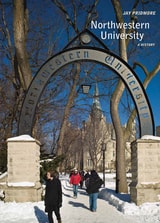
Northwestern University
A HistoryJay Pridmore
Northwestern University Press, 2012
Accompanied by a wealth of color photographs, ephemera, and archival material, Northwestern University: A History brings to the fore the storied traditions and contributions of the administrators, faculty, and alumni who built Northwestern into the world-class institution it is today.
Originally penned to commemorate the university’s sesquicentennial, this new edition charts Northwestern’s evolution in the years of Henry Bienen’s presidency (1995–2009) and offers a new foreword by current president Morton O. Schapiro. Northwestern University: A History captures the rich panoply of the institution’s rise to the first ranks of scholastic excellence and will delight students, their families, and alumni alike.

Northwestern University
Celebrating 150 YearsJay Pridmore
Northwestern University Press, 2000
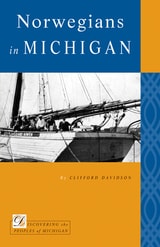
Norwegians in Michigan
Clifford Davidson
Michigan State University Press, 2010
In Norwegians in Michigan, Clifford Davidson shows how Norwegians took advantage of opportunities when they began settling in Michigan in the nineteenth century. Norwegians sailed Lake Michigan, joined the lumber trade, farmed the northwest part of the state, and mined copper and iron in the Upper Peninsula. At the same time, they brought a unique culture that came to be associated with Michigan and the Midwest. The first generations of Norwegians in Michigan maintained close cultural ties with their homeland.
Some Norwegian immigrants adjusted to life in a new land more quickly than others. Among these, according to Davidson, were engineers trained in Norway who developed Michigan's bridges, tunnels, and eventually even the cars that used them.
Illustrated with photographs, maps, and documents, Norwegians in Michigan vividly chronicles a now-familiar pattern of immigrants' cultural understandings prodding and shaping the culture of an emerging region and nation.
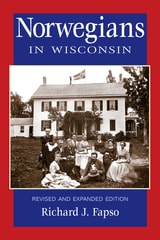
Norwegians in Wisconsin
Richard J. Fapso
Wisconsin Historical Society Press, 2001
This perennially popular book, now revised and expanded with additional historical photos and documents, offers a concise introduction to Wisconsin's Norwegian immigrants. The narrative examines the mass migration of Norwegians from 1837, when Ole Nattestad became the first Norwegian settler in Wisconsin, to the late nineteenth century, when Norwegian immigration largely came to a close. This volume demonstrates the efforts of immigrants to balance newfound American customs with the most treasured traditions of their homeland.
New to this edition are selected letters of Ole Munch Ræder, a scholar sent by the Norwegian government in 1847 to study the American legal system. Ræder visited several Wisconsin cities and villiages and paid special attention to the Norwegian community. His compelling accounts, which appeared in newspapers in Norway, offer a contemporary view of Norwegian life in Wisconsin.
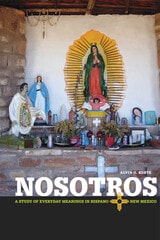
Nosotros
A Study of Everyday Meanings in Hispano New MexicoAlvin O. Korte
Michigan State University Press, 2012
Much knowledge and understanding can be generated from the experiences of everyday life. In this engaging study, Alvin O. Korte examines how this concept applies to Spanish-speaking peoples adapted to a particular locale, specifically the Hispanos and Hispanas of northern New Mexico. Drawing on social philosopher Alfred Schutz’s theory of typification, Korte looks at how meaning and identity are crafted by quotidian activities. Incorporating phenomenological and ethnomethodological strategies, the author investigates several aspects of local Hispano culture, including the oral tradition, leave-taking, death and remembrances of the dead, spirituality, and the circle of life. Although avoiding a social-problems approach, the book devotes necessary attention to mortificación (the death of the self), desmadre (chaos and disorder), and mancornando (cuckoldry). Nosotros is a vivid and insightful exploration with applications in numerous fields.
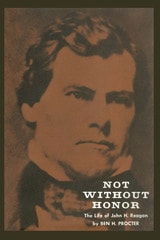
Not Without Honor
The Life of John H. ReaganBy Ben H. Procter
University of Texas Press, 1961
John H. Reagan was one of the most important figures in Texas history; this was the first biography of him to be published. Reagan, who was born in Sevier County, Tennessee, in 1818, came to Texas twenty-one years later—while Texas was still a republic—and stayed to play many major roles in its later economic and political development.
In this excellent biography, Ben H. Procter not only re-creates for us the character of the man, with his forthright integrity and his boundless desire for knowledge, but also places him against the background of the time in which he lived. In vivid language Procter portrays the violence and vigor of pioneer life, the excitement of frontier politics, the dedication, devotion, enthusiasm, and—ultimately—despair of the Civil War, and the bitterness of the struggle with the railroad tycoons and their gargantuan monopolies. Spanning as it does the Republic of Texas, early statehood, the Confederacy, Reconstruction, and the era of the "robber barons," the story of John H. Reagan encompasses a panoramic sweep of mid- to late-nineteenth-century United States history.
Throughout his long life, respect came to Reagan almost as a matter of course. The forceful strength of his personality made an impression few people could ignore. From the day when Colonel Durst hired the young Reagan as a tutor for his children, exclaiming, "This man is a scholar," until the day some fifty years later when Governor Hogg persuaded him to leave the U.S. Senate to become chairman of the new Railroad Commission because the Commission "must be above reproach," his extraordinary character and ability were recognized. In fact, the perceptive intelligence that made him examine all aspects of a situation, and the sturdy integrity and courage that made it impossible for him to abandon a position he believed to be right simply because it was for the moment unpopular, frequently gave him the appearance of a prophet. Although this "prophetic gift" occasionally led to interludes of public disfavor, Reagan was accorded honor, even in his own land—and in later years veneration—that any prophet might envy.
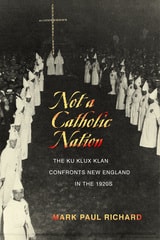
Not a Catholic Nation
The Ku Klux Klan Confronts New England in the 1920sMark Paul Richard
University of Massachusetts Press, 2015
Drawing on a wide range of previously untapped sources—French-language newspapers in the New England–Canadian borderlands; KKK documents scattered in local, university, and Catholic repositories; and previously undiscovered copies of the Maine Klansmen—Richard demonstrates that the Klan was far more active in the Northeast than previously thought. He also challenges the increasingly prevalent view that the Ku Klux Klan became a mass movement during this period largely because it functioned as a social, fraternal, or civic organization for many Protestants. While Richard concedes that some Protestants in New England may have joined the KKK for those reasons, he shows that the politics of ethnicity and labor played a more significant role in the Klan's growth in the region.
The most comprehensive analysis of the Ku Klux Klan's antagonism toward Catholics in the 1920s, this book is also distinctive in its consideration of the history of the Canada–U.S. borderlands, particularly the role of Canadian immigrants as both proponents and victims of the Klan movement in the United States.
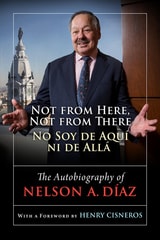
Not from Here, Not from There/No Soy de Aquí ni de Allá
The Autobiography of Nelson DíazNelson A. Díaz
Temple University Press, 2018
Raised in the squalor of a New York tenement until he was 10 years old, Nelson Díaz saw his life change when his family moved to a brand-new high-rise project in West Harlem in the 1950s. That experience, along with lessons learned as the only Latino law student at Temple University, would drive him throughout his life as a lawyer and activist, fighting for the expansion of rights for all Americans.
“No soy de aquí ni de allá” is a mantra for Puerto Ricans who feel like foreigners wherever they are and who seek a place for themselves. In his inspiring autobiography, Not from Here, Not from There, Díaz tells the story of his struggles and triumphs as his perspective widened from the New York streets and law school classrooms to the halls of power in Philadelphia and Washington, DC. Whether as a leader in economic development, a pioneer in court reform, or a champion of fair housing, Díaz has never stopped advocating for others. Díaz was happy to be the first Latino to “do something,” but he never wanted to be the last. This story of an outsider who worked his way to the inside offers powerful lessons on finding a place in the world by creating spaces where everyone is welcome.

Notable Women of Arkansas
From Hattie to Hillary, 100 Names to KnowNancy Hendricks
Butler Center for Arkansas Studies, 2016
Meet one Arkansas woman who was nominated for the Pulitzer Prize, Tony Award, and three Grammys. Learn about a female presidential candidate whose initials are not HRC. See beauty queens on the runway and a runaway beauty queen. Meet the trailblazing black actress who, if she had been born thirty years later, might have had a career like Halle Berry’s.
They are all Arkansas women, each with their own family, childhood, loves, losses, dreams, fears, hopes for the future, and ghosts from the past. These notable women—profiled together in one volume—have left an impressive legacy.
Notes of Travel Through the Territory of Arizona
J. H. Marion; Edited by Donald M. Powell
University of Arizona Press, 1965
“A valuable and well written document, now made available to the general public and enhanced by the addition of an introduction and notes by Mr. Powell. . . . the publication will be of value to serious students of Arizona history.”—Journal of Arizona History
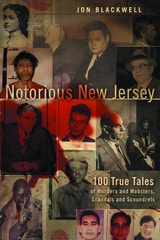
Notorious New Jersey
100 True Tales of Murders and Mobsters, Scandals and ScoundrelsJon Blackwell
Rutgers University Press, 2007
Notorious New Jersey is the definitive guide to murder, mayhem, the mob, and corruption in the Garden State. With tabloid punch, Jon Blackwell tells riveting accounts of Alexander Hamilton falling mortally wounded on the dueling grounds of Weehawken; Dutch Schultz getting pumped full of lead in the men’s room of the Palace Chop House in Newark; and a gang of Islamic terrorists in Jersey City mixing the witch’s brew of explosives that became the first bomb to rock the World Trade Center. Along with these dramatic stories are tales of lesser-known oddities, such as the nineteenth-century murderer whose skin was turned into leather souvenirs, and the state senator from Jersey City who faked his death in a scuba accident in the 1970s in an effort to avoid prison.
Blackwell also sheds light on some historical whodunits—was Bruno Hauptmann really guilty of kidnapping the Lindbergh baby? Who was behind the anthrax attacks of 2001? Not forgotten either are notorious characters who may actually be innocent, including Rubin “Hurricane” Carter, and those who have never been convicted of wrongdoing although they left office in scandal, including Robert Torricelli and James McGreevey.
Through 100 historic true-crime tales that span over 300 years of history, Blackwell shows readers a side of New Jersey that would make even the Sopranos shudder.
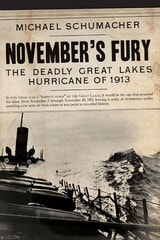
November's Fury
The Deadly Great Lakes Hurricane of 1913Michael Schumacher
University of Minnesota Press, 2014
On Thursday, November 6, the Detroit News forecasted “moderate to brisk” winds for the Great Lakes. On Friday, the Port Huron Times-Herald predicted a “moderately severe” storm. Hourly the warnings became more and more dire. Weather forecasting was in its infancy, however, and radio communication was not much better; by the time it became clear that a freshwater hurricane of epic proportions was developing, the storm was well on its way to becoming the deadliest in Great Lakes maritime history.
The ultimate story of man versus nature, November’s Fury recounts the dramatic events that unfolded over those four days in 1913, as captains eager—or at times forced—to finish the season tried to outrun the massive storm that sank, stranded, or demolished dozens of boats and claimed the lives of more than 250 sailors. This is an account of incredible seamanship under impossible conditions, of inexplicable blunders, heroic rescue efforts, and the sad aftermath of recovering bodies washed ashore and paying tribute to those lost at sea. It is a tragedy made all the more real by the voices of men—now long deceased—who sailed through and survived the storm, and by a remarkable array of photographs documenting the phenomenal damage this not-so-perfect storm wreaked.
The consummate storyteller of Great Lakes lore, Michael Schumacher at long last brings this violent storm to terrifying life, from its first stirrings through its slow-mounting destructive fury to its profound aftereffects, many still felt to this day.
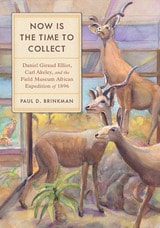
Now Is the Time to Collect
Daniel Giraud Elliot, Carl Akeley, and the Field Museum African Expedition of 1896Paul D. Brinkman
University of Alabama Press, 2024
The rediscovery of a curator’s lost journal illuminates the astonishing African journey that formed the basis of the Chicago Field Museum’s famed collections
“Now” Is the Time to Collect tells the fascinating story of the Chicago Field Museum of Natural History’s zoological expedition to Africa in 1896, the source of many of the museum’s foundational collections and an astounding episode in nineteenth-century science. After the well-publicized extinction of the dodo and Carolina parakeet and the collapse of the American bison population, late nineteenth-century naturalists expected many more vulnerable species to die out with spread of Western-style industrialization. This triggered a race to collect rare species of animals expected soon to be lost forever.
Established in 1893, Chicago’s ambitious Field Museum aimed to become a global center of study. Zoologist Daniel Giraud Elliot persuaded museum patrons to fund an immediate expedition to British Somaliland (contemporary Somalia). There, his team hunted and killed hundreds of animals for the growing collection. On the trip was groundbreaking taxonomist Carl Akeley. Back in Chicago, Akeley created captivating lifelike dioramas of rare animal groups that enhanced the museum’s fame and remain popular to this day.
Enriched with illuminated passages from Elliot’s journal, only recently rediscovered, “Now” Is the Time to Collect is the first book of its kind by an American museum and a case study in what author Paul D. Brinkman calls “salvage zoology”—the practice of aggressively collecting rare animal specimens for preservation just prior to the birth of the modern conservation movement. It is a riveting account of the expedition, the travelers’ experiences in Somalia during its colonial period, and the astonishing origins of one of Chicago’s classic museum experiences.
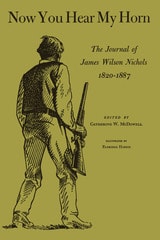
Now You Hear My Horn
The Journal of James Wilson Nichols, 1820–1887Edited by Catherine W. McDowell
University of Texas Press, 1967
Jim Nichols was a lively, vigorous frontiersman who came to Texas about the time of its Revolution. As with many men of that day, Nichols' formal education was lacking, but he was a born writer with a vivid way of saying things. He had an abundance of exciting events to write about: fighting against Mexicans and Indians, Ranger activities, an attack by wolves, a buffalo stampede, and many other colorful episodes. Nichols' account is fast-moving, fascinating frontier history by a man who was really there.
Nowville
The Untold History of Nashville's Contemporary Art SceneJoe Nolan
Vanderbilt University Press, 2024
This is the origin story of Nashville’s surging contemporary art scene told by the ones who were there before anyone else. Not a story about commercial spaces or official institutions—this is the story of moldy warehouse studios and improvised galleries, happy-kegger after-parties and front lawn art sales, exhibitions in apartment living rooms and secret art displays hidden in plain sight.
Nowville is an oral history of the Nashville art scene beginning in the 1990s. Author Joe Nolan tracks down the city’s art punks, art monks, radical art students, and visionary pioneers to share what made their moments in Nashville so special. He also offers insights into how this homespun movement powered by DIY innovating came to be a thriving creative community and a cornerstone of the city’s contemporary allure.
This book is the recipient of the 2025 Norman L. and Roselea J. Goldberg Prize from Vanderbilt University Press for the best book in the area of art or medicine.
Nuclear Nuevo México
Colonialism and the Effects of the Nuclear Industrial Complex on NuevomexicanosMyrriah Gómez
University of Arizona Press, 2022
Contrary to previous works that suppress Nuevomexicana/o presence throughout U.S. nuclear history, Nuclear Nuevo México focuses on recovering the voices and stories that have been lost or ignored in the telling of this history. By recuperating these narratives, Myrriah Gómez tells a new story of New Mexico, one in which the nuclear history is not separate from the collective colonial history of Nuevo México but instead demonstrates how earlier eras of settler colonialism laid the foundation for nuclear colonialism in New Mexico.
Gómez examines the experiences of Nuevomexicanas/os who have been impacted by the nuclear industrial complex, both the weapons industry and the commercial industry. Gómez argues that Los Alamos was created as a racist project that targeted poor and working-class Nuevomexicana/o farming families, along with their Pueblo neighbors, to create a nuclear empire. The resulting imperialism has left a legacy of disease and distress throughout New Mexico that continues today.

Nut Country
Right-Wing Dallas and the Birth of the Southern StrategyEdward H. Miller
University of Chicago Press, 2015
In Nut Country, Edward H. Miller tells the story of that transformation, showing how a group of influential far-right businessmen, religious leaders, and political operatives developed a potent mix of hardline anticommunism, biblical literalism, and racism to generate a violent populism—and widespread power. Though those figures were seen as extreme in Texas and elsewhere, mainstream Republicans nonetheless found themselves forced to make alliances, or tack to the right on topics like segregation. As racial resentment came to fuel the national Republican party’s divisive but effective “Southern Strategy,” the power of the extreme conservatives rooted in Texas only grew.
Drawing direct lines from Dallas to DC, Miller's captivating history offers a fresh understanding of the rise of the new Republican Party and the apocalyptic language, conspiracy theories, and ideological rigidity that remain potent features of our politics today.