Results by title
8642 books match the query '20th century' and 219 start with n
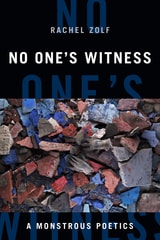
No One's Witness
A Monstrous PoeticsSyd Zolf
Duke University Press, 2021

No Peace, No War
An Anthropology of Contemporary Armed ConflictsPaul Richards
Ohio University Press, 2004
A rash of small wars erupted after the Cold War ended in Africa, the Balkans, and other parts of the former communist world. The wars were in “inter-zones,” the spaces left where weak states had withdrawn or collapsed. Consequently the debate over what constitutes war has returned to basics. No Peace, No War departs from the usual analysis that considers the new wars mindless mass actions to offer the paradoxical idea that to understand war one must deny war special status. Rather than leave war to the security specialists, these writers attempt to grasp its character as one among many aspects of social reality.
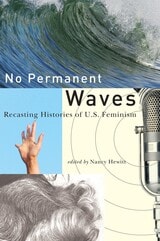
No Permanent Waves
Recasting Histories of U.S. FeminismHewitt, Nancy A
Rutgers University Press, 2010
A respected group of contributors from diverse generations and backgrounds argue for new chronologies, more inclusive conceptualizations of feminist agendas and participants, and fuller engagements with contestations around particular issues and practices. Race, class, and sexuality are explored within histories of women's rights and feminism as well as the cultural and intellectual currents and social and political priorities that marked movements for women's advancement and liberation. These essays question whether the concept of waves surging and receding can fully capture the complexities of U.S. feminisms and suggest models for reimagining these histories from radio waves to hip-hop.
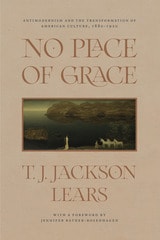
No Place of Grace
Antimodernism and the Transformation of American Culture, 1880-1920T. J. Jackson Lears
University of Chicago Press, 2021
First published in 1981, T. J. Jackson Lears’s No Place of Grace is a landmark book in American studies and American history, acclaimed for both its rigorous research and the deft fluidity of its prose. A study of responses to the emergent culture of corporate capitalism at the turn of the twentieth century, No Place of Grace charts the development of contemporary consumer society through the embrace of antimodernism—the effort among middle- and upper-class Americans to recapture feelings of authentic experience. Rather than offer true resistance to the increasingly corporatized bureaucracy of the time, however, antimodernism helped accommodate Americans to the new order—it was therapeutic rather than oppositional, a striking forerunner to today’s self-help culture. And yet antimodernism contributed a new dynamic as well, “an eloquent edge of protest,” as Lears puts it, which is evident even today in anticonsumerism, sustainable living, and other practices. This new edition, with a lively and discerning foreword by Jennifer Ratner-Rosenhagen, celebrates the fortieth anniversary of this singular work of history.
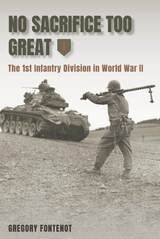
No Sacrifice Too Great
The 1st Infantry Division in World War IIGregory Fontenot
University of Missouri Press, 2027
The U.S. 1st Infantry Division (1st ID), familiarly known as the Big Red One, adapted to dynamic battlefield conditions throughout the course of its deployment during World War II by innovating and altering behavior, including tactics, techniques, and procedures. Both the Division’s leaders and soldiers accomplished this by thinking critically about their experiences in combat and wasting little time in putting lessons learned to good use. Simply put, they learned on the job—in battle and after battle—and did so quickly.
In telling the Division’s WWII story, which includes an extensive photographic essay featuring many previously unpublished images, Gregory Fontenot includes the stories of individual members of the Big Red One, from high-ranking officers to enlisted men fresh off the streets of Brooklyn, both during and after the conflict. Colonel Fontenot’s rare ability to combine expert analysis with compelling narrative history makes No Sacrifice Too Great an absorbing read for anyone interested in the military history of the United States.

No Storm, Just Weather
Judith Kuckart
Seagull Books, 2023
Sunday evening, Tegel Airport, Berlin: A woman strikes up a conversation with a man, Robert Sturm, who is thirty-six years old and eighteen years her junior. He is on his way to Siberia and will return the following Saturday. She cannot wait . . .
In 1981 she came to West Berlin as an eighteen-year-old to study medicine and met Viktor, who was twice her age. Though he opened the world up to her, he remained closed himself. At the turn of the millennium and thirty-six, she meets Johann. He is thirty-six too. They try to make a life together, but their jobs aren’t the only things that are precarious. Saturday morning, Tegel Airport again: For six days, her everyday life and her memories have become entwined. Why are the men in her life always thirty-six? Is she still the person she remembers? Or, being someone who knows their way around the mind, is she in fact what she has forgotten?
No Votes for Women
The New York State Anti-Suffrage MovementSusan Goodier
University of Illinois Press, 2013
No Walls of Stone
An Anthology of Literature by Deaf and Hard of Hearing WritersJill Jepson
Gallaudet University Press, 1992

No. 10
The Geography of Power at Downing StreetJack Brown
Haus Publishing, 2019
Written by Number 10’s first ever ‘Researcher in Residence,’ with unprecedented access to people and papers, No. 10: The Geography of Power at Downing Street sheds new light on unexplored aspects of Prime Ministers’ lives. Jack Brown tells the story of the intimately entwined relationships between the house and its post-war residents, telling how each occupant’s use and modification of the building reveals their own values and approaches to the office of Prime Minister. The book reveals how and why Prime Ministers have stamped their personalities and philosophies upon Number 10 and how the building has directly affected the ability of some Prime Ministers to perform the role. Both fascinating and extremely revealing, No. 10 offers an intimate account of British political power and the building at its core. It is essential reading for anyone interested in the nature and history of British politics.

No.9
The 1968 Farmington Mine DisasterBonnie E. Stewart
West Virginia University Press, 2011
Ninety-nine men entered the cold, dark tunnels of the Consolidation Coal Company’s No.9 Mine in Farmington, West Virginia, on November 20, 1968. Some were worried about the condition of the mine. It had too much coal dust, too much methane gas. They knew that either one could cause an explosion. What they did not know was that someone had intentionally disabled a safety alarm on one of the mine’s ventilation fans. That was a death sentence for most of the crew. The fan failed that morning, but the alarm did not sound. The lack of fresh air allowed methane gas to build up in the tunnels. A few moments before 5:30 a.m., the No.9 blew up. Some men died where they stood. Others lived but suffocated in the toxic fumes that filled the mine. Only 21 men escaped from the mountain.
Nobody Grew but the Business
On the Life and Work of William GaddisJoseph Tabbi
Northwestern University Press, 2015
Finalist, 2016 Society for Midland Authors Award for Biography & Memoir
During his lifetime, William Gaddis (1922–1998) evaded biographical questions, never read from his work publicly, and didn’t allow his photograph to appear on his books. Before his novel J R (1975) won Gaddis the National Book Award and some measure of renown, he had given up the bohemian world of 1950s Greenwich Village for a series of corporate jobs that both paid the bills and provided an inside view of the encroachment of market values into every corner of American culture.
By illustrating the interconnectedness of Gaddis’s life and work, Tabbi, among his foremost interpreters, demystifies the “difficult author” and shows a writer who was as attuned as any to the way Americans talk, and who sensitively chronicled the gradual commodification of artistic endeavor. Illuminating, heartbreaking, and masterful, Tabbi’s book gives us the most subtly drawn portrait to date of one of the twentieth century’s seminal novelists.
Nobody's Boy and His Pals
The Story of Jack Robbins and the Boys’ Brotherhood RepublicHendrik Hartog
University of Chicago Press, 2024
In 1914, social reformer Jack Robbins and a group of adolescent boys in Chicago founded the Boys’ Brotherhood Republic, an unconventional and unusual institution. During a moral panic about delinquent boys, Robbins did not seek to rehabilitate and/or punish wayward youths. Instead, the boys governed themselves, democratically and with compassion for one another, and lived by their mantra “So long as there are boys in trouble, we too are in trouble.” For nearly thirty years, Robbins was their “supervisor,” and the will he drafted in the late 1950s suggests that he continued to care about forgotten boys, even as the political and legal contexts that shaped children’s lives changed dramatically.
Nobody’s Boy and His Pals is a lively investigation that challenges our ideas about the history of American childhood and the law. Scouring the archives for traces of the elusive Jack Robbins, Hendrik Hartog examines the legal histories of Progressive reform, childhood, criminality, repression, and free speech. The curiosity of Robbins’s story is compounded by the legal challenges to his will, which wound up establishing the extent to which last wishes must conform to dominant social values. Filled with persistent mysteries and surprising connections, Nobody’s Boy and His Pals illuminates themes of childhood and adolescence, race and ethnicity, sexuality, wealth and poverty, and civil liberties, across the American Century.
Nobody's Nation
Reading Derek WalcottPaul Breslin
University of Chicago Press, 2001
According to Breslin, Walcott's work is centrally concerned with the West Indies' imputed absence from history and lack of cohesive national identity or cultural tradition. Walcott sees this lack not as impoverishment but as an open space for creation. In his poems and plays, West Indian history becomes a realm of necessity, something to be confronted, contested, and remade through literature. What is most vexed and inspired in Walcott's work can be traced to this quixotic struggle.
Linking extensive archival research and new interviews with Walcott himself to detailed critical readings of major works, Nobody's Nation will take its place as the definitive study of the poet.
Nobody's Son
Notes from an American LifeLuis Alberto Urrea
University of Arizona Press, 1998
. . . I'm not saying it's our story. I'm not saying it isn't. It might be yours. "How do you tell a story that cannot be told?" writes Luis Alberto Urrea in this potent memoir of a childhood divided. Born in Tijuana to a Mexican father and an Anglo mother from Staten Island, Urrea moved to San Diego when he was three. His childhood was a mix of opposites, a clash of cultures and languages. In prose that seethes with energy and crackles with dark humor, Urrea tells a story that is both troubling and wildly entertaining. Urrea endured violence and fear in the black and Mexican barrio of his youth. But the true battlefield was inside his home, where his parents waged daily war over their son's ethnicity. "You are not a Mexican!" his mother once screamed at him. "Why can't you be called Louis instead of Luis?" He suffers disease and abuse and he learns brutal lessons about machismo. But there are gentler moments as well: a simple interlude with his father, sitting on the back of a bakery truck; witnessing the ultimate gesture of tenderness between the godparents who taught him the magical power of love. "I am nobody's son. I am everybody's brother," writes Urrea. His story is unique, but it is not unlike thousands of other stories being played out across the United States, stories of other Americans who have waged war—both in the political arena and in their own homes—to claim their own personal and cultural identity. It is a story of what it means to belong to a nation that is sometimes painfully multicultural, where even the language both separates and unites us. Brutally honest and deeply moving, Nobody's Son is a testament to the borders that divide us all.
Noel Coward
A BiographyPhilip Hoare
University of Chicago Press, 1998
"Philip Hoare's careful research and lucid presentation in his Noël Coward: A Biography adds depth to the picture."-New York Times Book Review
"A fascinating, in-depth biography."—Library Journal
"Hoare has profiled vividly and in-depth a complex legend who had a talent for creating and recreating both himself and his works."—Publishers Weekly
"In the thicket of books about the life and work of Coward, Philip Hoare's stands out as the most well-documented and objective."—Los Angeles Times
"[Hoare's] book, like its subject, strives for effortless sophistication, and succeeds."—Newsday
"Hoare's retelling of Coward's story [is] the most vivid, insightful, and fascinating so far."—John Lahr, The New Yorker

Non-Design
Architecture, Liberalism, and the MarketAnthony Fontenot
University of Chicago Press, 2021
Nonprofit Neighborhoods
An Urban History of Inequality and the American StateClaire Dunning
University of Chicago Press, 2022
Nonprofits serving a range of municipal and cultural needs are now so ubiquitous in US cities, it can be difficult to envision a time when they were more limited in number, size, and influence. Turning back the clock, however, uncovers both an illuminating story of how the nonprofit sector became such a dominant force in American society, as well as a troubling one of why this growth occurred alongside persistent poverty and widening inequality. Claire Dunning’s book connects these two stories in histories of race, democracy, and capitalism, revealing how the federal government funded and deputized nonprofits to help individuals in need, and in so doing avoided addressing the structural inequities that necessitated such action in the first place.
Nonprofit Neighborhoods begins after World War II, when suburbanization, segregation, and deindustrialization inaugurated an era of urban policymaking that applied private solutions to public problems. Dunning introduces readers to the activists, corporate executives, and politicians who advocated addressing poverty and racial exclusion through local organizations, while also raising provocative questions about the politics and possibilities of social change. The lessons of Nonprofit Neighborhoods exceed the bounds of Boston, where the story unfolds, providing a timely history of the shift from urban crisis to urban renaissance for anyone concerned about American inequality—past, present, or future.
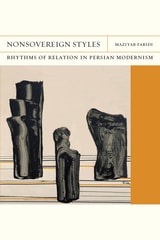
Nonsovereign Styles
Rhythms of Relation in Persian ModernismMaziyar Faridi
Northwestern University Press, 2027
Exploring motifs in modern Persian literature and Iranian film that demand new forms of relationality from politics
Assembling an understudied corpus of literary and filmic texts at the intersection of Persian and global modernism, Maziyar Faridi traces a constellation of aesthetic motifs that resist colonially imported constructs of political relationality in order to argue for an intermedial poetics of nonsovereignty. Moving from the poetry of Nima Yushij and Ahmad Shamlou to the ciné-poems of Férydoun Rahnéma and Forugh Farrokhzad, Nonsovereign Styles charts the transformation of poetic language through its exposure to minor ethnic languages and the rhetorics of English, French, and Spanish modernist poetry and alternative film. Faridi centers two key motifs: ezterāb, a trembling rhythm in which the self encounters itself as difference, and mehr, an aporetic mode of relation beyond identity, community, and sovereignty. Against the state’s project of ethnonationalism, these motifs form a poetics that is both transhistorical and transnational, producing a translational link between Iranian and internationalist poets, such as Langston Hughes and Paul Éluard. By situating Persian modernism within the broader map of global modernism, this book invites us to consider what reading these texts can teach us today about styles of relating to the world and the very sense of the political.
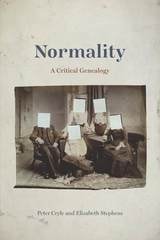
Normality
A Critical GenealogyPeter Cryle and Elizabeth Stephens
University of Chicago Press, 2017
In Normality, Peter Cryle and Elizabeth Stephens offer an intellectual and cultural history of what it means to be normal. They explore the history of how communities settle on any one definition of the norm, along the way analyzing a fascinating series of case studies in fields as remote as anatomy, statistics, criminal anthropology, sociology, and eugenics. Cryle and Stephens argue that since the idea of normality is so central to contemporary disability, gender, race, and sexuality studies, scholars in these fields must first have a better understanding of the context for normality. This pioneering book moves beyond binaries to explore for the first time what it does—and doesn’t—mean to be normal.
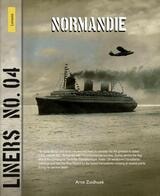
Normandie
Arne Zuidhoek
Amsterdam University Press, 2024

Northern Ireland After the Good Friday Agreement
Victims, Grievance and BlameMarie Smyth and Mike Morrissey
Pluto Press, 2002
The result of extensive research among local communities, and drawing on survey and interview evidence, Northern Ireland After the Good Friday Agreement sets this issue within the context of past conflict and the continuing sectarian violence of the present. In particular it presents the views of ordinary people about their personal experiences of political violence and the impact it has had upon their lives.
Moreover, it shows how the Troubles have affected the young people of the region, and looks at the problems facing a society coming out of a protracted period of low-intensity conflict.
Northern Ireland's Troubles
The Human CostsMarie-Therese Fay
Pluto Press, 1999

Northern Lights
Drago Jancar
Northwestern University Press, 2001
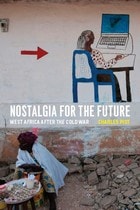
Nostalgia for the Future
West Africa after the Cold WarCharles Piot
University of Chicago Press, 2010
Since the end of the cold war, Africa has seen a dramatic rise in new political and religious phenomena, including an eviscerated privatized state, neoliberal NGOs, Pentecostalism, a resurgence in accusations of witchcraft, a culture of scamming and fraud, and, in some countries, a nearly universal wish to emigrate. Drawing on fieldwork in Togo, Charles Piot suggests that a new biopolitics after state sovereignty is remaking the face of one of the world’s poorest regions.
In a country where playing the U.S. Department of State’s green card lottery is a national pastime and the preponderance of cybercafés and Western Union branches signals a widespread desire to connect to the rest of the world, Nostalgia for the Future makes clear that the cultural and political terrain that underlies postcolonial theory has shifted. In order to map out this new terrain, Piot enters into critical dialogue with a host of important theorists, including Agamben, Hardt and Negri, Deleuze, and Mbembe. The result is a deft interweaving of rich observations of Togolese life with profound insights into the new, globalized world in which that life takes place.
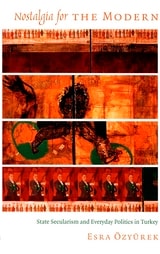
Nostalgia for the Modern
State Secularism and Everyday Politics in TurkeyEsra Özyürek
Duke University Press, 2006
Drawing on her ethnographic research in Istanbul and Ankara during the late 1990s, Özyürek describes how ordinary Turkish citizens demonstrated their affinity for Kemalism in the ways they organized their domestic space, decorated their walls, told their life stories, and interpreted political developments. She examines the recent interest in the private lives of the founding generation of the Republic, reflects on several privately organized museum exhibits about the early Republic, and considers the proliferation in homes and businesses of pictures of Atatürk, the most potent symbol of the secular Turkish state. She also explores the organization of the 1998 celebrations marking the Republic’s seventy-fifth anniversary. Özyürek’s insights into how state ideologies spread through private and personal realms of life have implications for all societies confronting the simultaneous rise of neoliberalism and politicized religion.
Not Alone
LGB Teachers Organizations from 1970 to 1985Jason Mayernick
Rutgers University Press, 2024
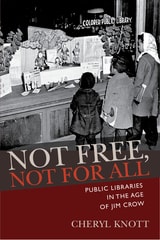
Not Free, Not for All
Public Libraries in the Age of Jim CrowCheryl Knott
University of Massachusetts Press, 2015
Winner of the 2016 Eliza Atkins Gleason Book Award and the 2016 Lillian Smith Book Award
Americans tend to imagine their public libraries as time-honored advocates of equitable access to information for all. Through much of the twentieth century, however, many black Americans were denied access to public libraries or allowed admittance only to separate and smaller buildings and collections. While scholars have examined and continue to uncover the history of school segregation, there has been much less research published on the segregation of public libraries in the Jim Crow South. In fact, much of the writing on public library history has failed to note these racial exclusions.
In Not Free, Not for All, Cheryl Knott traces the establishment, growth, and eventual demise of separate public libraries for African Americans in the South, disrupting the popular image of the American public library as historically welcoming readers from all walks of life. Using institutional records, contemporaneous newspaper and magazine articles, and other primary sources together with scholarly work in the fields of print culture and civil rights history, Knott reconstructs a complex story involving both animosity and cooperation among whites and blacks who valued what libraries had to offer. African American library advocates, staff, and users emerge as the creators of their own separate collections and services with both symbolic and material importance, even as they worked toward dismantling those very institutions during the era of desegregation.

Not June Cleaver
Women and Gender in Postwar America, 1945-1960June Meyerowitz
Temple University Press, 1994

Not Just Roommates
Cohabitation after the Sexual RevolutionElizabeth H. Pleck
University of Chicago Press, 2012
The late twentieth century has seen a fantastic expansion of personal, sexual, and domestic liberties in the United States. In Not Just Roommates, Elizabeth H. Pleck explores the rise of cohabitation, and the changing social norms that have allowed cohabitation to become the chosen lifestyle of more than fifteen million Americans.
Despite this growing social acceptance, Pleck contends that when it comes to the law, cohabitors have been, and continue to be, treated as second-class citizens, subjected to discriminatory laws, limited privacy, a lack of political representation, and little hope for change. Because cohabitation is not a sexual identity, Pleck argues, cohabitors face the legal discrimination of a population with no group identity, no civil rights movement, no legal defense organizations, and, often, no consciousness of being discriminated against. Through in-depth research in written sources and interviews, Pleck shines a light on the emergence of cohabitation in American culture, its complex history, and its unpleasant realities in the present day.
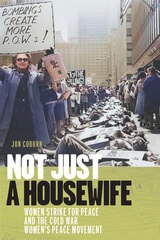
Not Just a Housewife
Women Strike for Peace and the Cold War Women's Peace MovementJon Coburn
University of Massachusetts Press, 2025
On November 1, 1961, thousands of middle-class white women took to the streets throughout the United States to demonstrate against atomic weapons. They were brought together by the group Women Strike for Peace (WSP), which grew from modest beginnings at a Georgetown cocktail party to become one of the most effective peace organizations in American history. Under the stewardship of children’s book illustrator Dagmar Wilson, and with indispensable support from figures such as Bella Abzug, a lawyer who would later help found the National Women’s Political Caucus and serve as US Representative for New York, WSP branches spread to cities and towns across the country, and the group influenced major arms-control treaties and successful antiwar efforts of the Cold War period. Single-handedly, WSP dismantled the McCarthyite House Un-American Activities Committee (HUAC), catalysed public support for the 1963 Nuclear Weapons Test Ban Treaty, and brokered unprecedented exchanges between American and Vietnamese women during the American War in Vietnam. WSP accomplished their political wins , in part, through a public image that stressed the inherent moral authority and sanctity of motherhood.
In Not Just a Housewife, Jon Coburn explores the fascinating story of WSP to argue that the group’s historic significance was much more complex than the maternal activism for which it is often remembered. He traces activists’ evolution through the Cold War’s cultural upheavals, uncovering the significance of forgotten episodes, such as the extraordinary self-immolation of 82-year-old Detroit activist Alice Herz and WSP’s unheralded contributions to the 1977 National Women’s Conference. In so doing, Coburn recovers WSP’s revolutionary politics and militant protests and contends that the organization fused this radical activism with the seeming respectability of motherhood. Through unprecedented access to organizational archives and oral histories, Not Just a Housewife details how WSP’s unique fusion of radicalism and respectability significantly shaped Cold War-era women’s peace movement history, as well as the broader American culture.
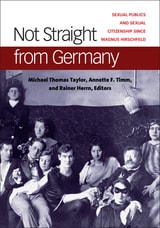
Not Straight from Germany
Sexual Publics and Sexual Citizenship since Magnus HirschfeldMichael Thomas Taylor, Annette F. Timm, and Rainer Herrn, Editors
University of Michigan Press, 2017
Two visual sourcebooks and catalog essays on an exhibition of contemporary artists’ responses to the Hirschfeld historical materials interrogate the modes of visual representation that Hirschfeld employed by re-imagining the public visibility of his institute from a contemporary perspective. The archival material includes stunning, never-before-published images from Hirschfeld’s institute that challenge many received ideas, while the scholarly and art catalog essays explore collaboration and dialogue as methods of research and activism that resonate beyond the academy to pressing issues of public concern.
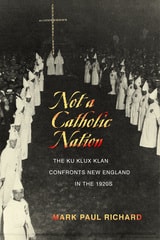
Not a Catholic Nation
The Ku Klux Klan Confronts New England in the 1920sMark Paul Richard
University of Massachusetts Press, 2015
Drawing on a wide range of previously untapped sources—French-language newspapers in the New England–Canadian borderlands; KKK documents scattered in local, university, and Catholic repositories; and previously undiscovered copies of the Maine Klansmen—Richard demonstrates that the Klan was far more active in the Northeast than previously thought. He also challenges the increasingly prevalent view that the Ku Klux Klan became a mass movement during this period largely because it functioned as a social, fraternal, or civic organization for many Protestants. While Richard concedes that some Protestants in New England may have joined the KKK for those reasons, he shows that the politics of ethnicity and labor played a more significant role in the Klan's growth in the region.
The most comprehensive analysis of the Ku Klux Klan's antagonism toward Catholics in the 1920s, this book is also distinctive in its consideration of the history of the Canada–U.S. borderlands, particularly the role of Canadian immigrants as both proponents and victims of the Klan movement in the United States.

Not at All What One Is Used To
The Life and Times of Isabella GardnerMarian Janssen
University of Missouri Press, 2026
Born in 1915 to one of New England’s elite wealthy families, Isabella Gardner was expected to follow a certain path in life—one that would take her from marriageable debutante to proper society lady. But that plan was derailed when at age eighteen, Isabella caused a drunk-driving accident. Her family, to shield her from disgrace, sent her to Europe for acting studies, not foreseeing how life abroad would fan the romantic longings and artistic impulses that would define the rest of Isabella’s years. In Not at All What One Is Used To, author Marian Janssen tells the story of this passionate, troubled woman, whose career as a poet was in constant compromise with her wayward love life and her impulsive and reckless character.
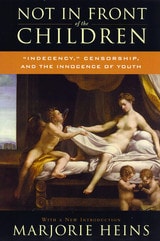
Not in Front of the Children
'Indecency,' Censorship, and the Innocence of YouthHeins, Marjorie
Rutgers University Press, 2007
From Huckleberry Finn to Harry Potter, from Internet filters to the v-chip, censorship exercised on behalf of children and adolescents is often based on the assumption that they must be protected from “indecent” information that might harm their development—whether in art, in literature, or on a Web site. But where does this assumption come from, and is it true?
In Not in Front of the Children, Marjorie Heins explores the fascinating history of “indecency” laws and other restrictions aimed at protecting youth. From Plato’s argument for rigid censorship, through Victorian laws aimed at repressing libidinous thoughts, to contemporary battles over sex education in public schools and violence in the media, Heins guides us through what became, and remains, an ideological minefield. With fascinating examples drawn from around the globe, she suggests that the “harm to minors” argument rests on shaky foundations.

Not the Camilla We Knew
One Woman's Path from Small-town America to the Symbionese Liberation ArmyRachael Hanel
University of Minnesota Press, 2022
The mystery of how an ordinary Minnesota girl came to be, briefly, one of the most wanted domestic terrorists in the United States
Behind every act of domestic terrorism there is someone’s child, an average American whose life took a radical turn for reasons that often remain mysterious. Camilla Hall is a case in point: a pastor’s daughter from small-town Minnesota who eventually joined the ranks of radicals like Sara Jane Olson (aka Kathleen Soliah) in the notorious Symbionese Liberation Army before dying in a shootout with Los Angeles Police in May 1974. How could a “good girl” like Camilla become one of the most wanted domestic terrorists in the United States? Rachael Hanel tells her story here, revealing both the deep humanity and the extraordinary circumstances of Camilla Hall’s life.
Camilla’s childhood in a tight-knit religious family was marred by loss and grief as, one after another, her three siblings died. Her path from her Minnesota home to her final, radical SLA family featured years as an artist and activist—in welfare offices, political campaigns, union organizing, culminating in a love affair that would be her introduction to the SLA. Through in-depth research and extensive interviews, Hanel pieces together Camilla’s bewildering transformation from a “gentle, zaftig, arty, otherworldy” young woman (as one observer remarked), working for social change within the system, into a gun-wielding criminal involved in the kidnapping of Patty Hearst.
During this time of mounting unrest and violence, Camilla Hall’s story is of urgent interest for what it reveals about the forces of radicalization. But as Hanel ventures ever further into Camilla’s past, searching out the critical points where character and cause might intersect, her book becomes an intriguing, disturbing, and ultimately deeply moving journey into the dark side of America’s promise.
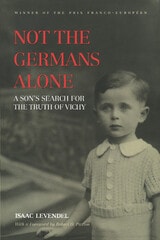
Not the Germans Alone
A Son's Search for the Truth of VichyIsaac Levendel
Northwestern University Press, 2000
On the eve of D-Day, Isaac Levendel's mother left her hiding place on a farm in southern France and never returned. After 40 years of silence and torment, he returned to France in 1990 determined to find out what had happened. This is the story of how, with perseverance, luck, and official help, he gained access to secret wartime documents laying bare the details of French collaboration-and the truth about his mother's fate.
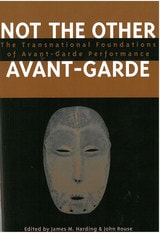
Not the Other Avant-Garde
The Transnational Foundations of Avant-Garde PerformanceEdited by James M. Harding and John Rouse
University of Michigan Press, 2010
Not the Other Avant-Garde is groundbreaking in both avant-garde studies and performance studies and will be a valuable contribution to the fields of theater studies, modernist studies, art history, literature, and music history.
"Joins the growing field of critical and transnational theories on the arts. . . its grounding in live performance and its foregrounding of the performative human body presents a new theoretical paradigm that is pathbreaking."
--Haiping Yan, University of California, Los Angeles
James M. Harding is Associate Professor of English at Mary Washington University. He is author of Adorno and "A Writing of the Ruins": Essays on Modern Aesthetics and Anglo-American Literature and Culture and editor of Contours of the Theatrical Avant-Garde: Performance and Textuality.
John Rouse is Associate Professor of Theater at the University of California, San Diego. He is author of Brecht and the West German Theatre.
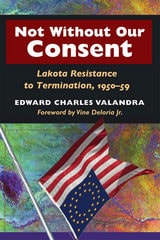
Not without Our Consent
Lakota Resistance to Termination, 1950-59Edward Charles Valandra
University of Illinois Press, 2006
Edward Valandra's Not Without Our Consent documents the tenacious and formidable Lakota resistance to attempts at applying this law. In unprecedented depth, it follows their struggle through the 1950s when, against all odds, their resistance succeeded in the amendment of PL 83-280 to include Native consent as a prerequisite to state jurisdiction. The various House and Senate bills discussed in the manuscript are reproduced in five appendices.
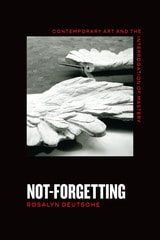
Not-Forgetting
Contemporary Art and the Interrogation of MasteryRosalyn Deutsche
University of Chicago Press, 2022
Amid times of emboldened cruelty and perpetual war, Rosalyn Deutsche links contemporary art to three practices that counter the prevailing destructiveness: psychoanalytic feminism, radical democracy, and war resistance. Deutsche considers how art joins these radical practices to challenge desires for mastery and dominion, which are encapsulated in the Eurocentric conception of the human that goes under the name “Man” and is driven by deadly inclinations that Deutsche calls masculinist. The masculinist subject—as an individual or a group—universalizes itself, claims to speak on behalf of humanity, and meets differences with conquest.
Analyzing artworks by Christopher D’Arcangelo, Robert Filliou, Hans Haacke, Mary Kelly, Silvia Kolbowski, Barbara Kruger, Louise Lawler, Martha Rosler, James Welling, and Krzysztof Wodiczko, Deutsche illuminates the diverse ways in which they expose, question, and trouble the visual fantasies that express masculinist desire. Undermining the mastering subject, these artworks invite viewers to question the positions they assume in relation to others. Together, the essays in Not-Forgetting, written between 1999 and 2020, argue that this art offers a unique contribution to building a less cruel and violent society.
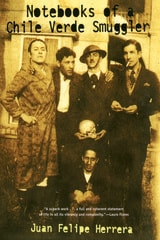
Notebooks of a Chile Verde Smuggler
Juan Felipe Herrera
University of Arizona Press, 2002
Notebooks of a Chile Verde Smuggler is a river of faces and phrases, jottings and reflections—a personal pilgrimage and collective parade of love, mock-prophecy, and chiste. Tuning in voices from numerous time zones, languages, and minds, Herrera recalls his childhood and coming of age, his participation in the Chicano Movement, and the surreal aspects of postmodern America. He uses broad strokes to paint a historical, social, and familial portrait that moves from the twilight of the nineteenth century to the dawn of the twenty-first, then takes up a finer brush to etch the eternal tension between desire and frustration, hope and disillusionment, violence and tenderness.
Here are transamerican sutras spanning metrocenters from Mexico City to San Francisco, or slinking across the border from Juárez to El Paso. Outrageous, rhythmic lists—"Foodstuffs They Never Told Us About," "Things Religion Makes Me Do"—that fire the imagination. Celebrations of his Plutomobile that "runs on ham hawks & bird grease," and of Chicano inventions such as cilantro aftershave and "the art of eating Vicks VapoRub with your dedos."
Pushing forms to the edge of possibility while forcing readers to rethink reality as well as language, Herrera invokes childhoods and neighborhoods, stand-up clowns and Movimiento gypsies, grandmothers of the buñuelo kitchen and tragicomic soliloquies of dizzy-headed outcasts of paradise. Notebooks of a Chile Verde Smuggler is a crucible of flavorful language meant to be rolled lazily on the mind's tongue—and then swallowed whole to let its hot and savory sweetness fill your soul.
Notes on Nowhere
Feminism, Utopian Logic, and Social TransformationJennifer Burwell
University of Minnesota Press, 1997
Notes on Nowhere was first published in 1997. Minnesota Archive Editions uses digital technology to make long-unavailable books once again accessible, and are published unaltered from the original University of Minnesota Press editions.
The term utopia implies both "good place" and "nowhere." Since Sir Thomas More wrote Utopia in 1516, debates about utopian models of society have sought to understand the implications of these somewhat contradictory definitions. In Notes on Nowhere, author Jennifer Burwell uses a cross section of contemporary feminist science fiction to examine the political and literary meaning of utopian writing and utopian thought.
Burwell provides close readings of the science fiction novels of five feminist writers-Marge Piercy, Sally Gearhart, Joanna Russ, Octavia Butler, and Monique Wittig-and poses questions central to utopian writing: Do these texts promote a tradition in which narratives of the ideal society have been used to hide rather than reveal violence, oppression, and social divisions? Can a feminist critical utopia offer a departure from this tradition by using utopian narratives to expose contradiction and struggle as central aspects of the utopian impulse? What implications do these questions have for those who wish to retain the utopian impulse for emancipatory political uses?
As one way of answering these questions, Burwell compares two "figures" that inform utopian writing and social theory. The first is the traditional abstract "revolutionary" subject who contradicts existing conditions and who points us to the ideal body politic. The second, "resistant," subject is partial, concrete, and produced by conditions rather than operating outside of them. In analyzing contemporary changes in the subject's relationship to social space, Burwell draws from and revises "standpoint approaches" that tie visions of social transformation to a group's position within existing conditions.
By exploring the dilemmas, antagonisms, and resolutions within the critical literary feminist utopia, Burwell creates connections to a similar set of problems and resolutions characterizing "nonliterary" discourses of social transformation such as feminism, gay and lesbian studies, and Marxism. Notes on Nowhere makes an original, significant, and persuasive contribution to our understanding of the political and literary dimensions of the utopian impulse in literature and social theory.
Jennifer Burwell teaches in the Department of English at Wesleyan University in Connecticut.

Notes on Vermin
Caroline Hovanec
University of Michigan Press, 2025
Notes on Vermin is an atlas of the literary vermin that appear in modern and contemporary literature, from Franz Kafka’s gigantic insect to Richard Wright’s city rats to Namwali Serpell’s storytelling mosquitoes. As parasites, trespassers, and collectives, vermin animals prove useful to writers who seek to represent life in the margins of power. Drawing on psychoanalysis, cultural studies, eco-Marxism, and biopolitics, this book explores four uses for literary vermin: as figures for the repressed thought, the uncommitted fugitive, the freeloading parasite, and the surplus life. In a series of short, accessible, interlinked essays, Notes on Vermin explores what animal pests can show us about our cultures, our environments, and ourselves.
Notes to Make the Sound Come Right
Four Innovators of Jazz PoetryT.J. Anderson III
University of Arkansas Press, 2004
Nothing Gold Can Stay
A MemoirWalter Sullivan
University of Missouri Press, 2006
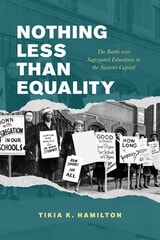
Nothing Less Than Equality
The Battle over Segregated Education in the Nation’s CapitalTikia K. Hamilton
University of Chicago Press, 2026
The landmark Brown v. Board of Education case, which barred racial segregation in American public schools, wasn’t the only path for Black parents, teachers, and activists who sought equality of educational opportunity. Some believed that the solution to inequality lay in pressing the federal government to live up to the Jim Crow doctrine of “separate but equal” by providing more resources to Black schools. And for a time, this seemed true in Washington, DC, where Black activists leveraged their status as residents of the nation’s capital to advocate on behalf of Black education. However, disappointments with the “separate but equal” strategy and a sea change in activism led to an embrace of integration.
In Nothing Less Than Equality, Tikia K. Hamilton reveals the rich and complex history of educational activism in Washington prior to Brown v. Board of Education, illuminating complex dynamics that provide a counterpoint and backdrop to the landmark Supreme Court case. Hamilton thoroughly examines the multipronged strategies employed by parents, teachers, attorneys, and activists to democratize education, demonstrating that there was no linear path to Brown.
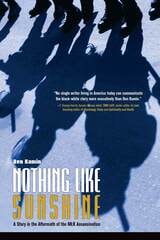
Nothing Like Sunshine
A Story in the Aftermath of the MLK AssassinationBen Kamin
Michigan State University Press, 2010
Rabbi Ben Kamin has written a definitive personal expression about race, coming of age in the 1960s, a forbidden friendship, and his personal love for Dr. Martin Luther King Jr. This is a story that spans a four-decade search for a lost high school chum, a deep misunderstanding, and a coming to terms with an America painfully evolving from the blood of MLK to the promise of Barack Obama.
The book is a remembrance of Kamin's life at Cincinnati's notorious Woodward High School, a microcosm of the 1960s and of America itself, as well as detailing Kamin's search-for Clifton, for America, for the key to understanding what race relations really are in the United States. Simultaneously, it is the story of the emerging rabbi's search for the legacy of his spiritual mentor, Dr. Martin Luther King Jr., taking Kamin from Cincinnati to Cleveland to Memphis to New Orleans and other points, and constantly bringing him home to his friend Clifton and "the heaving hallways" of that high school.

Nothing Permanent
Modern Architecture in CaliforniaTodd Cronan
University of Minnesota Press, 2023
A critical look at the competing motivations behind one of modern architecture’s most widely known and misunderstood movements
Although “mid-century modern” has evolved into a highly popular and ubiquitous architectural style, this term obscures the varied perspectives and approaches of its original practitioners. In Nothing Permanent, Todd Cronan displaces generalizations with a nuanced intellectual history of architectural innovation in California between 1920 and 1970, uncovering the conflicting intentions that would go on to reshape the future of American domestic life.
Focusing on four primary figures—R. M. Schindler, Richard Neutra, and Charles and Ray Eames—Nothing Permanent demonstrates how this prolific era of modern architecture in California, rather than constituting a homogenous movement, was propelled by disparate approaches and aims. Exemplified by the twin pillars of Schindler and Neutra and their respective ideological factions, these two groups of architects represent opposing poles of architectural intentionality, embodying divergent views about the dynamic between interior and exterior, the idea of permanence, and the extent to which architects could exercise control over the inhabitants of their structures.
Looking past California modernism’s surface-level idealization in present-day style guides, home decor publications, films, and television shows, Nothing Permanent details the intellectual, aesthetic, and practical debates that lie at the roots of this complex architectural moment. Extracting this period from its diffusion into visual culture, Cronan argues that mid-century architecture in California raised questions about the meaning of architecture and design that remain urgent today.
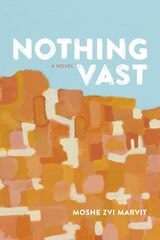
Nothing Vast
A NovelMoshe Zvi Marvit
Acre Books, 2024
Spanning from 1932 to 1973, Nothing Vast delves deeply into the circumstances and concerns of Jews in cities across the globe—in Poland, France, Morocco, and the United States—as well as in Israel. Giving voice to characters male and female, young and old, Moshe Zvi Marvit braids together stories of migration and struggle, of custom and superstition, of long-held secrets and lies. This beautifully crafted novel follows a survivor of sexual assault, a member of the French resistance, a dream interpreter, a petty criminal, and a venerated rabbi.
Based on the experiences and traditions of the author’s own half-Arab Jewish family, the book is rife with historical and cultural detail and with the intricacies of faith and identity, both personal and national. At the center of the novel is Israel itself—a place existing first in the collective imagination, then in reality as Marvit slips into nonfiction to document the establishment of the country and the reactions to its birth. The characters’ experiences upon arrival in their new nation are vastly different: one family is given a large orange grove upon which to establish a Yeshiva, while the other, not accorded the same privileges, lives beneath notice. The story takes yet another twist when, years later, a grandchild of one of the founding rabbis, seeking answers, discovers the origin of his family’s land.
Visceral, intellectual, and searching, Nothing Vast is nothing short of a virtuosic debut.
Novel Competition
American Fiction and the Cultural Economy, 1965-1999Evan Brier
University of Iowa Press, 2024
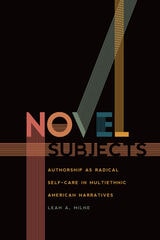
Novel Subjects
Authorship as Radical Self-Care in Multiethnic American NarrativesLeah A. Milne
University of Iowa Press, 2021
In Novel Subjects, Leah Milne offers a new way to look at multicultural literature by focusing on scenes of writing in contemporary works by authors with marginalized identities. These scenes, she argues, establish authorship as a form of radical self-care—a term we owe to Audre Lorde, who defines self-care as self-preservation and “an act of political warfare.”
In engaging in this battle, the works discussed in this study confront limitations on ethnicity and nationality wrought by the institutionalization of multiculturalism. They also focus on identities whose mere presence on the cultural landscape is often perceived as vindictive or willful. Analyzing recent texts by Carmen Maria Machado, Louise Erdrich, Ruth Ozeki, Toni Morrison, and more, Milne connects works across cultures and nationalities in search of reasons for this recent trend of depicting writers as characters in multicultural texts. Her exploration uncovers fiction that embrace unacceptable or marginalized modes of storytelling—such as plagiarism, historical revisions, jokes, and lies—as well as inauthentic, invisible, and unexceptional subjects. These works ultimately reveal a shared goal of expanding the borders of belonging in ethnic and cultural groups, and thus add to the ever-evolving conversations surrounding both multicultural literature and self-care.