Results by title
28164 books match the query 'History' and 647 start with n
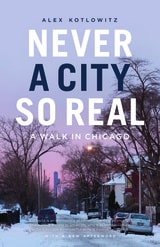
Never a City So Real
A Walk in ChicagoAlex Kotlowitz
University of Chicago Press, 2019
The book is a tour of the people of Chicago, those who have been Kotlowitz’s guide into this city’s – and by inference, this country’s – heart. Chicago, after all, is America’s city. Kotlowitz introduces us to the owner of a West Side soul food restaurant who believes in second chances, a steelworker turned history teacher, the “Diego Rivera of the projects,” and the lawyers and defendants who populate Chicago’s Criminal Courts Building. These empathic, intimate stories chronicle the city’s soul, its lifeblood.
This new edition features a new afterword from the author, which examines the state of the city today as seen from the double-paned windows of a pawnshop. Ultimately, Never a City So Real is a love letter to Chicago, a place that Kotlowitz describes as “a place that can tie me up in knots but a place that has been my muse, my friend, my joy.”
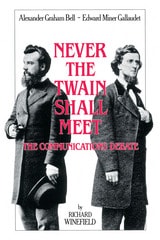
Never the Twain Shall Meet
Bell, Gallaudet, and the Communications DebateRichard Winefield
Gallaudet University Press, 1987
New African Cinema
Orlando, Valérie K
Rutgers University Press, 2017
Orlando illuminates the diverse themes evident in the works of filmmakers such as Ousmane Sembène’s Ceddo (Senegal, 1977), Sarah Maldoror’s Sambizanga (Angola, 1972), Assia Djebar’s La Nouba des femmes de Mont Chenoua (The Circle of women of Mount Chenoua, Algeria, 1978), Zézé Gamboa’s The Hero (Angola, 2004) and Abderrahmane Sissako’s Timbuktu (Mauritania, 2014), among others. Orlando also considers the influence of major African film schools and their traditions, as well as European and American influences on the marketing and distribution of African film. For those familiar with the polemics of African film, or new to them, Orlando offers a cogent analytical approach that is engaging.
New Approaches to Latin American History
Edited by Richard Graham and Peter H. Smith
University of Texas Press, 1974
New Approaches to Latin American History incorporates methods and concepts from the social sciences without abandoning a distinctively historical approach. A collection of original essays by distinguished younger scholars, it proposes original concepts and methods for analyzing crucial problems in Latin American history.
Using as examples such subjects as salvery, dictatorship, immigration, and the relationship between land ownership and political power, the contributors show how approaches and techniques from psychology, political science, economics. and sociology can be applied to historical studies. The papers attempt to explain the thematic and substantive importance of the particular problems at hand; describe and evaluate standard approaches to them; propose original hypotheses; suggest methods for testing the hypotheses; or indicate major methodological or conceptual difficulties that have so far hampered such work.
Despite their diversity of content, the papers show strong underlying unities. First, they all point to the need for placing institutions and actions in a broad societal context. The authurs present an implicit, cumulative argument against the excessive isolation of historical phenomena. Second, they demonstrate the utility of interdisciplinary research. Third, they issue an implicit call for rigorous comparative analysis. The propositions formulated in these essays can best tested and modified in comparative fashion.
Ultimately this book deals with the exposition of a research style: a style based on systematic doubt, an awareness of the need for conceptual rigor, and a willingness to try new methodologies. For this reason it is of interest to historians in every field as well as to students of Latin America.
New Approaches to Resistance in Brazil and Mexico
John Gledhill and Patience A. Schell, eds.
Duke University Press, 2012
Contributors. Helga Baitenmann, Marcus J. M. de Carvalho, Guillermo de la Peña, John Gledhill, Matthew Gutmann, Maria Gabriela Hita, Alan Knight, Ilka Boaventura Leite, Jean Meyer, John Monteiro, Luis Nicolau Parés, Patricia R. Pessar, Patience A. Schell, Robert Slenes, Juan Pedro Viqueira, Margarita Zárate
New Bodleian
Making the Weston LibraryEdited by the Bodleian Library
Bodleian Library Publishing, 2015
New Bodleian: The Making of the Weston Library tells the story of how the plans for the new Weston Library—as the New Bodleian is now known—were realized, describing in detail the architectural, academic, curatorial, and heritage considerations addressed, as well as the successful collaborations between clients and consultants. Among the updates introduced were enhanced public access, including new entrance spaces; redesigned reading rooms for the study of special collections; new teaching facilities; and state-of-the-art storage space for the library’s many treasures. With over one hundred color illustrations, the book sheds light on the challenges of meeting the needs of an internationally renowned, four-hundred-year-old institution in the twenty-first century.
New Brunswick, New Jersey
The Decline and Revitalization of Urban AmericaListokin, David
Rutgers University Press, 2016

New Considerations of the Doctrinal Differences Between Catholics and Protestants
A Defense of My Symbolism Against the Objections of Ferdinad Christian Baur in TübingenJohann Adam Möhler
Catholic University of America Press, 2027
New Countries
Capitalism, Revolutions, and Nations in the Americas, 1750–1870John Tutino, editor
Duke University Press, 2016
Contributors. Alfredo Ávila, Roberto Breña, Sarah C. Chambers, Jordana Dym, Carolyn Fick, Erick Langer, Adam Rothman, David Sartorius, Kirsten Schultz, John Tutino
New Day Begun
African American Churches and Civic Culture in Post-Civil Rights AmericaR. Drew Smith, ed.
Duke University Press, 2003
This collection of essays analyzes the results of an unprecedented survey of nearly 2,000 African American churches across the country conducted by The Public Influences of African-American Churches Project, which is based at Morehouse College in Atlanta. These essays—by political scientists, theologians, ethicists, and others—draw on the survey findings to analyze the social, historical, and institutional contexts of black church activism and to consider the theological and moral imperatives that have shaped black church approaches to civic life—including black civil religion and womanist and afrocentric critiques. They also look at a host of faith-based initiatives addressing economic development and the provision of social services. New Day Begun presents necessary new interpretations of how black churches have changed—and been changed by—contemporary American political culture.
Contributors. Lewis Baldwin, Allison Calhoun-Brown, David D. Daniels III, Walter Earl Fluker, C.R.D. Halisi, David Howard-Pitney, Michael Leo Owens, Samuel Roberts, David Ryden, Corwin Smidt, R. Drew Smith
New Day in Babylon
The Black Power Movement and American Culture, 1965-1975William L. Van Deburg
University of Chicago Press, 1992
"New Day in Babylon is an extremely intelligent synthesis, a densely textured evocation of one of American history's most revolutionary transformations in ethnic group consciousness."—Bob Blauner, New York Times
Winner of the Gustavus Myers Center Outstanding Book Award, 1993
New Deal / New South
An Anthony J. Badger ReaderAnthony J. Badger
University of Arkansas Press, 2007
New Deal Archaeology in Tennessee
Intellectual, Methodological, and Theoretical ContributionsEdited by David H. Dye
University of Alabama Press, 2016
Exploring how New Deal innovation transformed archaeology in the American South.
New Deal Archaeology in Tennessee tells the engrossing story of Southeastern archaeology in the 1930s. The Tennessee Valley Authority Act of May 1933 initiated an ambitious program of flood control and power generation by way of a chain of hydroelectric dams on the Tennessee River. The construction of these dams flooded hundreds of thousands of square miles of river bottoms, campsites, villages, and towns that had been homes to Native Americans for centuries. This triggered an urgent need to undertake extensive archaeological fieldwork throughout the region. Those studies continue to influence contemporary archaeology.
The state of Tennessee and the Tennessee Valley were especially well suited research targets thanks to their mild climate and long field seasons. A third benefit in the 1930s was the abundance of labor supplied by Tennesseans unemployed during the Great Depression. Within months of the passage of the Tennessee Valley Authority Act, teams of archaeologists fanned out across the state and region under the farsighted direction of Smithsonian Institution curators Neil M. Judd, Frank H. H. Roberts, and Frank M. Setzler. The early months of 1934 would become the busiest period of archaeological fieldwork in US history.
The twelve insightful essays in New Deal Archaeology in Tennessee document and explore this unique peak in archaeological study. Chapters highlight then-new techniques such as mound “peeling” and stratigraphic excavation adapted from the University of Chicago; the four specific New Deal sites of Watts Bar Reservoir, Mound Bottom, Pack, and Chickamauga Basin; bioarchaeology in the New Deal; and the enduring impact of the New Deal on contemporary fieldwork.
The challenges of the 1930s in recruiting skilled labor, training unskilled ancillary labor, developing and improvising new field methods, and many aspects of archaeological policies, procedures, and best-practices laid much of the foundation of contemporary archaeological practice. New Deal Archaeology in Tennessee offers an invaluable record of that pivotal time for professional, student, and amateur archaeologists.
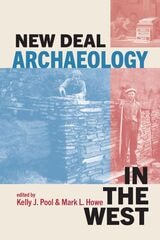
New Deal Archaeology in the West
Edited by Kelly J. Pool and Mark L. Howe
University of Utah Press, 2023
Descriptions of New Deal projects and their contributions to our understanding of the past, as well as the stories of those involved—archaeologists, avocationalists, and others—are woven together across the chapters. Also documented are lost or scattered artifacts, records, and ancestors’ remains; incomplete analyses; unpublished reports; inconsistent application of scientific methodology; and the loss of Native sacred sites and traditional lands and lifeways. Authors highlight characteristics that distinguished the American West from the East during the Depression and affected the nature of New Deal projects, including the extent of federal land available in the West, the reliance of sparsely populated areas upon tourism, the presence of large resident Native populations with deep histories, and the wide-ranging degree of existing archaeology infrastructure in each state. This volume demonstrates that despite regional differences, New Deal-funded archaeological and cultural heritage projects created a legacy of knowledge and practice across the nation.
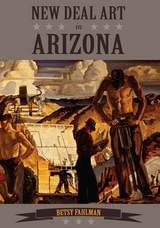
New Deal Art in Arizona
Betsy Fahlman
University of Arizona Press, 2009
Art is a powerful instrument of historical record and cultural construction, and many of the issues captured by the Farm Security Administration photographers remain significant issues today: migratory labor, the economic volatility of the mining industry, tourism, and water usage. Art tells important stories, too, including the work of Japanese American photographer Toyo Miyatake in Arizona’s internment camps, murals by Native American artist Gerald Nailor for the Navajo Nation Council Chamber in Window Rock, and African American themes at Fort Huachuca. Illustrated with 100 black-andwhite photographs and covering a wide range of both media and themes, this fascinating and accessible volume reclaims a richly textured story of Arizona history with potent lessons for today.
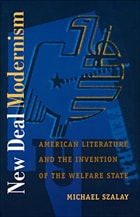
New Deal Modernism
American Literature and the Invention of the Welfare StateMichael Szalay
Duke University Press, 2000
Szalay situates his study within a liberal culture bent on security, a culture galvanized by its imagined need for private and public insurance.
Taking up prominent exponents of social and economic security—such as Franklin Delano Roosevelt, John Maynard Keynes, and John Dewey—Szalay demonstrates how the New Deal’s revision of free-market culture required rethinking the political function of aesthetics. Focusing in particular on the modernist fascination with the relation between form and audience, Szalay offers innovative accounts of Busby Berkeley, Jack London, James M. Cain, Robert Frost, Ayn Rand, Betty Smith, and Gertrude Stein, as well as extended analyses of the works of Ernest Hemingway, John Steinbeck, and Richard Wright.
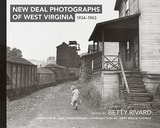
New Deal Photographs of West Virginia, 1934-1943
Betty Rivard
West Virginia University Press, 2012
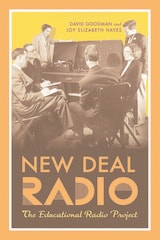
New Deal Radio
The Educational Radio ProjectDavid Goodman
Rutgers University Press, 2022
Contextualizing the different series aired by the Educational Radio Project as part of a unified project about radio and citizenship is crucial to understanding them. New Deal Radio argues that this distinctive government commercial partnership amounted to a critical intervention in US broadcasting and an important chapter in the evolution of public radio in America.
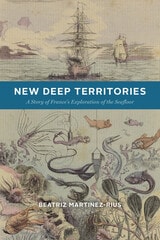
New Deep Territories
A Story of France’s Exploration of the SeafloorBeatriz Martinez-Rius
University of Chicago Press, 2026
Beneath the surface of the seas and oceans lies a territory as important for human societies as the exposed land and the airspace above them: the seafloor. Our daily life is inextricably linked to the seafloor and its resources, from global telecommunications infrastructure to offshore oil and gas extraction to strategic mineral mining.
By focusing on France, a country with an underwater territory seventeen times larger than its emerged lands, New Deep Territories explains how the seafloor emerged as a territory during the second half of the twentieth century. Beatriz Martinez-Rius traces the evolution of the country’s seafloor exploration and the motivations that fueled it from the aftermath of World War I to the late 1970s. In the early 1960s, the seafloor, instead of colonial territories, came to be seen as a source of natural resources. The French government, corporations such as oil companies, and scientists all imagined future uses of the seafloor, and these ever-evolving aspirations drove the development of technologies, techniques, and scientific fields that built up the submerged territory. Government officers and industrial stakeholders massively invested in technoscientific development to prepare for a future reliant on seafloor resources, including oil, gas, and minerals, well before it was technologically possible, economically feasible, and legally acceptable to extract them. The future they envisioned did not arrive, but their investment resulted in an unprecedented understanding of the ocean’s crust. Today, once again, national governments, international organizations, and private stakeholders are turning their attention to the seafloor.
New Documents Illustrating Early Christianity 11A
Texts from EphesusJames R. Harrison
SBL Press, 2024
New Documents Illustrating Early Christianity 11B
Essays on EphesusJames R. Harrison
SBL Press, 2025
New Earth Histories
Geo-Cosmologies and the Making of the Modern WorldEdited by Alison Bashford, Emily M. Kern, and Adam Bobbette
University of Chicago Press, 2023
This book brings the history of the geosciences and world cosmologies together, exploring many traditions, including Chinese, Pacific, Islamic, South and Southeast Asian conceptions of the earth’s origin and makeup. Together the chapters ask: How have different ideas about the sacred, animate, and earthly changed modern environmental sciences? How have different world traditions understood human and geological origins? How does the inclusion of multiple cosmologies change the meaning of the Anthropocene and the global climate crisis? By carefully examining these questions, New Earth Histories sets an ambitious agenda for how we think about the earth.
The chapters consider debates about the age and structure of the earth, how humans and earth systems interact, and how empire has been conceived in multiple traditions. The methods the authors deploy are diverse—from cultural history and visual and material studies to ethnography, geography, and Indigenous studies—and the effect is to highlight how earth knowledge emerged from historically specific situations. New Earth Histories provides both a framework for studying science at a global scale and fascinating examples to educate as well as inspire future work. Essential reading for students and scholars of earth science history, environmental humanities, history of science and religion, and science and empire.

New England Hospitals
1790-1833Leonard K. Eaton
University of Michigan Press, 1957
New England Metropolis
Boston and the Industrialization of New England, 1807–1850Richard Garver
University of Massachusetts Press, 2026
At the outset of the nineteenth century, Boston was at its zenith as a maritime city even as New England was in decline. Many struggling farmers abandoned the area for more promising opportunities to the west. Yet by 1850, New England had been transformed into one of the most industrialized regions in the world. Former agricultural villages had become specialized manufacturing towns producing consumer goods for sale, and Boston merchant capitalists had established textile complexes that produced fabrics in huge quantities. Although Boston had been superseded by New York as a trading center, it thrived not only as a financial market but as an exchange hub in which these hinterland manufacturers acquired raw materials, capital, sales services, and transportation. With Boston at its metropolitan center, New England was transformed into an industrial geography that was unique nationally and internationally.
New England Metropolis demonstrates that, in contrast to the course of industrialization in other regions of the country, New England’s transformation was driven by entrepreneurs in hundreds of rural villages and towns and by and Boston merchant capitalists who recruited underemployed agricultural household members to produce consumer goods for sale beyond the region, including in the slave economies of the South and the Caribbean. As Boston merchants adapted commercial, financial and transportation infrastructure they had developed to serve overseas trade to the needs of the region's manufacturers, industrialization halted New England’s decline and, by 1850, had propelled it to prosperity.
New Englanders in a New Land
Newark in the Proprietary Period, 1666-1702Timothy J. Crist
Rutgers University Press, 2027
New England Puritans from the former New Haven Colony settled Newark in 1666. Their fierce determination to establish scripture-based government in a close-knit township, with community control over admitting new inhabitants, often put them in direct conflict with New Jersey's proprietary government. Newark's egalitarian system for allocating land diverged sharply from the proprietors' headright approach, adapted from the West Indies and Carolina, that rewarded settler use of indentured servants and enslaved labor with larger distributions of land.
This study provides a fresh interpretation of the founding and settlement of Newark as a self-contained New England community, including their negotiations with Native Americans, formation of godly self-government, gradual allocation of township land, and introduction of slavery. To implement their New England way, Newarkers resisted the proprietary government to the point of rebellion, bringing into stark relief the inherent conflict between two sources of authority, one scriptural and community-based and the other royal and proprietary, and two systems of land distribution.
New German Dance Studies
Edited by Susan Manning and Lucia Ruprecht
University of Illinois Press, 2012
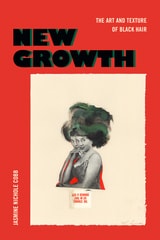
New Growth
The Art and Texture of Black HairJasmine Nichole Cobb
Duke University Press, 2022
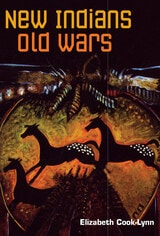
New Indians, Old Wars
Elizabeth Cook-Lynn
University of Illinois Press, 2006
Addressing Native American Studies' past, present, and future, the essays in New Indians, Old Wars tackle the discipline head-on, presenting a radical revision of the popular view of the American West in the process. Instead of luxuriating in its past glories or accepting the widespread historians' view of the West as a shared place, Elizabeth Cook-Lynn argues that it should be fundamentally understood as stolen.
Firmly grounded in the reality of a painful past, Cook-Lynn understands the story of the American West as teaching the political language of land theft and tyranny. She argues that to remedy this situation, Native American studies must be considered and pursued as its own discipline, rather than as a subset of history or anthropology. She makes an impassioned claim that such a shift, not merely an institutional or theoretical change, could allow Native American studies to play an important role in defending the sovereignty of indigenous nations today.
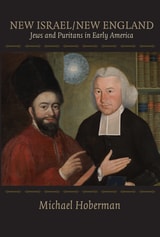
New Israel / New England
Jews and Puritans in Early AmericaMichael Hoberman
University of Massachusetts Press, 2011
More often than not, Michael Hoberman shows, Puritans thought and wrote about Jews in order to resolve their own theological and cultural dilemmas. A number of prominent New Englanders, including Roger Williams, Increase Mather, Samuel Sewall, Benjamin Colman, Cotton Mather, Jonathan Edwards, and Ezra Stiles, wrote extensively about post-biblical Jews, in some cases drawing on their own personal acquaintance with Jewish contemporaries.
Among the intriguing episodes that Hoberman investigates is the recruitment and conversion of Harvard's first permanent instructor of Hebrew, the Jewish-born Judah Monis. Later chapters describe the ecumenical friendship between Newport minister Ezra Stiles and Haim Carigal, an itinerant rabbi from Palestine, as well as the life and career of Moses Michael Hays, the prominent freemason who was Boston's first permanently established Jewish businessman, a founder of its insurance industry, an early sponsor of the Bank of Massachusetts, and a personal friend of Paul Revere.
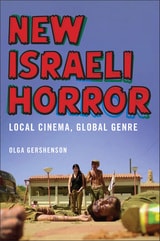
New Israeli Horror
Local Cinema, Global GenreOlga Gershenson
Rutgers University Press, 2024
Before 2010, there were no Israeli horror films. Then distinctly Israeli serial killers, zombies, vampires, and ghosts invaded local screens. The next decade saw a blossoming of the genre by young Israeli filmmakers. New Israeli Horror is the first book to tell their story. Through in-depth analysis, engaging storytelling, and interviews with the filmmakers, Olga Gershenson explores their films from inception to reception. She shows how these films challenge traditional representations of Israel and its people, while also appealing to audiences around the world.
Gershenson introduces an innovative conceptual framework of adaptation, which explains how filmmakers adapt global genre tropes to local reality. It illuminates the ways in which Israeli horror borrows and diverges from its international models. New Israeli Horror offers an exciting and original contribution to our understanding of both Israeli cinema and the horror genre.
A companion website to this book is available at https://websites.umass.edu/newisraelihorror/
Book trailer: https://youtu.be/oVJsD0QCORw (https://youtu.be/oVJsD0QCORw)
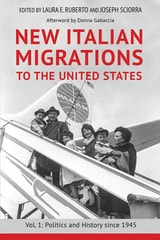
New Italian Migrations to the United States
Vol. 1: Politics and History since 1945Edited by Laura E. Ruberto and Joseph Sciorra: Afterword by Donna Gabaccia
University of Illinois Press, 2017
Contributors: Ottorino Cappelli, Donna Gabaccia, Stefano Luconi, Maddalena Marinari, James S. Pasto, Rodrigo Praino, Laura E. Ruberto, Joseph Sciorra, Donald Tricarico, and Elizabeth Zanoni.
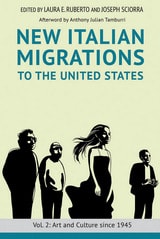
New Italian Migrations to the United States
Vol. 2: Art and Culture since 1945Laura Ruberto, Joseph Sciorra
University of Illinois Press, 2017
Contributors: John Allan Cicala, Simone Cinotto, Teresa Fiore, Incoronata (Nadia) Inserra, Laura E. Ruberto, Joseph Sciorra, and Anthony Julian Tamburri.
New Jersey Anthology
Lurie, Maxine N
Rutgers University Press, 2002
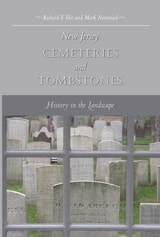
New Jersey Cemeteries and Tombstones
History in the LandscapeVeit, Richard F
Rutgers University Press, 2008
From the earliest memorials used by Native Americans to the elaborate structures of the present day, Richard Veit and Mark Nonestied use grave markers to take an off-beat look at New Jersey’s history that is both fascinating and unique.
New Jersey Cemeteries and Tombstones presents a culturally diverse account of New Jersey’s historic burial places from High Point to Cape May and from the banks of the Delaware to the ocean-washed Shore, to explain what cemeteries tell us about people and the communities in which they lived. The evidence ranges from somber seventeenth-century decorations such as hourglasses and skulls that denoted the brevity of colonial life, to modern times where memorials, such as a life-size granite Mercedes Benz, reflect the materialism of the new millennium. Also considered are contemporary novelties such as pet cemeteries and what they reveal about today’s culture. To tell their story the authors visited more than 1,000 burial grounds and interviewed numerous monument dealers and cemetarians.
This richly illustrated book is essential reading for history buffs and indeed anyone who has ever wandered inquisitively through their local cemeteries.
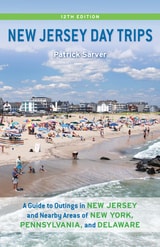
New Jersey Day Trips
A Guide to Outings in New Jersey and Nearby Areas of New York, Pennsylvania, and DelawareSarver, Patrick
Rutgers University Press, 0
Shades of F. Scott Fitzgerald roam Princeton as lads and lasses walk the well-clipped paths between venerable university halls, while russet leaves flutter overhead from rows of sturdy trees. Visions of knights and their fair maidens come to mind as explorers wander around Lambert Castle, an 1892 sandstone and granite mansion that looms like a medieval fortress with rounded towers and turrets on a hillside below the cliffs of the Garret Mountain Reservation. For art lovers who like to stroll on lush lawns and enjoy the beauty around them, Grounds for Sculpture is the place to be seen in New Jersey. And, then there's always the 127 miles of beach along the state's east coast that make perfect day trips for swimming, boating, fishing, and other fun activities.
Now in a revised and expanded 12th edition, New Jersey Day Trips offers everyone a fascinating journey through hundreds of tourist attractions in all corners of the Garden State. Plus, this comprehensive resource explores the most popular points just beyond the state's borders. Patrick Sarver has updated most entries and added more than twenty new points of interest to an already extensive list of destinations, making this the most sought-after guidebook about New Jersey. Attractions can be located easily by subject category, letting travelers zero in on places that appeal to them. Entries include descriptions, hours of operation, location, price range, telephone numbers, and Web sites, making this best seller a one-stop source of discovery for day trippers of all ages--an ideal travel guide for adults or families who live in or plan to visit New Jersey..
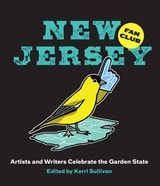
New Jersey Fan Club
Artists and Writers Celebrate the Garden StateKerri Sullivan
Rutgers University Press, 2022
Despite the many jokes and stereotypes about New Jersey and its residents, in reality the state is a wildly diverse place, home to a vast variety of landscapes, cultures, and people. There is no singular New Jersey experience, and the stories that its residents have to share about the state will surprise you.
New Jersey Fan Club: Artists and Writers Celebrate the Garden State is an eclectic anthology featuring personal essays, interviews, and comics from a broad group of established and emerging writers and artists who have something to say about New Jersey. It offers a multifaceted look at the state’s history and significance, told through narrative nonfiction, photographs, and illustrations.
New Jersey Fan Club is edited by Kerri Sullivan, founder of the popular Instagram account Jersey Collective (@jerseycollective), which features weekly takeovers by different New Jerseyans. This book functions the same way: it gives dozens of different contributors the chance to share what New Jersey looks like to them. The book is an exploration of how the same locale can shape people in different ways, and it will inspire readers to look at the Garden State with fresh eyes and appreciate its bounty of beautiful places and vibrant spaces.
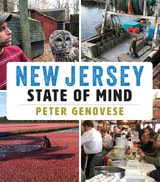
New Jersey State of Mind
Peter Genovese
Rutgers University Press, 2020
For this new book, Genovese spent months scouring the state for rich stories and fascinating locations. New Jersey State of Mind takes us on a journey to over twenty-five of these places and introduces us to the colorful characters who live and work there, from a demolition derby driver to a female craft brewer, and from a Cuban celebrity chef to a Portuguese pig breeder. He also reveals the many natural wonders that have earned New Jersey its “Garden State” nickname, from cranberry bogs to river tours to wild bird sanctuaries.
Collectively, these pieces paint a picture of a diverse state full of hard-working individuals who care for their communities. This book cuts through the myths and stereotypes surrounding the state and reveals the proud beating heart of the real New Jersey.
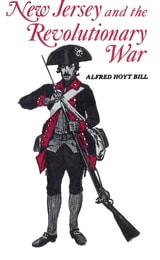
New Jersey and The Revolutionary War
Bill, Alfred
Rutgers University Press, 1970
Bill introduces us to the people who were responsible for winning the war and shaping the future of our country, people such as George Washington, General Hugh Mercer, Thomas Paine, Alexander Hamilton, James Monroe, and Thomas Marshall. He also portrays other colorful figures, such as Benedict Arnold, and British officers, including Howe, Cornwallis, and RaIl. Alfred Bill has produced that rare species of history book that reads like an exciting adventure story. He not only presents the facts, but clearly illuminates them with pertinent background information. Clearly written and highly readable, this book will be enjoyed by everyone from students 10 serious historians.
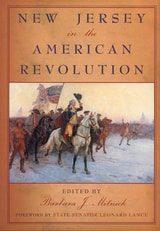
New Jersey in the American Revolution
Mitnick, Barbara J
Rutgers University Press, 2005
Barbara J. Mitnick has edited a remarkably comprehensive anthology, bringing new life to the rich and turbulent late eighteenth-century period in New Jersey. Originally conceived as a legacy of the state's 225th Anniversary of the Revolution Celebration Commission and sponsored by the Washington Association of New Jersey, the volume brings together contributions by twelve outstanding and recognized experts on New Jersey history.
Chapters explore topics including New Jersey as the "Crossroads of the Revolution," important military campaigns, the 1776 Constitution, and the significant contribution of blacks, Native Americans, and women. Reflecting the contemporary view that the war's impact extended beyond military engagements, original essays also discuss the fine and decorative arts, literature, architecture, archaeology, and social and economic conditions. The reader is presented with a picture of life in New Jersey both separate from as well as connected to the fight for American independence and the establishment of the nation.
Fresh and significant observations, including the fact that soldiers fought 238 battles on New Jersey soil (more than any other state) and that the social and political changes resulting from the war were more revolutionary than evolutionary make this accessibly written, beautifully illustrated volume appeal to the lay reader as well as scholars of New Jersey and Revolutionary War history.
New Jersey's Multiple Municipal Madness
Karcher, Alan
Rutgers University Press, 1998
Alan Karcher looks at the history and high cost of New Jersey's multiple municipalities. He investigates the economic considerations, political pressures, and personal agendas that created the bizarre configurations dividing the Garden State, while analyzing the public policies that allowed and even encouraged the formation of new municipalities. Karcher also examines the political dynamics that thwarted every effort of New Jersey metropolises to join the front ranks of major American cities.
Karcher identifies the major motivations behind the unparalleled experience of New Jersey's municipal multiplication. He delves deeply into the primary causes of new lines being drawn, such as road appropriations, the location of a railroad station, control of a local school district, the regulation of alcohol sales, and the preservation of exclusivity prior to the acceptance of zoning. He also assesses the present situation and what has happened in the past 60 years since the municipal multiplication madness ceased, calling on elected officials to confront reality and correct yesterday's excesses.
The genesis of the present political map of the state is a story that while interesting is not always charming, while fascinating is far from edifying. Little in the history can be called quaint. Rather it is a story of separation and exclusion, of division and greed, of preservation of prerogatives and prejudices. It is a story that supports the conclusion that these lines are rarely the product of chance, rather they were drawn by politicians with very human foibles and frailties, and with very narrow agendas-agendas that have proven to be egregiously expensive for today's taxpayers.
Alan Karcher, the former Speaker of the New Jersey Assembly during the activist 1980s, currently practices municipal law in Middlesex County. He represents the third generation of his family to serve as a member of the New Jersey State Legislature.
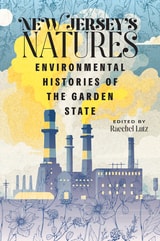
New Jersey's Natures
Environmental Histories of the Garden StateRaechel Lutz
Rutgers University Press, 2026
New Jersey’s Natures takes up the challenge of expanding academic and popular conceptions of New Jersey and its landscapes through the lens of environmental history. Scholars’ essays showcase the ways in which nature is integral to understandings of the state and its past as well as its future. These essays show that New Jersey should no longer solely be known as a place where pollution and suburbanization run amok but rather a place where history happens.
The contributors investigate how nature and history are intertwined within this small but mighty state, covering topics from the colonial period to the present across North, South, and Central Jersey. They investigate natural features like the Delaware River and Bay, the Pinelands, and the unforgettable Jersey Shore. In this book, you will find Indigenous Americans making meaning as settlers threaten their ways of life, Governor William Livingston considering Central Jersey’s features as he fights in the American Revolution, farmers building the state’s industrial agriculture, a foreign diplomat planting an arboretum, squatters in the swampy Meadowlands subverting social and economic norms, activists fighting for parks, forests, and beaches across two centuries, and much more.
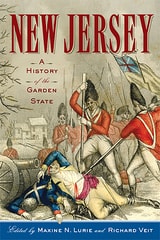
New Jersey
A History of the Garden StateLurie, Maxine N
Rutgers University Press, 2012
New Jersey: A History of the Garden State presents a fresh, comprehensive overview of New Jersey’s history from the prehistoric era to the present. The findings of archaeologists, political, social, and economic historians provide a new look at how the Garden State has evolved.
The state has a rich Native American heritage and complex colonial history. It played a pivotal role in the American Revolution, early industrialization, and technological developments in transportation, including turnpikes, canals, and railroads. The nineteenth century saw major debates over slavery. While no Civil War battles were fought in New Jersey, most residents supported it while questioning the policies of the federal government.
Next, the contributors turn to industry, urbanization, and the growth of shore communities. A destination for immigrants, New Jersey continued to be one of the most diverse states in the nation. Many of these changes created a host of social problems that reformers tried to minimize during the Progressive Era. Settlement houses were established, educational institutions grew, and utopian communities were founded. Most notably, women gained the right to vote in 1920. In the decades leading up to World War II, New Jersey benefited from back-to-work projects, but the rise of the local Ku Klux Klan and the German American Bund were sad episodes during this period.
The story then moves to the rise of suburbs, the concomitant decline of the state’s cities, growing population density, and changing patterns of wealth. Deep-seated racial inequities led to urban unrest as well as political change, including such landmark legislation as the Mount Laurel decision. Today, immigration continues to shape the state, as does the tension between the needs of the suburbs, cities, and modest amounts of remaining farmland.
Well-known personalities, such as Jonathan Edwards, George Washington, Woodrow Wilson, Dorothea Dix, Thomas Edison, Frank Hague, and Albert Einstein appear in the narrative. Contributors also mine new and existing sources to incorporate fully scholarship on women, minorities, and immigrants. All chapters are set in the context of the history of the United States as a whole, illustrating how New Jersey is often a bellwether for the nation..
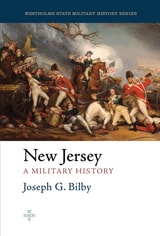
New Jersey
A Military HistoryJoseph G. Bilby
Westholme Publishing, 2017
New Jersey: A Military History by military historian Joseph G. Bilby tells the long, diverse, and sometimes complicated story of New Jersey’s citizens and their significant and continuing role in America’s defense. Over more than 350 years as a colony and state, hundreds of thousands of New Jersey residents have served in regular armed forces, militia, and National Guard units or in direct support of those organizations. New Jerseyans in the military include General “Scotch Willie” Maxwell of Sussex County, an unappreciated Revolutionary War master tactician; First Sergeant George Ashby of Allentown, of Company H, 45th United States Colored Infantry, the state’s last surviving Civil War veteran; Clara Maas of Newark, a nurse who sacrificed her life in the effort to eradicate Yellow Fever; Captain William J. Reddan, who led his company into hell during the Meuse-Argonne offensive in 1918; and Medal of Honor winner John Basilone, whose sense of duty and honor led him to return to combat and death in World War II.
Complete with maps, an annotated list of historical sites in the state, and further reading, New Jersey: A Military History is an important reference for those interested in the role of the Garden State in our nation’s wars.
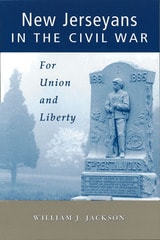
New Jerseyans in the Civil War
For Union and LibertyJackson, William J
Rutgers University Press, 2006
The Civil War divided New Jersey just as it did the nation. As a small state sandwiched between two large and powerful neighbors, New Jersey had always enthusiastically supported the creation of a strong central government. On the other hand, many New Jersey citizens did not share the anti-slavery sentiments of the North; they supported property rights of slave owners and believed in the natural inferiority of blacks. Subsequently, when southern states began to secede from the Union to form the Confederacy, New Jerseyans were left divided and confused.
William J. Jackson examines the ironies, paradoxes, and contradictions that characterized New Jersey's unique historical role in the war. This is the only book to incorporate social and political history with that of military history and strategy. Civil War aficionados and historians will also welcome Jackson's analysis of the participation of New Jersey African Americans on the home front and in the military.

New Korean Wave
Transnational Cultural Power in the Age of Social MediaDal Yong Jin
University of Illinois Press, 2016
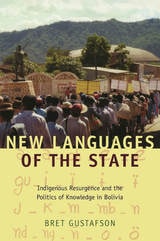
New Languages of the State
Indigenous Resurgence and the Politics of Knowledge in BoliviaBret Gustafson
Duke University Press, 2009
Gustafson shows that bilingual education is an issue that extends far beyond the classroom. Public schools are at the center of a broader battle over territory, power, and knowledge as indigenous movements across Latin America actively defend their languages and knowledge systems. In attempting to decolonize nation-states, the indigenous movements are challenging deep-rooted colonial racism and neoliberal reforms intended to mold public education to serve the market. Meanwhile, market reformers nominally embrace cultural pluralism while implementing political and economic policies that exacerbate inequality. Juxtaposing Guarani life, language, and activism with intimate portraits of reform politics among academics, bureaucrats, and others in and beyond La Paz, Gustafson illuminates the issues, strategic dilemmas, and imperfect alliances behind bilingual intercultural education.
New Latina Narrative
The Feminine Space of Postmodern EthnicityEllen McCracken
University of Arizona Press, 1999
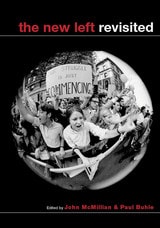
New Left Revisited
edited by John McMillian and Paul Buhle
Temple University Press, 2003

New Left, New Right, and the Legacy of the Sixties
Paul Lyons
Temple University Press, 1996
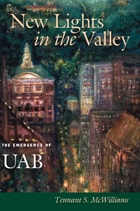
New Lights in the Valley
The Emergence of UABTennant S. McWilliams
University of Alabama Press, 2007
A scholarly narrative of UAB from its nascent beginnings through the mid 1990s.
While the economy and culture of the post—World War II South changed from an era of material capital (e.g., cotton and iron ore) to a period of social capital (intellectual development and networked approaches to social change), one of the most important components of urban life, the university, emerged as both a creator and a reflector of such modernization.
This is the case with Birmingham and its youthful institution of higher learning, the University of Alabama at Birmingham. From its early days as a struggling offshoot of the capstone campus in Tuscaloosa, UAB’s journey to its current status as a major university has been a bumpy but interesting one. Tennant McWilliams, a longtime UAB history professor, explores the whole range of historical considerations, including UAB’s similarities and connections to trans-Atlantic civic universities; the irony of the shift from Big Steel to Big Medicine in Birmingham; the visionary administrations of Joseph F. Volker and others; and the evolving decision to make non-medical life at UAB less of a commuter experience and more of a traditional campus experience.
McWilliams does not palliate the missteps and disputes that have, from time to time, impeded the institution’s progress. But he explains why, despite various hurdles and distractions, UAB has risen to be Alabama’s largest employer and can rightly boast that its complex of health care services, especially organ transplantation and neuroscience, as well as such fields as philosophy and psychology, are among the best in the nation.