Results by title
60 books match the query '1918-1945' and 3 start with o

One Third of a Nation
Lorena Hickok Reports on the Great DepressionLorena Hickok
University of Illinois Press, 1981
Between 1933 and 1935, Lorena Hickok traveled across thirty-two states as a "confidential investigator" for Harry Hopkins, head of FDR's Federal Emergency Relief Administration. Her assignment was to gather information about the day-to-day toll the Depression was exacting on individual citizens. One Third of a Nation is her record, underscored by the eloquent photographs of Dorothea Lange, Walker Evans, and others, of the shocking plight of millions of unemployed and dispossessed Americans.
[more]
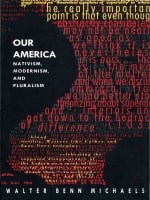
Our America
Nativism, Modernism, and PluralismWalter Benn Michaels
Duke University Press, 1997
Arguing that the contemporary commitment to the importance of cultural identity has renovated rather than replaced an earlier commitment to racial identity, Walter Benn Michaels asserts that the idea of culture, far from constituting a challenge to racism, is actually a form of racism. Our America offers both a provocative reinterpretation of the role of identity in modernism and a sustained critique of the role of identity in postmodernism.
“We have a great desire to be supremely American,” Calvin Coolidge wrote in 1924. That desire, Michaels tells us, is at the very heart of American modernism, giving form and substance to a cultural movement that would in turn redefine America’s cultural and collective identity—ultimately along racial lines. A provocative reinterpretation of American modernism, Our America also offers a new way of understanding current debates over the meaning of race, identity, multiculturalism, and pluralism.
Michaels contends that the aesthetic movement of modernism and the social movement of nativism came together in the 1920s in their commitment to resolve the meaning of identity—linguistic, national, cultural, and racial. Just as the Johnson Immigration Act of 1924, which excluded aliens, and the Indian Citizenship Act of the same year, which honored the truly native, reconceptualized national identity, so the major texts of American writers such as Cather, Faulkner, Hurston, and Williams reinvented identity as an object of pathos—something that can be lost or found, defended or betrayed. Our America is both a history and a critique of this invention, tracing its development from the white supremacism of the Progressive period through the cultural pluralism of the Twenties. Michaels’s sustained rereading of the texts of the period—the canonical, the popular, and the less familiar—exposes recurring concerns such as the reconception of the image of the Indian as a symbol of racial purity and national origins, the relation between World War I and race, contradictory appeals to the family as a model for the nation, and anxieties about reproduction that subliminally tie whiteness and national identity to incest, sterility, and impotence.
[more]
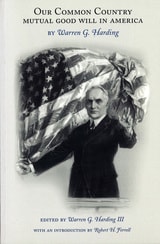
Our Common Country
Mutual Good Will in AmericaWarren G. Harding, Edited by Warren G. Harding, III, & Intro by Robert H. Ferrell
University of Missouri Press, 2003
Our Common Country is a collection of informal addresses, eighteen in all, given by Warren G. Harding as president-elect that defined his vision for the United States. What makes these addresses as relevant today as they were in 1921 is the unsettled mood of the country. Even though World War I is now a distant memory, today’s Americans have suffered through similar conflicts.
In 1917 when Americans went off to war, the red, white, and blue flew everywhere. Two million American soldiers went to France and fifty thousand of them died; the battle of the Meuse-Argonne was one of the costliest in American history. With the announcement by America’s allies that the United States’s contributions to the war were insignificant compared to their own, President Wilson’s leadership began to collapse. Also, the domestic economy’s boom was turning to a bust and the national debt was expanding. The general consensus of Americans was that “things had gone to hell in a handbasket.”
In an effort to ease the minds of troubled and confused Americans, President Harding tried to provide them with inspiration. Addressing different groups of the population—mothers, veterans, patriots, farmers, businessmen, the press—he sought to send a consistent personal message of reassurance. During his administration, he would bring a formal end to the war by signing the Treaty of Berlin and would limit strategic armaments through the treaties of the Washington Conference. He would also establish the Bureau of the Budget, thereby bringing order to the departmental and bureaucratic requests that had disgraced budget making for decades. He planted the seeds for a department of health, education, and welfare, which was finally realized thirty years later. Although the former president was much maligned after his death, his good works during his term of office speak for themselves and show concern for his fellow Americans. His warmth, strength of character, and intelligence are demonstrated throughout these addresses. Harding spoke to his own time, yet these addresses speak to our own confusing times as well.
[more]